
What Are the Types of SEO?
Quick answer: What are the types of SEO? Three core types, on-page, off-page and technical SEO, plus four specialties for sites that need them: local, ecommerce, international, and image and video SEO. These are industry labels, not Google's categories, and they overlap on the same pages. Seven is this guide's grouping, not an official count.
Published guides count anywhere from three to fourteen types, partly because authors slice the same work differently and partly because they add approach labels such as white hat. This guide sorts the work into seven kinds and files the leftover labels in their own section.
Google groups its advice differently. Google Search Essentials has three parts: technical requirements, spam policies and key best practices. Across the Google pages we read for this guide, on-page, off-page and the hat colors never appear as terms. Google does use topic names such as Image SEO Best Practices, and its generative AI guide mentions technical SEO in passing, but it publishes no list of types.
| Type | What you work on | Who it applies to |
|---|---|---|
| On-page SEO | The content and HTML of each page | Every site |
| Off-page SEO | Links, mentions and reviews on other sites | Every site, mostly after the basics |
| Technical SEO | Whether Google can reach, read and index the site | Every site |
| Local SEO | Your presence in searches tied to a place | Businesses with a location or service area |
| Ecommerce SEO | Category, product and filter pages at scale | Sites that sell from a catalog |
| International SEO | Language and country versions of pages | Sites for several languages or countries |
| Image and video SEO | How pictures and videos are found and described | Sites where pictures or video bring visitors |
If you want the definition before the map, start with what SEO is and how it works.
On-Page SEO
On-page SEO is work on the page itself: the content you write and the HTML around it, meaning the title, headings, meta description, image alt text, link text and internal links. Some people call it on-site SEO. Google's key best practices open with people-first content, then ask you to put the words people would search with in prominent places, such as the title and main heading, alt text and link text.
The SEO Starter Guide adds three details worth knowing. Google builds the title link in results from the title element and other headings on the page, and a good title is unique to that page, clear, concise and accurate. The snippet usually comes from the page content and only occasionally from the meta description tag, so a description is a suggestion, not a switch. And there is no ideal number of headings: heading order helps screen readers, but Google Search doesn't mind headings used out of order.
Start here if your pages are indexed but show up for the wrong searches, or show up and draw no clicks. That points at what the page says and how its result looks, not at your server or your links. Our on-page SEO guide holds the full set of techniques.
Off-Page SEO
Off-page SEO covers signals that come from outside your site: links from other sites (often called backlinks), brand mentions and reviews. Some call it off-site SEO. Google's key best practices tell you to let people know about your site and to be active in communities where like-minded people gather. The Starter Guide lists social media, community engagement, advertising and word of mouth as ways to promote a site, and calls word of mouth one of the most effective and lasting.
One guardrail matters more than any tactic. Google's spam policies treat link spam as a violation: buying or selling links for ranking purposes, excessive link exchanges and automated programs that create links are all examples, and sites that break the policies may rank lower or not appear at all. So off-page work is mostly about earning attention, not placing links. On social media, claim only what Google claims: it is a way to promote content so people and search engines find it faster.
Start here if your pages are indexed and answer the search well, yet nobody links to them or mentions them, and the Links report in Search Console is nearly empty. For the rules and a routine, read our off-page SEO guide.
Technical SEO
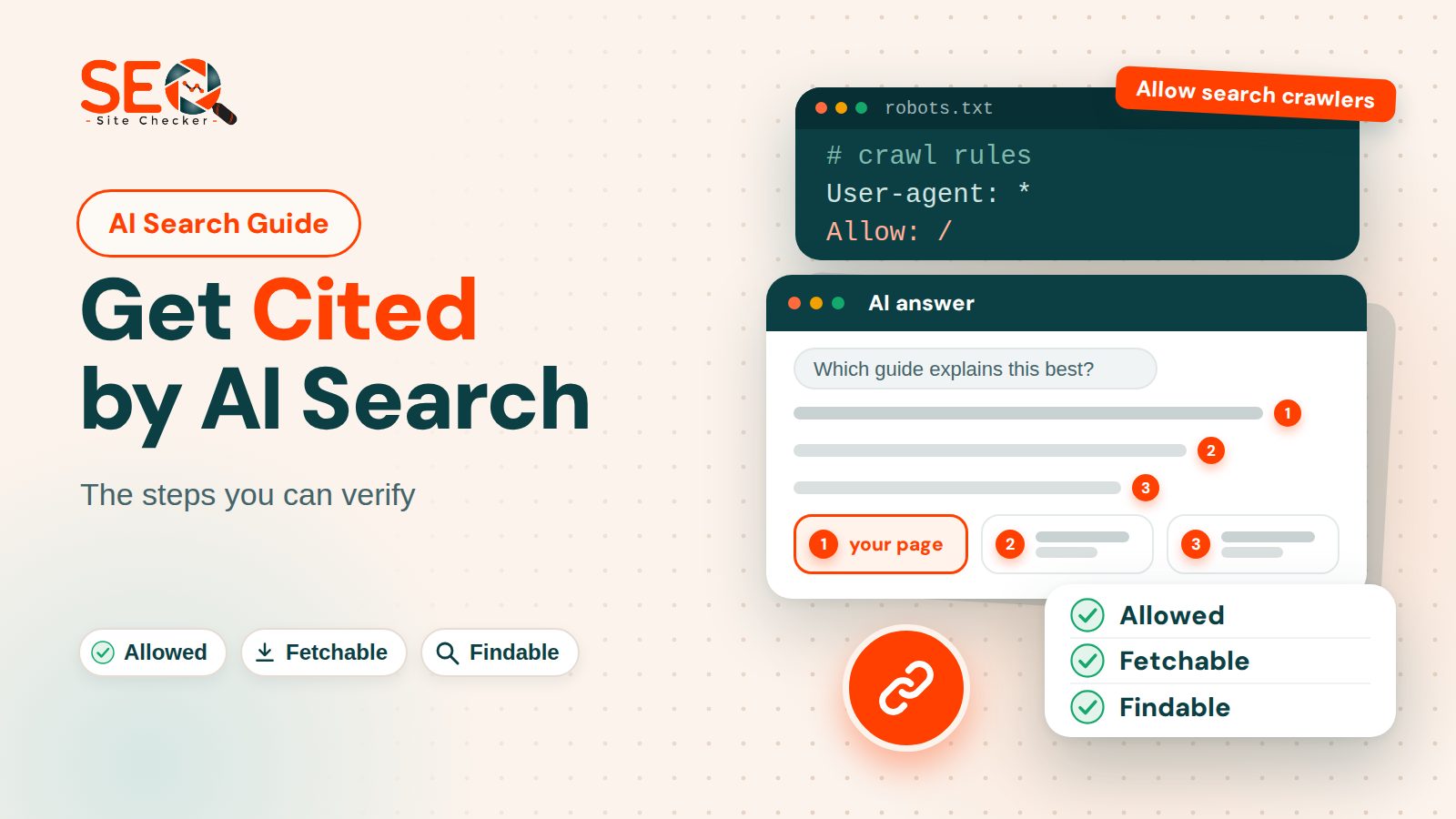
Technical SEO is the work of making sure Google can reach, read and index your pages. Google's own technical requirements make a tidy spine for it: Googlebot isn't blocked, the page works (Google receives an HTTP 200 status code), and the page has indexable content. Most sites pass these without realizing it, though passing doesn't promise indexing.
Three examples show what the work looks like. A page blocked by robots.txt is unlikely to show in results, though Google notes the bare URL can still appear, so keeping a page out takes noindex on a page Google may crawl. Googlebot won't crawl a page behind a login. And Google uses the mobile version of your content for indexing and ranking, called mobile-first indexing, so that version needs the same content as the desktop one. A different design is fine; less content can cost you traffic. Mobile SEO therefore lives inside this type.
Google points to three places to look: the Page Indexing report and the Crawl Stats report in Search Console, plus the URL Inspection tool for a single page.
Start here if pages you want in results are missing from Google, or errors pile up in those reports. Nothing else matters for a page Google can't index. Our technical SEO checklist carries the full list.
Local SEO
When a customer searches for a business or place near them, Google shows local results on Google Maps and in Search, often as the map block that practitioners call the local pack. Local SEO is the work that helps your business appear there. It is mainly about a business, not a web page, and it runs through a Google Business Profile as well as your site.
Check eligibility first, because a purely online business has no profile to build. Google's guidelines allow a Business Profile for a business with a physical location that customers can visit, or one that travels to customers where they are. A rented mailing address where you don't actually operate, which Google calls a virtual office, doesn't qualify, and a service-area business should hide its address and set a service area instead.
Google says local results are mainly based on three factors. Relevance is how well a profile matches the search. Distance is how far the business is from the searcher, or from where Google believes the searcher is. Prominence is how well known the business is, based partly on how many websites link to it and how many reviews it has. Read Google's tips to improve your local ranking for the detail, and note its blunt line: "There's no way to request or pay for a better local ranking on Google." Distance is the one factor you can't change, so the work is relevance and prominence.
The same page lists what you can control. Verify the business, keep its information complete and accurate (address, business hours including special hours, category and attributes), reply to customer reviews, and add photos and videos. Reviews and positive ratings can help, and Google doesn't say by how much.
On your site, Google's ecommerce documentation suggests LocalBusiness structured data for a physical store's location and opening hours. Directories are a separate topic that our local business listings guide covers. Start here if customers find you by place: a shop, a clinic, or a trade that visits homes.
Ecommerce SEO
Ecommerce SEO is SEO for sites that sell products, where hundreds or thousands of category, product and filter pages share a handful of templates. The risk there is crawling and duplication more than wording. Four points from Google's ecommerce guides change the work at catalog scale:
- Crawl paths. If category pages don't link to every product, Googlebot might not find all of them by crawling alone, and it generally doesn't submit searches into a search box.
- URLs. A fragment such as #black or #white is the same page, /product/black-t-shirt and /product?sku=1234 may return identical content, and a timestamp in a URL can make a crawler see endless pages. Filter URLs from faceted navigation multiply the problem.
- Pagination. Load more buttons and infinite scroll can hide products from a crawler unless every product is reachable through a link.
- Structured data. The schema.org types Google lists as relevant are Product and ProductGroup, Review, Organization, BreadcrumbList for breadcrumb markup, VideoObject, and LocalBusiness for a physical store.
Structured data can improve the accuracy of Google's understanding of a page, which is not the same as promising a rich result. Product data can also go to Google Merchant Center, which is optional for search results but required for some surfaces, such as the Shopping tab.
To check your Product structured data, paste the JSON-LD into our free Schema Markup Validator under Paste JSON-LD or HTML code and press Validate Structured Data. A minimal Product with an Offer, which we ran through it for this post, came back with 0 errors and 5 warnings, each naming a missing recommended property such as brand or aggregateRating. The tool tests field rules for 27 schema types, ProductGroup not among them, and cannot say whether Google will show a rich result. For keyword research, product copy and the wider store checklist, see our ecommerce SEO checklist.
International SEO
Google separates two cases. A multilingual site offers content in more than one language, such as a Canadian business with English and French versions. A multi-regional site explicitly targets users in different countries, such as a manufacturer that ships to Canada and the United States. A site can be both. International SEO is the work of helping Google show the right version to the right searcher, and geotargeting is the country side of it.
Four rules carry most of the weight. Give each language version its own URL instead of switching content with cookies or browser settings. Tell Google about the versions with hreflang annotations, which can sit in HTML link tags, HTTP headers or a sitemap; Google calls the three methods equivalent, so pick the one that suits your stack. Make each version list itself and every other version, using fully qualified URLs. And consider an x-default fallback page for visitors whose language you don't cover.
Three things to avoid. Don't redirect visitors automatically by language. Don't adapt content by IP location: Google calls IP analysis generally not reliable, and its crawler sends requests without an Accept-Language header, so it may never see your variations. And don't count on the lang attribute or hreflang to tell Google a page's language, because Google works that out from the visible content.
For URL structure, Google's table gives four options:
- A country-code domain such as example.de gives clear geotargeting, but it can target only a single country and is expensive.
- A subdomain such as de.example.com is easy to set up.
- A subdirectory such as example.com/de/ has low maintenance.
- URL parameters are not recommended.
Localized versions count as duplicates only when the main content stays untranslated. The details above come from Google's documentation on localized versions of a page; for the multilingual versus multi-regional split and the URL options, read Google's guide to multi-regional and multilingual sites.
Image and Video SEO
Image and video SEO helps Google find, understand and show your pictures and videos, whether in Google Images, in the main results, in Video mode or in Discover. Google's technical requirements apply to media files too.
For images, Google's image SEO guidance starts with plain HTML. Use an img element, because Google finds images in its src attribute and doesn't index CSS images. An image sitemap can list images Google would not otherwise discover. Pick short, descriptive file names, so my-new-black-kitten.jpg beats IMG00023.JPG, and write useful, information-rich alt text without stuffing keywords, because alt text is the most important attribute for image metadata. Supported image formats include JPEG, PNG, WebP, SVG and AVIF.
Video has its own rules. Google finds videos in video, embed, iframe or object elements, and the video must sit on a watch page that is itself indexed. Don't make loading depend on a user action such as a click or swipe, and give each video one stable thumbnail URL. Metadata can come from structured data, a video sitemap or Open Graph.
Before you upload pictures, shrink them with our free image compressor. It takes PNG, JPG and WebP files, can output AVIF, WebP, JPEG or PNG, and needs no account. Smaller files help page speed, but they don't make an image rank on their own. Our tip: name the file before you upload it, because renaming hundreds of live images later means editing every page that uses them.
Other Labels You Will See, and Where AI Search Fits
Other SEO categories describe a method, a channel or a scale, not a new area of work.
White hat, black hat and gray hat
White hat SEO, black hat SEO and gray hat SEO describe how you work, not what you work on, so each of the seven types can be done either way. Google's pages don't use the terms. Google publishes spam policies instead, which name the behaviors: cloaking, hidden text and links, keyword stuffing, link spam, sneaky redirects and scaled content abuse. Automated systems catch violations and, as needed, human review can lead to a manual action, and sites that violate the policies may rank lower or not appear at all. Our guide to black hat vs white hat SEO maps those labels to Google's spam policies.
Gray hat has no Google definition, so ask one plain question about any tactic: does it break the policies? Negative SEO, as practitioners define it, is an attack on a competitor, not a strategy for your own site.
Mobile, content, voice and enterprise SEO
Mobile SEO sits inside technical and on-page work, because Google indexes the mobile version of your site. Content SEO is on-page work, since people-first content is the first item in Google's key best practices. Voice SEO is a label practitioners use, but none of the Google pages we read treats it as a discipline of its own, so you won't find voice tactics here.
Enterprise SEO is the same work at scale, and Google's pages don't use the label. Its closest match is the crawl budget guide, written mainly for sites with 1 million or more unique pages that change about weekly, or 10,000 or more that change daily. Google calls those figures a rough estimate, not exact thresholds.
AI search is a layer, not a type
Google's AI features page says the best practices for SEO remain relevant for AI Overviews and AI Mode, with no additional requirements and no other special optimizations necessary. To appear as a supporting link, a page must be indexed and eligible to be shown with a snippet. Google's guide to generative AI features names AEO (answer engine optimization) and GEO (generative engine optimization) as terms you may see used, and says optimizing for generative AI search is optimizing for the search experience, so still SEO. Treat both as industry terms. For practical checks, see how to show up in AI search.
Which Types of SEO Does Your Site Need?
Work in this order. If pages are missing from Google, start with technical SEO, then on-page, then off-page, and add local, ecommerce, international or media work when the business has that shape. The three core types touch the same URL, so this is a sequence, not a choice.
Two illustrations, not client results, show the types of SEO with examples. A 12-page site for a plumber who visits customers starts by confirming the pages are indexed (technical), then fixes titles and descriptions (on-page), then claims the Business Profile and asks real customers for reviews (local, which also feeds off-page). Ecommerce, international and media work aren't needed.
A store with 500 products starts elsewhere: category pages that link to every product, then URL duplicates and pagination (technical and ecommerce), then product titles and Product markup (on-page and ecommerce), and last reviews and mentions (off-page).
| If this is true | Start with |
|---|---|
| Pages are missing from Google | Technical SEO |
| Indexed, but wrong searches or few clicks | On-page SEO |
| Good pages, no references elsewhere | Off-page SEO |
| Customers visit you, or you travel to them | Local SEO |
| You sell from a catalog | Ecommerce SEO |
| You serve several languages or countries | International SEO |
| Pictures or video bring the audience | Image and video SEO |
To see where one of your pages stands, run our free SEO checker report: type the address under Enter a Website URL and click Generate Report. A bare domain works, because the field adds https:// as you click out of it; pressing Enter first stops at the browser's URL check. The report runs more than 60 checks, free and with no account needed, and guests see each result and explanation. It covers titles, meta descriptions, headings and alt text (on-page), robots.txt, sitemaps, canonical, noindex, HTTPS and the mobile viewport tag (technical), the presence of structured data, and an AI readiness score.
The report reads one public page and its site files. It doesn't see your backlinks, your Business Profile, hreflang, the properties inside your Product markup or your rankings, so it is not a score for every type of SEO, only a read on that one page.
Frequently Asked Questions
Frequently Asked Questions (FAQs) is a list of common questions and answers provided to quickly address common concerns or inquiries.
How many types of SEO are there?
No official count exists. Published guides count anywhere from three to fourteen, depending on whether they split the same work into finer pieces or add approach labels such as white hat. The core is three: on-page, off-page and technical. This guide uses seven kinds of work, and Google publishes no list of types.
What are the 4 types of SEO?
The most common four are on-page, off-page, technical and local SEO. Many guides list the three core types and add local as the fourth, because it applies to any business that serves a place. It runs through a Google Business Profile, which a purely online business cannot have.
Which type of SEO is most important?
None on its own, because it depends on what holds the site back. Technical SEO comes first when pages are missing from Google, then on-page, then off-page. Local, ecommerce, international or media work matters only if your business has that shape. The decision table in this guide shows where to start.
What is the difference between on-page, off-page and technical SEO?
On-page SEO is work on the content and HTML of a page, off-page SEO is what other sites do with your name through links, mentions and reviews, and technical SEO decides whether Google can reach and index the site. Google sorts its own advice differently, and all three touch the same URL.
Are white hat and black hat SEO types of SEO?
No, they describe method, not work area. White hat follows search engine guidelines, while black hat breaks them to manipulate rankings. None of the Google pages we read uses either term, but Google's spam policies name the behaviors and say violating sites may rank lower or not appear at all. Any of the seven types can be done either way.
Is there a separate type of SEO for AI search?
Not according to Google. Its AI features page says SEO best practices remain relevant for AI Overviews and AI Mode, with no additional requirements and no special optimizations needed. To appear as a supporting link, a page must be indexed and eligible to show with a snippet. GEO and AEO are industry terms for AI search work.
Which types of SEO does a small local business need?
Usually the three core types plus local SEO. Confirm the pages are indexed, fix titles and descriptions, then claim and complete the Business Profile and ask real customers for reviews. Ecommerce, international and media work apply only if the business has that shape. Google suggests a small local business can probably manage much of this on its own.