What Is the Function of a Search Engine? (Beginner's Guide)
 James Okafor
Mar 04 /
7 months ago
James Okafor
Mar 04 /
7 months ago

Introduction
Every single day, billions of people type questions into a search bar and expect an answer in under a second. It sounds simple enough but what actually happens behind the scenes is anything but. The moment you hit that search button, an incredibly complex chain of events fires off in milliseconds, all working together to bring you the most relevant result possible.
Most of us use search engines dozens of times a day without ever stopping to wonder how they actually work. And that's totally fine until you're trying to grow a blog, launch a business, or get your website noticed online. At that point, understanding what a search engine does becomes one of the most valuable things you can know.
This guide is written specifically for beginners. We're going to walk you through the core functions of a search engine in plain, easy-to-understand language, no technical jargon, no confusing acronyms, just clear explanations that actually make sense. If you'd like a quick overview first, check out our related guide on what a search engine is and its role before diving in.
By the time you finish reading, you'll not only understand what a search engine does, you'll also know why it matters for your website and what you can start doing about it today.
What Is a Search Engine? (Quick Recap)
Before we get into the functions, let's quickly clear up what a search engine actually is because there's one mix-up that trips people up all the time.
A search engine is not the same thing as a web browser. Your browser whether that's Chrome, Firefox, Edge, or Safari, is the software you use to access the internet. A search engine, on the other hand, is the service you use to find things on the internet. Think of it this way: your browser is the car, and the search engine is the GPS telling you where to go.
The most popular search engines in the world right now include Google, Bing, Yahoo, and DuckDuckGo. Among these, Google dominates with more than 90% of global search traffic.
At its core, a search engine is a massive, highly organized information retrieval system. It works behind the scenes to collect, sort, and serve web pages based on what users are looking for. Now let's get into exactly how it does that.
What Is the Main Function of a Search Engine?
Here's the short answer: The primary function of a search engine is to help users find the most relevant, trustworthy information from across the web quickly and accurately in response to a search query.
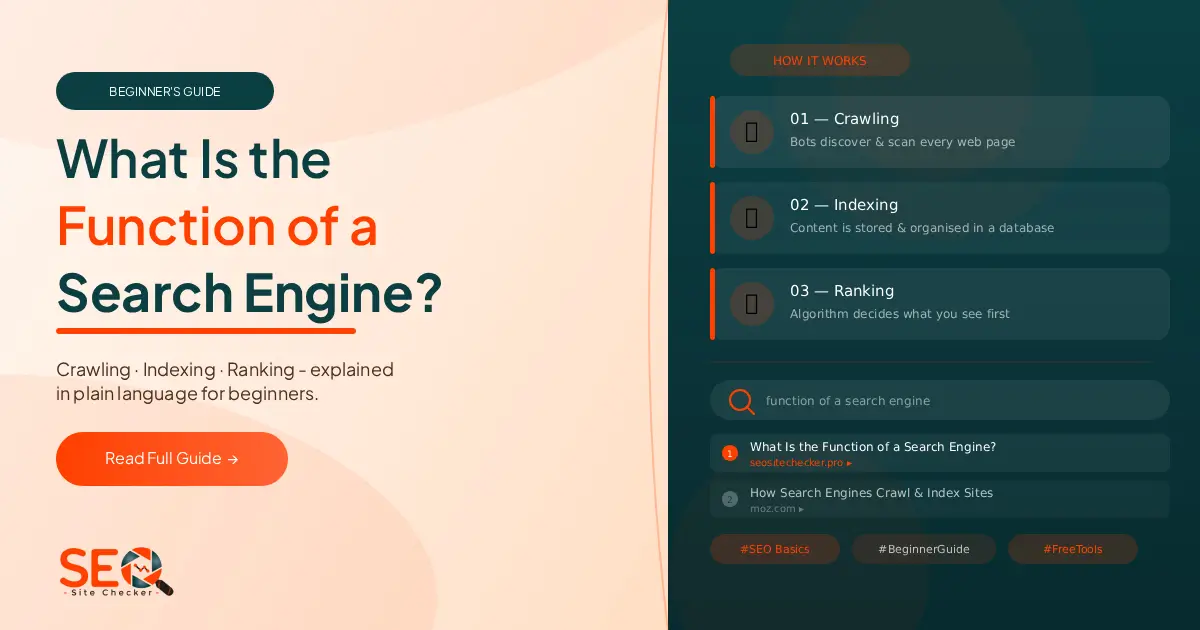
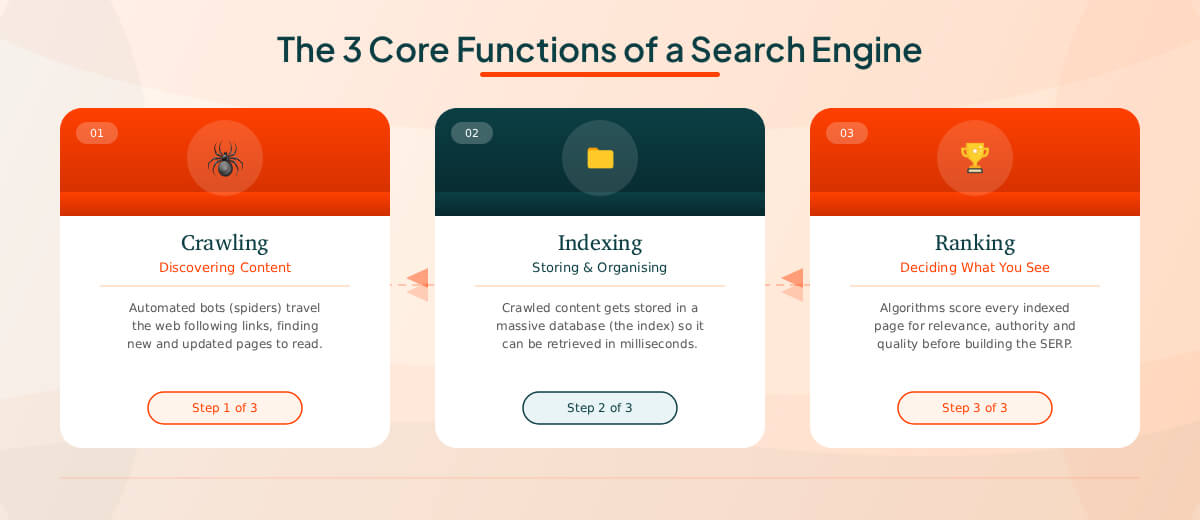
But that one-sentence definition covers up a lot of moving parts. In reality, every search engine has three core functions working together constantly:
- Crawling: discovering content across the web
- Indexing: organizing and storing that content in a database
- Ranking: deciding what shows up first when someone searches
Each of these plays a critical role. Remove any one of them, and the whole system breaks down. We'll explore each one in detail in the next section but what's important to understand right now is that every function exists for a single purpose: to match the right content with the right person at the right time.
The 3 Core Functions of a Search Engine (Explained Simply)
This is the heart of the article. Let's break down each of the three core functions in a way that's genuinely easy to understand even if you've never thought about this before.
Function #1: Web Crawling: How Search Engines Discover Content
Imagine the internet is a gigantic city with millions of streets, buildings, and alleyways. Web crawling is like sending out scouts to explore every corner of that city and report back with what they find.
Search engines use automated programs called crawlers, also known as spiders or bots, to travel across the web. These bots start with a list of known web pages and follow links from one page to another, discovering new content along the way. Every time a new link is found, the bot follows it and records what's there.
This process runs continuously. Search engines are always crawling, always discovering, and always updating their understanding of what's on the web. When you publish a new blog post or update an existing page. A crawler will eventually find it, especially if your site has a properly submitted XML sitemap.
One important concept to know here is the crawl budget which refers to the number of pages a search engine will crawl on your site within a given time period. For smaller websites, this usually isn't a concern. But for large websites with thousands of pages, managing your crawl budget becomes an important part of technical SEO.
💡 For a deeper dive into how web crawlers work, check out this helpful explainer from Cloudflare.
Function #2: Indexing: How Search Engines Store and Organize the Web
Once a crawler visits a page and collects its content, that information gets stored in a massive database called the index. Think of the index like the card catalog of the world's largest library except instead of millions of books, it holds hundreds of billions of web pages.
When a page is indexed, the search engine reads and analyzes everything on it, the text, the images, the links, the metadata, the headings, and even the structure of the page itself. All of this information helps the search engine understand what the page is about and how valuable it might be to users.
However, not every page gets indexed. A page might be skipped if it:
- Contains a noindex tag telling search engines to ignore it
- Is blocked by the site's robots.txt file
- Has very thin or low-quality content
- Is a duplicate of another page already in the index
This is why proper on-page SEO matters from day one. Your title tags, meta descriptions, headings, and structured data all help search engines understand your content better and index it correctly. If you want to check whether your pages are being properly indexed and optimized, our free SEO tools can help you get started with no cost at all.
Function #3: Ranking and Retrieving Results: How Search Engines Decide What You See
Here's where things get really interesting. Once a search query is entered, the search engine doesn't just randomly pull pages from its index, it ranks them. And it does this using a complex set of rules called an algorithm.
Google's algorithm, for example, considers hundreds of ranking factors when deciding which pages deserve to appear at the top of the results. Some of the most important include:
- Relevance: does the page actually answer the user's query?
- Authority: does the site have credible backlinks from other trusted websites?
- User Experience: is the page fast, mobile-friendly, and easy to navigate?
- Content Quality: is the content original, in-depth, and genuinely helpful?
- Page Speed: does the page load quickly on all devices?
The results the algorithm produces are displayed on what's called a SERP — a Search Engine Results Page. The SERP can include organic results, paid ads, featured snippets (those boxed answers at the top), and People Also Ask sections.
Think of the ranking process like a teacher grading essays. The most relevant, well-written, and trustworthy answer earns the top spot. To learn more about what goes into SEO rankings, the Beginner's Guide to SEO by Moz is an excellent resource to bookmark.
Other Important Functions of a Search Engine
Beyond the three core functions, modern search engines do a lot more than just crawl, index, and rank. Here are a few other key roles they play:
Answering Questions Directly (Featured Snippets and Knowledge Panels)
Search engines have evolved from simply listing links to actually providing direct answers. When you ask a question like "how tall is the Eiffel Tower," Google often gives you the answer right at the top of the page, no clicking required. This happens through featured snippets, knowledge panels, and the ever-growing People Also Ask section.
Voice search has accelerated this shift dramatically. As more people search by speaking rather than typing, search engines are optimized to deliver clear, concise spoken answers, which makes writing answer-based content on your website even more valuable.
Personalizing Search Results
Did you know that two people can type the exact same search and see completely different results? That's because search engines personalize results based on factors like your location, your search history, your device type, and even the time of day. A search for "best pizza" in Houston will look very different from the same search done in New York.
This personalization makes search results more useful for the individual user — but it also means that rankings aren't a fixed reality. Your page might rank differently depending on who is doing the searching.
Filtering Spam and Low-Quality Content
One of the most important and often overlooked, functions of a search engine is acting as a quality gatekeeper for the web. Search engines actively work to filter out spam, misleading content, and low-quality pages from their results.
Google has released major algorithm updates over the years, including Panda, Penguin, and Helpful Content. All designed to reward genuinely useful content and push down sites that try to manipulate rankings through shortcuts or low-effort material.
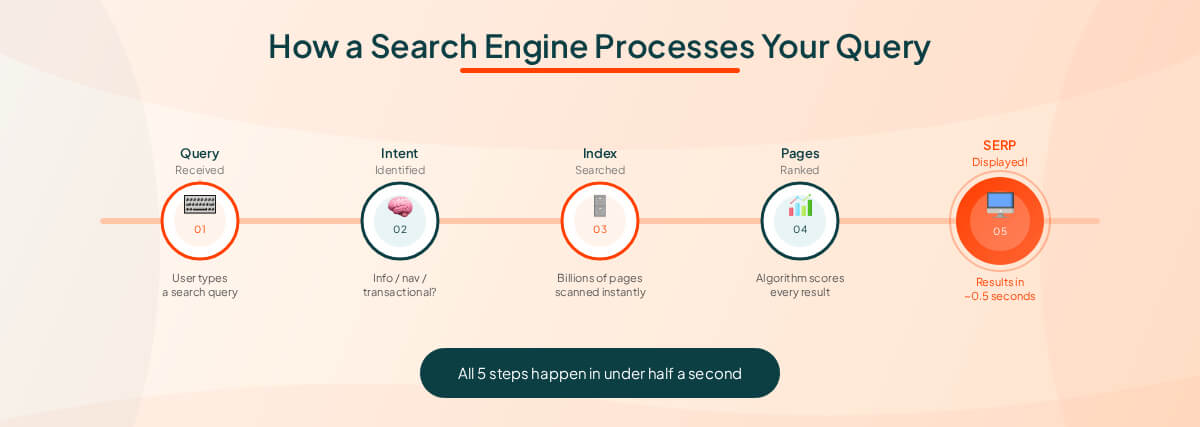
How a Search Engine Processes Your Query Step by Step
So what actually happens in the fraction of a second between you hitting "Search" and seeing results on your screen? Here's the full picture, broken down into simple steps:
- Your query is received: The search engine reads your typed or spoken query.
- Intent is identified: The engine determines what you're actually looking for: information, a specific website, or a product to buy.
- The index is searched: Matching pages are pulled from the search engine's index database.
- Pages are scored and ranked: The algorithm evaluates each result against hundreds of ranking factors.
- Results are displayed: Your SERP appears, typically within half a second.
- Feedback is collected: How you interact with results (clicks, time on page, bounce rates) feeds back into the algorithm to improve future results.
This entire process from query to result, is one of the most sophisticated information retrieval systems ever built. To understand it more deeply from the source, Google's official How Search Works guide is worth reading.
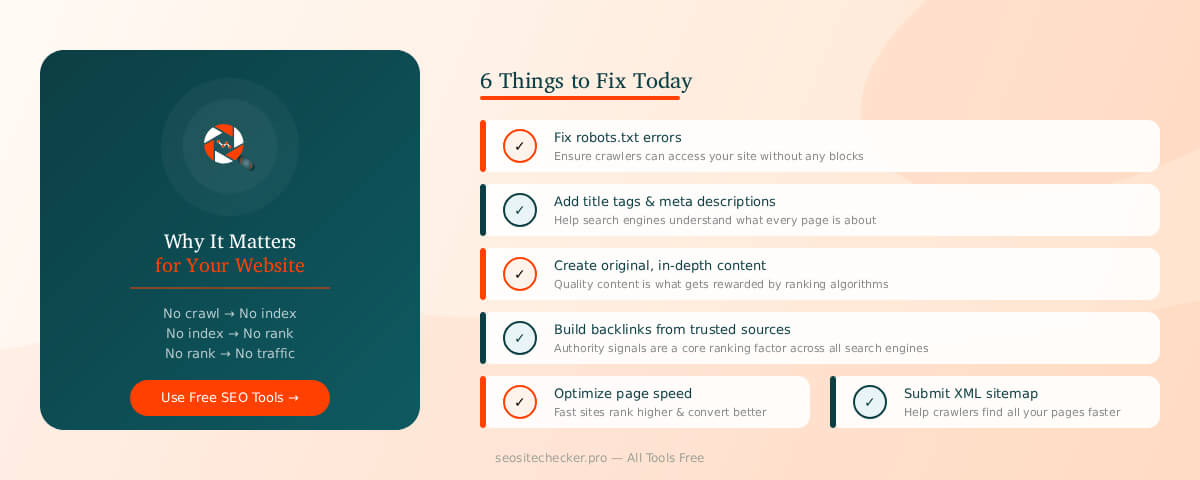
Why Understanding Search Engine Functions Matters for Your Website
Now that you know how search engines work, here's the big question: why should you care? The answer is simple, if you have a website, a blog, or any kind of online presence, the way search engines function directly affects whether people can find you. To see where your own pages stand, enter your web address and get a free website SEO score along with the checks that produced it.
Here's the chain reaction that every website owner needs to understand:
If your site can't be crawled, it won't be indexed. If it's not indexed, it won't rank. And if it doesn't rank, it won't get any organic traffic, no matter how good your content is.
Here are some practical things you can do right now to make sure search engines can properly access and reward your website:
- Make sure your site doesn't have any robots.txt errors blocking search engine crawlers
- Add descriptive title tags and meta descriptions to every page
- Create original, in-depth content that genuinely answers your audience's questions
- Build your site's authority through backlinks from reputable sources
- Optimize for page speed and mobile experience both are key ranking factors
- Submit an XML sitemap to help crawlers discover all your pages faster
If you're not sure where to start, check out our blog for more SEO guides covering everything from technical SEO to content strategy, all written in plain, beginner-friendly language.
Search Engine vs. Web Browser: What's the Difference?
This is one of the most common points of confusion for beginners, so let's settle it once and for all. A web browser and a search engine are two completely different things even though they're often used together.
Your web browser is the software application you use to access the internet. Chrome, Firefox, Microsoft Edge, and Safari are all browsers. They open web pages, load content, and display it on your screen.
A search engine, on the other hand, is a service that helps you find information on the internet. Google, Bing, Yahoo, and DuckDuckGo are all search engines. They organize the web so you can find what you're looking for.
Here's the best analogy: your browser is the car that drives you around, and the search engine is the GPS that tells you where to go. You need both but they do very different jobs.
Quick Comparison:
- Browser: software that opens and displays web pages | Examples: Chrome, Firefox, Safari
- Search Engine: service that finds and ranks web pages | Examples: Google, Bing, DuckDuckGo
Types of Search Engines (Quick Overview)
Not all search engines work the same way or serve the same purpose. Here's a quick overview of the four main types you should know about:
Crawler-Based Search Engines
These are the most common type of search engine and the ones most people think of when they hear the term. Google and Bing are both crawler-based. They use automated bots to constantly crawl the web, index new content, and rank results based on their algorithms. When you optimize your website for SEO, this is the type of search engine you're primarily targeting.
Directory-Based Search Engines
Directory-based search engines rely on human editors to manually review and categorize websites into a structured index. Yahoo Directory was one of the most well-known examples. These are largely considered a thing of the past, as crawler-based engines proved far more scalable and efficient as the web grew.
Meta Search Engines
Meta search engines don't have their own index instead, they pull results from multiple search engines and combine them into one display. DuckDuckGo and Dogpile are popular examples. Many users prefer meta search engines for privacy reasons, since they typically don't track your search history.
Specialized or Vertical Search Engines
Specialized search engines are built to search within a specific niche or type of content. YouTube is essentially a search engine for videos. Amazon is a search engine for products. PubMed is a search engine for medical research. These are incredibly powerful for their specific domains — and optimizing for them often requires different strategies than traditional web SEO.
Quick Facts About Search Engines Worth Knowing
Before we wrap up the main content, here are a few eye-opening facts that put the scale of search engines into perspective:
- Google processes over 8.5 billion searches every single day
- Google's index contains over 100 billion web pages
- The very first search engine was called Archie, created back in 1990
- Google's original algorithm was named PageRank, after co-founder Larry Page
- Over 90% of all global searches happen on Google alone
- The average Google search returns results in under 0.5 seconds
Conclusion
Search engines might feel like magic, type a question and get an answer in milliseconds. But as we've covered throughout this guide, there's a very real, very logical system working behind the scenes every time you search.
To recap what we've learned: every search engine has three core functions, crawling to discover content, indexing to organize it, and ranking to decide what users see first. On top of that, modern search engines personalize results, filter out spam, and deliver direct answers through features like featured snippets and knowledge panels.
The most important takeaway for anyone with a website is this: if search engines can't crawl your site, they can't index it. If they can't index it, they can't rank it. And if it doesn't rank, no one finds you. Understanding this process gives you a real advantage when it comes to building a site that actually gets found.
Now that you know how search engines work, the next logical step is making sure your website is set up to perform well in them. Start by running a quick check with our free SEO tools, every tool is completely free, no sign-up required, and designed to give you the kind of insights that usually cost a premium elsewhere.
Whether you're a blogger, a freelancer, a small business owner, or just someone who's curious about how the internet really works, we hope this guide gave you the clarity you were looking for. Keep exploring, keep learning, and remember: great SEO starts with understanding the basics.
Frequently Asked Questions
Frequently Asked Questions (FAQs) is a list of common questions and answers provided to quickly address common concerns or inquiries.
What are the 3 main functions of a search engine?
The three core functions are crawling, indexing, and ranking. Crawling refers to the discovery of web pages by automated bots. Indexing is the process of storing and organizing that content in a searchable database. Ranking is how the search engine decides which pages are most relevant to a given query and in what order to display them.
What is the primary purpose of a search engine?
The primary purpose of a search engine is to help users find the most relevant and trustworthy information from across the internet as quickly as possible. Everything it does crawling, indexing, personalizing, filtering spam, comes back to that one goal: connecting the right content to the right person.
What is the difference between a search engine and a browser?
A browser is the software application you use to access and view content on the internet, such as Chrome or Firefox. A search engine is an online service that helps you find specific information, such as Google or Bing. In simple terms: you open your browser to get online, and then you use a search engine to find what you're looking for.
How does a search engine index a website?
Search engines send out automated programs called crawlers to visit your website, read its content, and store relevant information in a massive database called an index. For your site to be indexed properly, it needs to be accessible to bots (no robots.txt blocks), have quality content, include proper meta tags and headings, and ideally have an XML sitemap submitted to the search engine.
Why is understanding search engine functions important for SEO?
Understanding how search engines work is the foundation of every effective SEO strategy. If your site isn't crawlable, it won't be indexed. If it's not indexed, it can't rank. And if it doesn't rank, no one will find it through organic search. Knowing these functions helps you identify technical issues, create better content, and build a site that search engines can find, understand, and reward.
Which is the most used search engine in the world?
Google is by far the most used search engine in the world, holding over 90% of the global search market share. Other notable search engines include Bing (Microsoft), Yahoo, DuckDuckGo and Baidu (primarily used in China).