Local SEO Cost: What a Package Includes and How to Check a Quote
 Kendall Chris
Updated

Local SEO Cost: The Short Answer
Quick answer: Local SEO cost is whatever a provider and a buyer agree on, and published prices disagree because they measure different things: who was asked, what was averaged and when. Google Business Profile Help, as fetched on November 18, 2026, says "There's no way to request or pay for a better local ranking on Google." So a package buys work you can check, never a position.
Two dated examples show the spread, and both are what providers say they charge, not what businesses pay. Ahrefs, which sells SEO software, polled 439 SEO providers (page updated August 15, 2024) and reports $1,557 a month on average for local SEO, with each provider counted at the top of its price band. SE Ranking, which also sells SEO software, and the website platform Duda gathered data from 260 agencies (December 13, 2024) and found $500 to $1,000 a month the most common retainer band for SEO in general.
What a Local SEO Package Includes
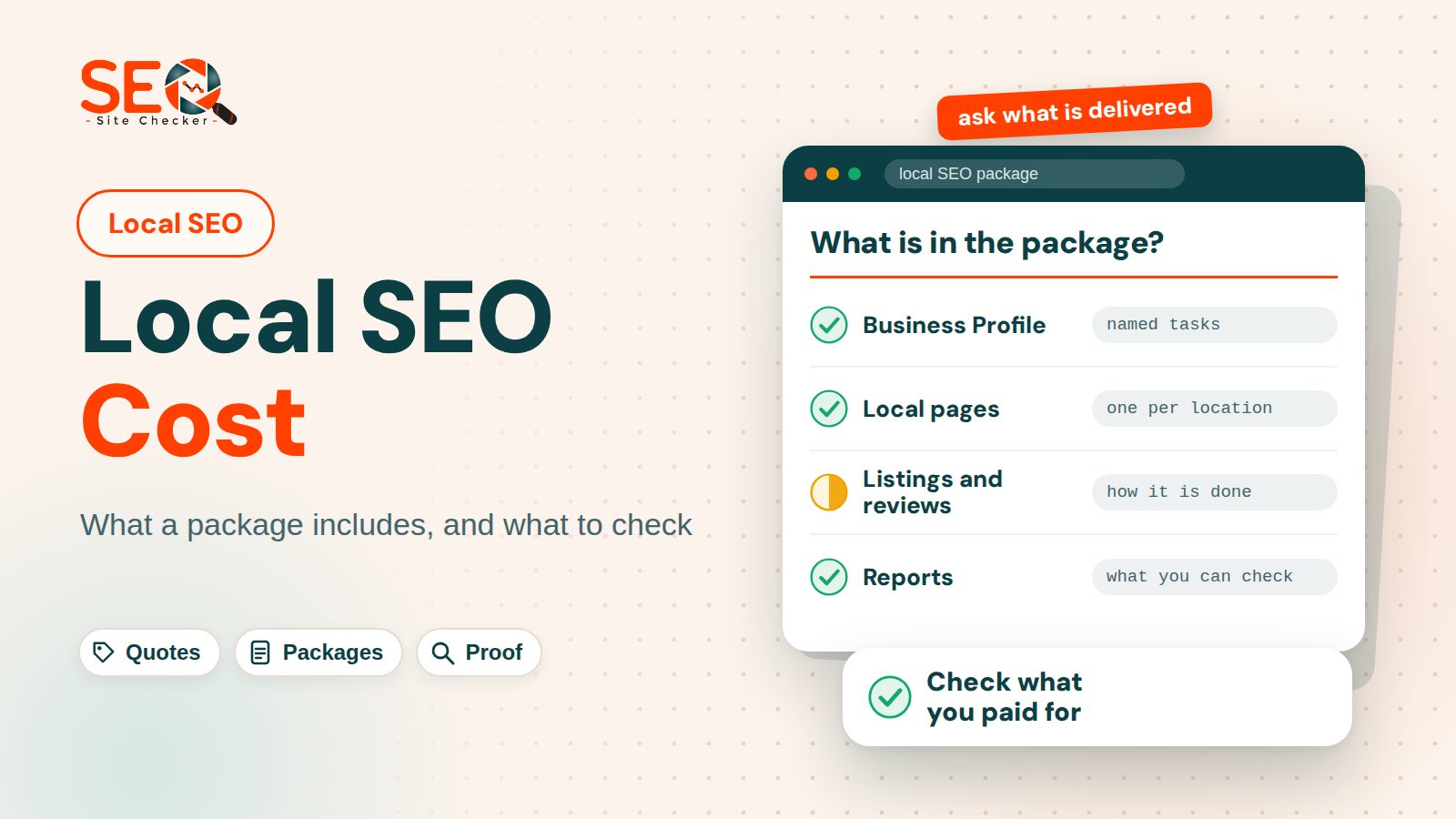
What is included in local SEO packages has no standard answer, and 85 percent of the agencies in the SE Ranking and Duda survey (December 13, 2024) bundle their service into SEO packages. Hold a proposal against these seven lines.
- Google Business Profile optimization. Business Profile verification, complete categories, hours and photos, and review replies. Google says "Businesses with complete and accurate info are more likely to show up in local search results."
- Website work. Title tags, local landing pages, location pages, local keyword research, LocalBusiness (schema.org) markup, broken links and redirects.
- Local citations (local listings). The same NAP (name, address, phone) on directories. Our guide to local business listings covers NAP consistency.
- A review process. A way to ask real customers, never to write or pay for reviews.
- Local link building. Paid links are a separate Google rule, covered below.
- Monthly reporting. It should match the views, searches, directions, calls and website clicks the profile shows its owners and managers.
- A setup audit. A one-time written baseline of the profile, listings and site.
For what agencies offer, BrightLocal, which sells local SEO software, ran its Local Search Industry Survey 2023 (August 17, 2023) with 534 local marketers: 92 percent of agency respondents offer Business Profile management, 83 percent citation management and 50 percent outreach, link building or digital PR. Those are services offered, not package contents or costs.
Google's Do you need an SEO? page (last updated June 5, 2026) lists "Technical advice on website development: for example, hosting, redirects, error pages, use of JavaScript" among services an SEO may provide, so hosting advice can sit in a package. Our view: selling the hosting itself is a second product, priced on its own.
What Google Says Local SEO Can and Cannot Buy
On Google Business Profile Help, in its "Tips to improve your local ranking on Google" page (fetched November 18, 2026), Google says "There's no way to request or pay for a better local ranking on Google." The page adds "Local results are mainly based on relevance, distance, and popularity." Its subheading calls the last factor "Prominence", the word we use from here on. Relevance is how well a profile matches the search, distance is how far the business is from the searcher, and prominence is how well known it is. Google says prominence is also based on "how many websites link to your business and how many reviews you have", and that "More reviews and positive ratings can help your business's local ranking." Those are Google's words, not a provider's promise.
For a quote, the local ranking factors mean four things:
- A provider can work on a complete, accurate profile.
- A provider can help you earn reviews and links the legitimate way.
- A provider cannot change where the searcher stands.
- A provider cannot sell you a position.
Google Business Profile Help's review tips (fetched November 18, 2026) call incentivized reviews "strictly prohibited", and the Maps User Generated Content Policy lists "Reviews or ratings that have been paid for, directly or in kind" as fake engagement. A package that sells reviews by the number is selling a violation.
Google's Business Profile guidelines (fetched November 18, 2026) cover the business name too: "Including unnecessary information in your business name isn't permitted, and could result in the suspension of your Business Profile." A virtual office, meaning a rented mailing address the business does not operate from, "isn't eligible for a Business Profile". A provider who stuffs keywords into your profile name or lists a mailing address puts your listing at risk.
Paying for links is a separate rule under Google's link spam policy, and what Google says about paid links has its own guide here.
On Google's Do you need an SEO? page (last updated June 5, 2026), Google says no one can promise a #1 ranking and that you are "responsible for the actions of any companies you hire". The Search Central pages show a last updated date; the Business Profile Help pages and the Maps policy show no date, so they carry the day we fetched them.
Local SEO Pricing Models: Retainer, Setup, Hourly, Per Location
| Model | What you pay for | Ask this |
|---|---|---|
| Monthly retainer | Recurring work: review requests, listing upkeep, pages, reports | Which tasks repeat each month, and what does the report show? |
| One-time setup fee | A fixed job, such as a profile cleanup or site audit | Which items are finished at the end, and who keeps the logins? |
| Hourly consulting rate | Time spent, billed as used | What is the estimate, and what is the cap? |
| Per location pricing | Each location or service area priced as a unit | Does each location get its own profile work and its own website page? |
| Pay per lead | A fee for each lead the provider counts | How is a lead counted, and who owns the calls? Our view: the counting rule sets what you pay. |
BrightLocal's 2023 survey shows how agencies and freelancers say they bill. A monthly fee based on deliverables led, at 63 percent of agencies and 51 percent of freelancers, so about six in ten agencies. Per project followed at 36 and 44 percent, and an hourly rate at 28 and 43.
The per location row rests on Google's guidelines for representing your business (fetched November 18, 2026): "Do not create more than one page for each location of your business, either in a single account or multiple accounts." The sentence sits in the address section, so we read it as one profile per location. The table carries questions, not prices.
Local SEO Cost: What the Published Numbers Measure
Local SEO package prices in surveys are what providers say they charge or how they say they bill, collected by companies that sell SEO software or services. None is what small businesses were measured paying.
| Source and date | What it measures | Sample | Figure |
|---|---|---|---|
| Ahrefs, SEO pricing survey (page updated August 15, 2024) | What SEO providers say they charge. The local figure covers providers who say they serve local markets and assumes each provider charges the top of its chosen band. | 439 SEO service providers, worldwide | Local SEO $1,557 a month on average (agencies $1,819, freelancers $1,150); common local hourly rate $75 to $100. |
| SE Ranking with Duda (page dated December 13, 2024) | What agencies charge for SEO retainers. SEO in general, not local only. | 260 agencies (170 surveyed with Duda, 90 from the publisher's directory); the publisher says the sample may not be large enough for statistical significance. | Most common retainer band $500 to $1,000 a month; 64 percent charge below $1,000, 30 percent below $500. |
| BrightLocal, Local Search Industry Survey 2023 (August 17, 2023) | How local marketers say they bill. No prices. | 534 local marketers reached through the publisher's own channels, so not a random sample; 53 percent SEO agencies, 72 percent in the US. | About six in ten agencies bill a monthly fee based on deliverables. |
| Setup fees, per location prices, what small businesses pay | No public source with a sample, a date and a method turned up. | Not applicable | No figure |
The sources disagree for five reasons: whose number it is (provider rates, not buyer spend), what was averaged (Ahrefs counts each provider at the top of its band, which pushes an average up), who was asked (providers worldwide, agencies from eight countries or regions, mostly American local marketers), what was priced (SEO in general or local SEO) and when. The surveys date from August 2023, August 2024 and December 2024, so none is current, and SE Ranking reports that 70 percent of the agencies it surveyed had raised prices or planned to in 2025.
We left one number out: an agency's pricing page cites a survey of 250 US marketing and sales professionals but does not say when it was run. Our view: never average the rows. A quote far from these figures is a reason to ask what it includes. We state no typical price for your town or trade.
What Moves a Local SEO Quote Up or Down
Four things shape local SEO cost, and only some are backed by Google's rules or the surveys. Competition is often named as a driver too, but no source here gives a number, so we name no trade that costs more.
- Number of locations. Each location is its own Business Profile, so a multi-location business pays for more work.
- Storefront or service area. Google says a service-area business "should have one profile for the central office or location with a designated service area". Our view: it needs more page and area work, a storefront business more review and photo upkeep.
- The starting condition. An unverified or duplicate profile, wrong hours, or broken links and redirect chains all add work.
- Scope. The monthly count of review requests, pages, listings and reports, and whether links are included at all, since only half of agencies offer them (BrightLocal, 2023).
How to Read a Local SEO Proposal Before You Sign
Eight questions follow for any local SEO contract; a proposal that cannot answer them in writing is a reason to pause.
- Deliverables. For a local SEO monthly retainer, ask for the scope of work as a monthly list in numbers and types: listing updates, review requests, pages, reports. Google's page on working with a third party (fetched November 18, 2026) says to get an official copy of the agreement that "clearly details the services and their costs", as an itemized quote does.
- Ownership of accounts. Our view: your business should own the Business Profile and the website, with the provider working as a manager from their own Google Account. Google's page on owners and managers (fetched November 18, 2026) says an owner has "full control over the profile" and that each user needs their own Google Account.
- No promised rankings. Cross out any promise of a #1 spot. Google says no one can make it, and its third party page lists promised placement as a warning sign.
- Reviews. The provider helps you ask real customers and never writes, buys or filters reviews. The Maps policy says merchants may not "Discourage or prohibit negative reviews, or selectively solicit positive reviews from customers".
- Name and address. The real-world name, no added keywords in the name or address lines, and no virtual office.
- Listings and links. Which directories, under whose logins, and what kind of links; the paid links guide above covers the rules.
- Reporting and access. A sample report, a list of every change, and read-only access first. At the audit stage Google says to "only grant read access to Search Console".
- The exit. Our view: ask for the exit terms, meaning what happens to the profile, listings and logins if you leave, plus the cancellation terms and contract length.
Google also says "Be careful if a company is secretive or won't clearly explain what they intend to do."
How to Check What You Paid For
None of the tools in this section, and not our SEO report either, sees your Google Business Profile, your citations, your reviews, your backlinks or your local rankings. A verified profile's owners and managers can open Business Profile performance (views, searches, directions, calls, website clicks), but Google says the data includes "views, searches, and actions from both organic search results and Google Ads", so it does not prove a package worked. The steps below check the website; we ran each on November 18, 2026.
- Check the markup. Paste your LocalBusiness markup into the Schema Markup Validator, a JSON-LD validator. Google's LocalBusiness structured data page (last updated September 8, 2026) requires an address, as a PostalAddress, and a name. On a made up business, complete markup gave 1 block, 0 errors and 0 warnings, and a version with only a name gave 1 error (the missing address) and 4 warnings. Changing the type to Plumber gave the same counts in both runs, because the tool applies its LocalBusiness field list to nearly every type under LocalBusiness, which fits Google's advice to use the most specific sub-type possible. The tool also warns when the address is plain text or the phone number has fewer than 6 digits, but it cannot judge whether a value is true: a name stuffed with keywords passed. Google's Rich Results Test is the next check.
- Check the redirects. Paste the http version of a location page into the Redirect Checker. On our listings guide it showed one 301 to the https address, then 200 OK, two requests in 285 milliseconds on that run. Use it on old location addresses after a redesign.
- Check the links. Run the Broken Link Checker on one service or location page. On the same guide it found 123 unique addresses and checked the first 100, its limit without an account: 1 broken (a host name that no longer resolves), 10 redirects and 19 it could not verify, in 71 seconds on that run. Read could not verify as unknown, never as fine.
- Check the tags. The Meta Tag Analyzer reads the title tag and meta description, the canonical URL and the Open Graph tags of one page. On the same guide it reported a 45 character title and a 146 character description. It reads the HTML our server receives, so tags added later by JavaScript are not shown.
- Read a whole page. A worked example on a local service business home page reads one report row by row.
None of this proves the provider did the work; it shows whether the page and the markup match what the proposal promised.
Is Local SEO Worth the Cost? A Break-Even Check
Nobody can say whether your local SEO budget will pay off before it starts, and we found no source that measures the return of local SEO for small businesses with a sample and a date. So here is a method, not a percentage.
- Find the profit per customer. Profit from one new customer, not sales.
- Divide the monthly local SEO cost by that profit. That is the break-even point: the new customers you need each month to cover the fee.
- Count what you can. Ask new customers how they found you, and count calls and direction requests in Business Profile performance, which includes Google Ads actions.
- Wait before you judge. Google's SEO starter guide (last updated December 10, 2025) says some changes take effect in a few hours and others could take several months, and that you "likely want to wait a few weeks to assess whether your work had beneficial effects".
Take made up numbers: a monthly fee of $900 and a profit of $300 per new customer. $900 divided by $300 is 3, so the package needs 3 new customers a month to break even. The figures are invented for the arithmetic, not typical of any trade. Our view: if a proposal cannot tie a line item to something you can count, that line is its weakest part.
When to Do the Basics Yourself
Google's Do you need an SEO? page (last updated June 5, 2026) says "If you run a small local business, you can probably do much of the work yourself." DIY local SEO covers these free steps:
- Verify the Business Profile, keep its information up to date, respond to reviews and add photos and videos, as Google's local ranking tips list.
- Ask real customers for reviews with a link or a QR code, as Google's review tips describe, and add LocalBusiness markup that you check with the tools above.
- Follow a weekly routine with free tools.
Paying can make sense, in our view, for a multi-location business, when you have little time, or when a profile problem is beyond you.
Before you agree to a local SEO cost, run the free SEO report on the page you want to win local customers with. It audits one URL and runs 60+ checks, and its Structured Data row counts JSON-LD and Microdata and flags JSON-LD blocks that are not valid JSON (what the Structured Data row means). It has no local rankings, no Business Profile data, no citation or review data and no backlink data.
Frequently Asked Questions
Frequently Asked Questions (FAQs) is a list of common questions and answers provided to quickly address common concerns or inquiries.
How much does local SEO cost?
No single price exists, because published figures measure different things. Ahrefs, which sells SEO software, polled 439 providers (page updated August 15, 2024) and reports $1,557 a month on average for local SEO. SE Ranking, which also sells SEO software, and the website platform Duda found $500 to $1,000 a month the most common SEO retainer band across 260 agencies (December 13, 2024). Use them to test a quote, not to predict one.
How much should a small business spend on local SEO?
Google gives no figure, and no dated, sampled source in this research gives a percentage of a marketing budget. Work out your break-even instead: divide the monthly fee by the profit from one new customer. Start with the free basics Google lists, then pay only for lines you can check.
Is local SEO a one-time or an ongoing cost?
Both. Setup work such as verifying the profile, completing information, listings and an audit can finish, while review requests, listing upkeep, new pages and reporting repeat. In BrightLocal's 2023 survey, about six in ten agencies bill a monthly fee based on deliverables, so ask which lines are monthly.
Can I do local SEO myself?
Often the basics, yes. Google says 'If you run a small local business, you can probably do much of the work yourself.' The free steps are verifying and completing the Business Profile, asking real customers for reviews and adding LocalBusiness markup. Paying can make sense for several locations, little time or a problem you cannot fix.
How long does local SEO take to work?
Nobody can promise a date. Google's SEO starter guide (last updated December 10, 2025) says some changes take effect in a few hours and others could take several months, and that you likely want to wait a few weeks before judging. Business Profile performance includes Google Ads actions, so it is not proof.
Why do local SEO prices vary so much?
Because the numbers measure different things and the scopes differ. Surveys differ in whose rates they report, whether they average the top of each band, who was sampled and whether they cover SEO in general. Scope differs by locations, service area or storefront, the starting condition and whether links are included.
Can you pay for a better local ranking on Google?
No. Google Business Profile Help (fetched November 18, 2026) says 'There's no way to request or pay for a better local ranking on Google.' Money can buy work on complete information, a better website and legitimate review effort, but no one controls the searcher's distance, and paid reviews break the Maps policy.
What are the red flags in a local SEO package?
A promised #1 ranking, which Google says no one can promise; no list of monthly deliverables; a profile set up in the provider's account instead of yours (our view); paid or filtered reviews; a keyword stuffed profile name or a virtual office address; unsolicited email out of the blue; and a secretive company.