AI Content Detectors: How They Work and When They Fail
 Kendall Chris
Sep 12 /
1 month ago
Kendall Chris
Sep 12 /
1 month ago

Most people arrive here for one of two reasons. Either you want to check whether something was written by AI, or your own writing got flagged and you need to understand what happened.
Both are worth answering properly, and answering them properly means starting with the caveat that applies to every detector, including the free one on this site.
AI detectors are a useful signal and unreliable evidence. They produce false positives often enough to matter, and the false positives are not random. They fall disproportionately on people writing in a second language, on technical and formulaic writing, and on anyone whose prose happens to be plain.
This covers how they work, how to use one sensibly, exactly where they fail, what to do if you are wrongly flagged, and what Google actually thinks about AI-written content.
How to Detect AI Content for Free
Three steps:
- Paste the text into a detector
- Run the check
- Read the score
That is the whole process. What matters is how you read the result, and there are four rules worth following.
Use at least 300 words. Below that, the signal is too weak to trust. A single paragraph tells you very little.
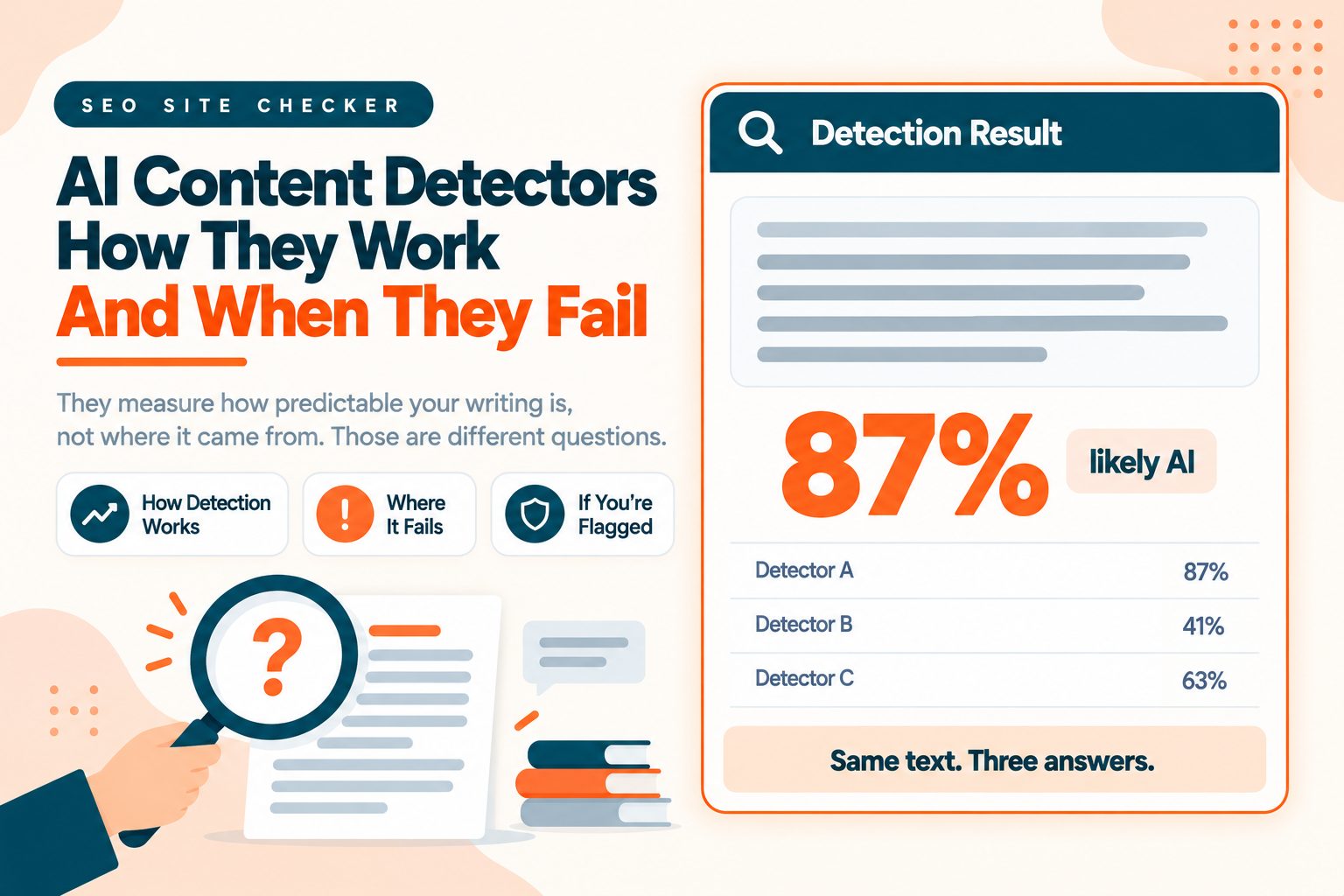
Run more than one. Agreement between two or three detectors is a considerably stronger signal than any single confident number. Disagreement tells you the result is unstable, which is itself useful information.
Read the score as a probability, not a measurement. "85 percent likely AI" does not mean 85 percent of the text was generated. It means the classifier's confidence sits at 85 percent, which is a different claim.
Never use a score on its own to accuse someone. This is the rule that matters most and the one most often broken. More on why in the section on failures.
Want to try these steps on your own text? The free AI Content Detector on this site works without an account. Paste between 50 and 15,000 characters, press Check for AI, and read two things:
- An AI probability from 0 to 100 percent, rounded to one decimal place and shown with a colored bar.
- A plain label that goes with the number: Likely human written below 30 percent, Mixed or unclear from 30 to just under 55, Possibly AI generated from 55 to just under 80, and Very likely AI generated at 80 or above.
That is the whole output. The score covers the passage as a whole, so there is no sentence-by-sentence highlighting and no way to see which lines pushed the number up. The box accepts as little as 50 characters, but the 300 word rule above still applies, because a short paste produces a number you should not lean on. The text is scored by a classifier model that runs on our own server, and that model reads only the first 768 tokens of what you paste (a token is a word or a piece of one), which works out to roughly 500 to 650 words of ordinary English and fewer for text full of long or technical words. For a longer document, check one section at a time. Every result ends with a reminder that no AI detector is fully accurate, and that reminder deserves to be taken literally.
How AI Detectors Actually Work
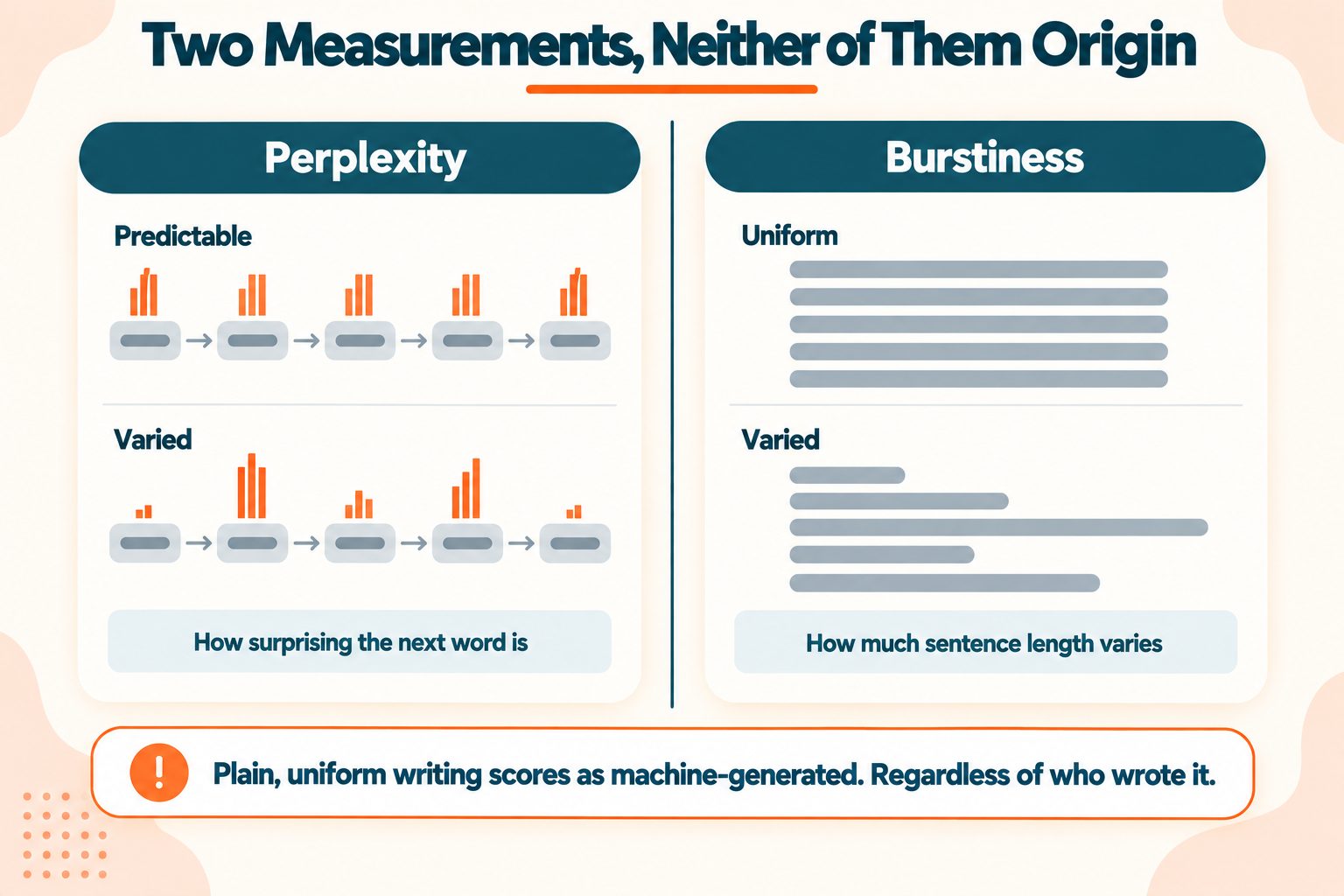
Two concepts are the easiest way into how detectors reason, and understanding them explains most of the failures in the next section.
Perplexity measures how predictable each word is given what came before. Language models select likely continuations, so their output tends to be less surprising than human writing. Low perplexity reads as machine-generated.
Burstiness measures variation in sentence length and structure. Human writing tends to swing between long and short, complex and simple. Model output is more uniform. Low burstiness also reads as machine-generated.
A detector is a classifier trained on large collections of human and AI text, learning which statistical patterns correlate with which origin. Some tools compute perplexity and burstiness directly. Others, including the one on this site, pass the text to a language model that was fine-tuned on labeled human and AI examples and read a probability off its output. In both designs the verdict comes from patterns in the writing, never from knowing who or what wrote it.
Here is the consequence that matters most.
The detector never sees where the text came from. It cannot. It reads the wording and structure of the text, then infers an origin from the patterns it finds.
Which means writing that is naturally plain, formulaic or structurally consistent tends to score as AI-like regardless of who wrote it or how. That is not a bug in a particular product. It is what the method does.
Where Detectors Fail
Detector accuracy is easy to overstate. Here is what the evidence actually shows.
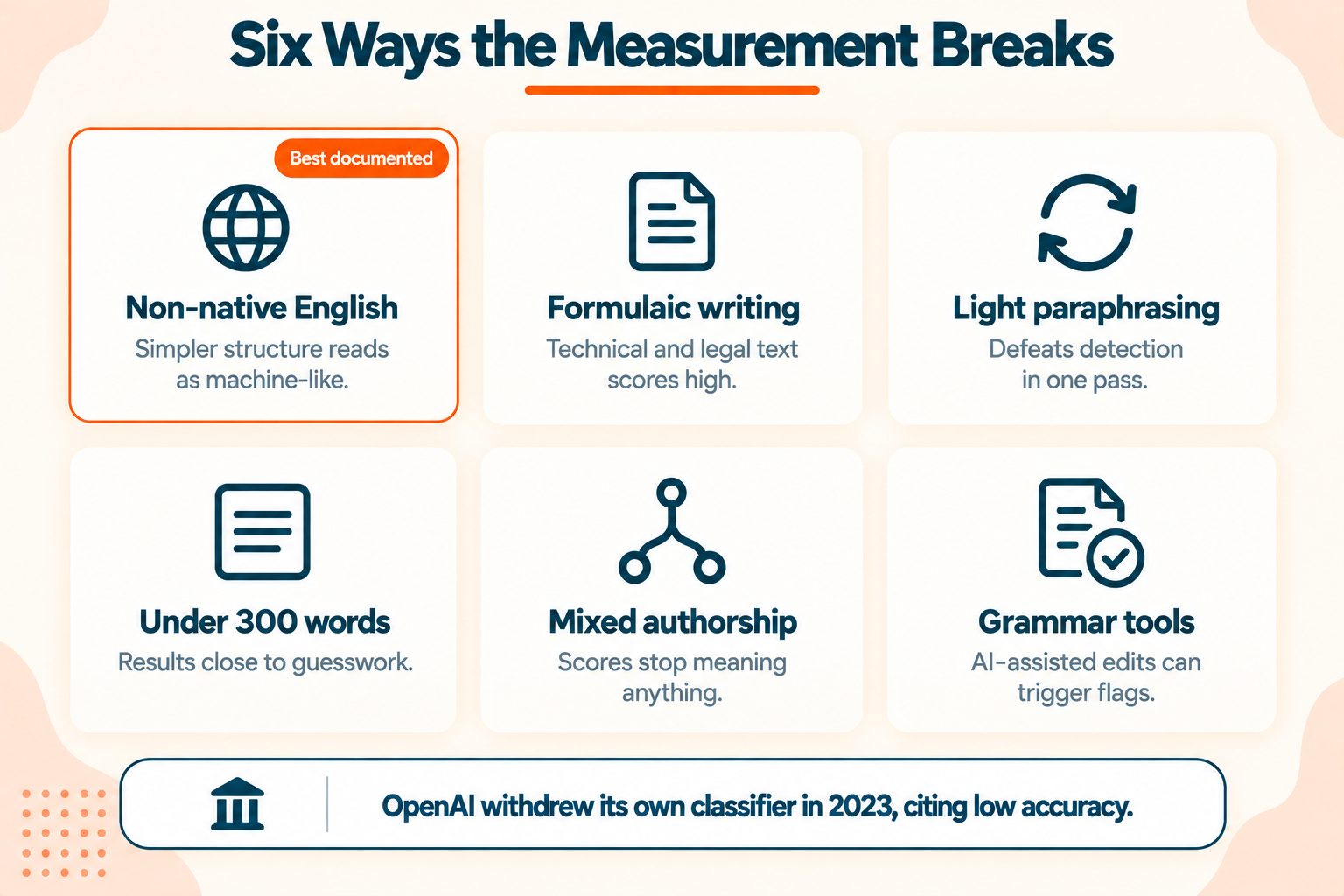
False positives against non-native English speakers. The most serious failure and the best documented. A 2023 Stanford study published in Patterns found that GPT detectors misclassified writing by non-native English speakers as AI-generated at high rates, while classifying native-speaker writing correctly.
The reason follows directly from the mechanism. Simpler vocabulary and more predictable sentence structure are exactly what a detector reads as machine-like. So detectors like these systematically penalize people for writing in a second language. The Stanford study on detector bias against non-native English writers sets out the findings in full.
Formulaic human writing. Technical documentation, legal drafting, academic abstracts, structured reports, standardized business correspondence. Writing that is supposed to be uniform reads as uniform, and uniform reads as AI.
Light paraphrasing can defeat them. Running generated text through a rewriting tool, or simply editing it by hand, can drop detection rates sharply. A detector can fail against anyone deliberately evading it, while flagging people who were not trying to evade anything. That is the worst possible combination of error types.
Short samples are unreliable. Under roughly 300 words the signal is too weak to distinguish.
Mixed authorship produces meaningless scores. Human writing tidied with AI assistance, or a generated draft substantially rewritten, sits in a space detectors were not built to classify. The number that comes out is not measuring anything coherent.
OpenAI withdrew its own detector. In July 2023, OpenAI discontinued its AI Text Classifier, citing a low rate of accuracy. The original announcement carries the withdrawal note.
That last one deserves a moment. The organization with the most direct possible knowledge of how its own models write built a detector, evaluated it, and concluded it did not work well enough to keep running. That is a good reason to read any detector's number, ours included, with caution.
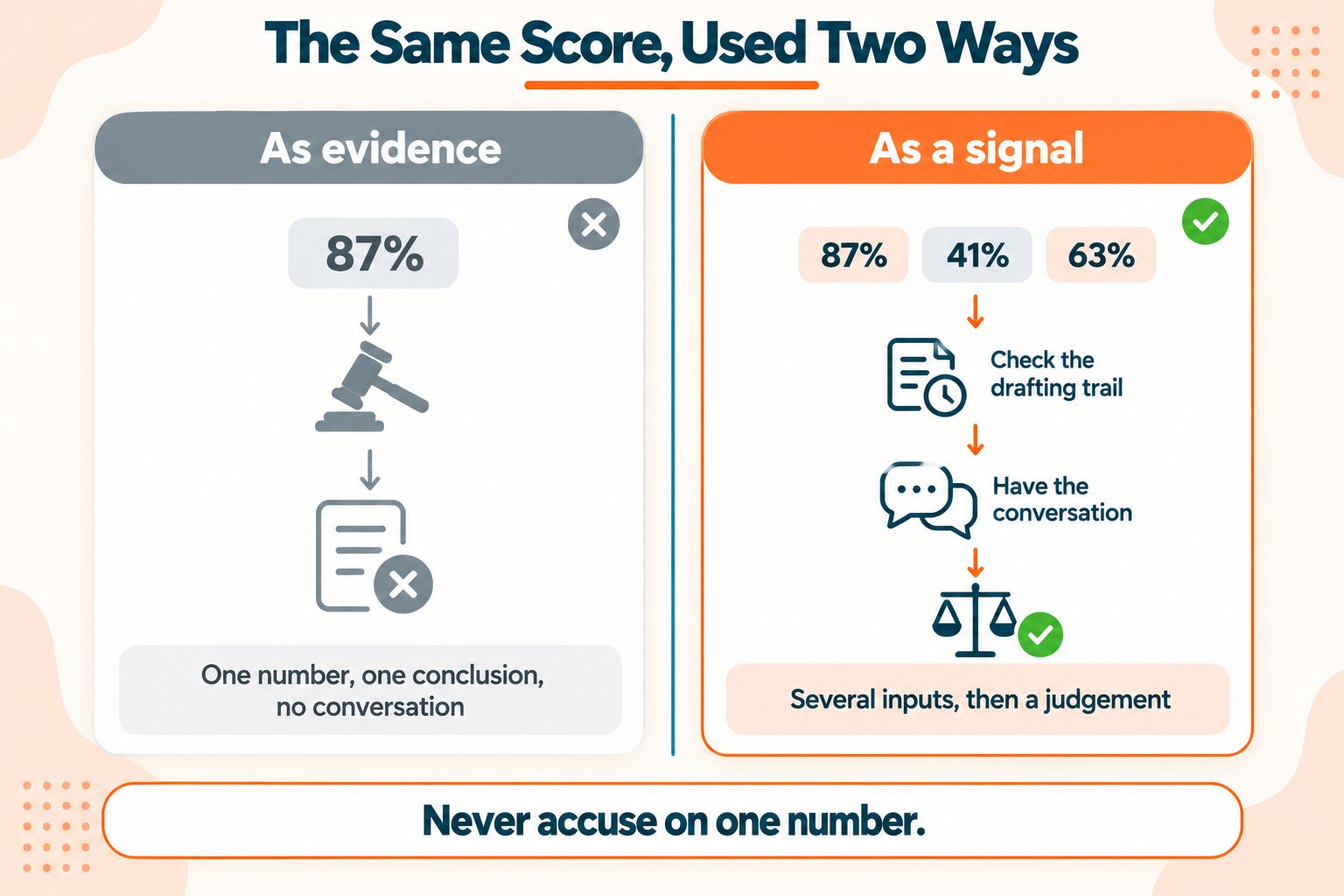
The practical rule: treat a detector score as one input among several. Never as evidence, and never on its own.
What to Do If You Are Wrongly Flagged
If you are here because your own writing was flagged, this section is for you.
Keep your drafting history. This is the strongest evidence available and it only works if it already exists. Google Docs version history, your editor's revision log, a git history, or simply a folder of dated drafts. Anyone who writes in a context where they might be accused should be building this trail as a matter of habit.
Run the text through other detectors. If three tools give you three different answers, that disagreement is itself evidence that the result is unstable. Screenshot all of them.
Ask what the score actually means. A percentage is a classifier's confidence estimate, not a measurement of how much text was generated. Plenty of people applying these tools do not know that, and asking the question changes the conversation.
Point at the documented limitations. The non-native speaker bias is peer-reviewed and citable. OpenAI's withdrawal of its own classifier is a matter of public record. Both are specific and verifiable rather than a general complaint about fairness.
Ask for a conversation rather than a verdict. Most institutions with a considered policy treat a detection score as a prompt for discussion, not as a finding. If the process you are in does not work that way, it is worth asking whether the policy says it should.
Worth being honest that this is harder outside education. A university usually has an appeals process. A client who has decided your work is AI-generated may not, and the drafting history matters more there than anywhere.
Does Google Penalize AI Content?
This is the question most people in SEO actually want answered.
No, and Google has been explicit about this.
Its stated position is that content quality matters, not how content was produced. Using automation to manipulate search rankings violates spam policy. Using automation to help produce genuinely helpful content does not. Google's guidance on AI-generated content sets this out directly.
Three things follow from that:
Google has not said it scores pages with an AI detector. Its published guidance is about the quality of content and whether it exists mainly to manipulate rankings, so a detection score is not something to optimize for.
Thin, unhelpful content ranks badly, as it always has. AI made producing that kind of content much cheaper, which is why there is a great deal more of it, but the problem is the quality rather than the tool that produced it.
Content produced at scale primarily to manipulate rankings is spam regardless of whether a human or a model wrote it. Google's scaled content abuse policy covers exactly this.
The practical implication for a publisher: running your own content through a detector before publishing is largely wasted effort. Nothing Google has published suggests it checks, and a clean score does not make thin content useful.
Where it genuinely matters is elsewhere. Client contracts with originality requirements. Academic submissions. Journalism, where disclosure standards apply. Those are real obligations, and they are about the agreement you made rather than about search rankings.
When Detection Is Worth Doing
None of the above means detectors are useless. It means they need using carefully.
Academic integrity, with process around it. A score that triggers a conversation is reasonable. A score that triggers a penalty on its own is not.
Commissioned writing. If you are paying for original work and the agreement specifies human authorship, a detector gives you a signal worth following up. Follow it up rather than acting on it.
Editorial triage at volume. If you screen hundreds of submissions, a detector can order the queue. It should not decide the outcome.
Checking your own writing. The most underrated use and the least discussed. A high score on something you definitely wrote yourself often means the writing is generic rather than that anything is wrong. Uniform sentence length, predictable structure, no distinctive phrasing. Treated that way, a detector becomes a bluntness check rather than an authenticity test.
Wrapping Up
Three things worth carrying away.
A score is a signal, not proof. It reflects patterns in how the writing reads, not where it came from, and those are different questions.
The errors are not evenly distributed. Non-native English speakers, technical writers and anyone with a plain style bear most of the false positives. That is a property of the method rather than a flaw in one product.
Never accuse on one number. Run several detectors, ask what the score means, and treat the result as the beginning of a conversation rather than the end of one.
Used that way, detection is genuinely useful. Used as evidence, it produces confident wrong answers about real people.
Frequently Asked Questions
Frequently Asked Questions (FAQs) is a list of common questions and answers provided to quickly address common concerns or inquiries.
Are AI content detectors accurate?
Not accurate enough to settle anything on their own. They produce meaningful false positive rates, particularly on non-native English writing and formulaic text, and light paraphrasing can defeat them.
Can AI detectors be wrong?
Regularly, in both directions. They flag human writing as AI and miss AI writing that has been edited. Treat scores as signals rather than proof.
How do AI detectors work?
They are classifiers trained on large collections of human and AI text. They pick up on patterns such as how predictable the word choices are and how varied the sentence structure is, then return a probability that the text was machine-written.
Why does my human writing get flagged as AI?
Usually because it is plain, uniform or formulaic. Detectors read patterns in the writing, not its origin, so simple clear writing can score as machine-like.
Does Google penalize AI-generated content?
No. Google judges content quality, not production method. Content created at scale to manipulate rankings is spam regardless of who or what wrote it.
Can AI detectors detect paraphrased content?
Poorly. Light rewriting can sharply reduce detection rates, which means a detector can fail against deliberate evasion while still flagging honest writers.
Can universities detect ChatGPT?
Policies differ from one institution to the next, and a detection score is only one input. Check the written policy that applies to you, and keep your drafts.
How much text does an AI detector need?
At least 300 words for a result worth trusting. Shorter samples produce results close to guesswork. Our free checker accepts 50 to 15,000 characters and reads roughly the first 500 to 650 words of what you paste, so check long documents one section at a time.
What should I do if I am falsely accused?
Produce your drafting history, run other detectors to show disagreement, and cite the documented limitations, including OpenAI withdrawing its own classifier.
Is it against the rules to use AI to write content?
It depends entirely on the agreement you are under. Google has no rule against AI as such, only against content made mainly to manipulate rankings. Your university, client or publisher may have one.
Is there a free AI content detector with no sign-up?
Yes. The AI Content Detector on this site is free and works without an account. Paste between 50 and 15,000 characters and it returns an AI probability and a plain label such as Likely human written or Very likely AI generated. Treat the number as a guide, not proof.