
How to Get Cited by ChatGPT and Perplexity: The Short Answer
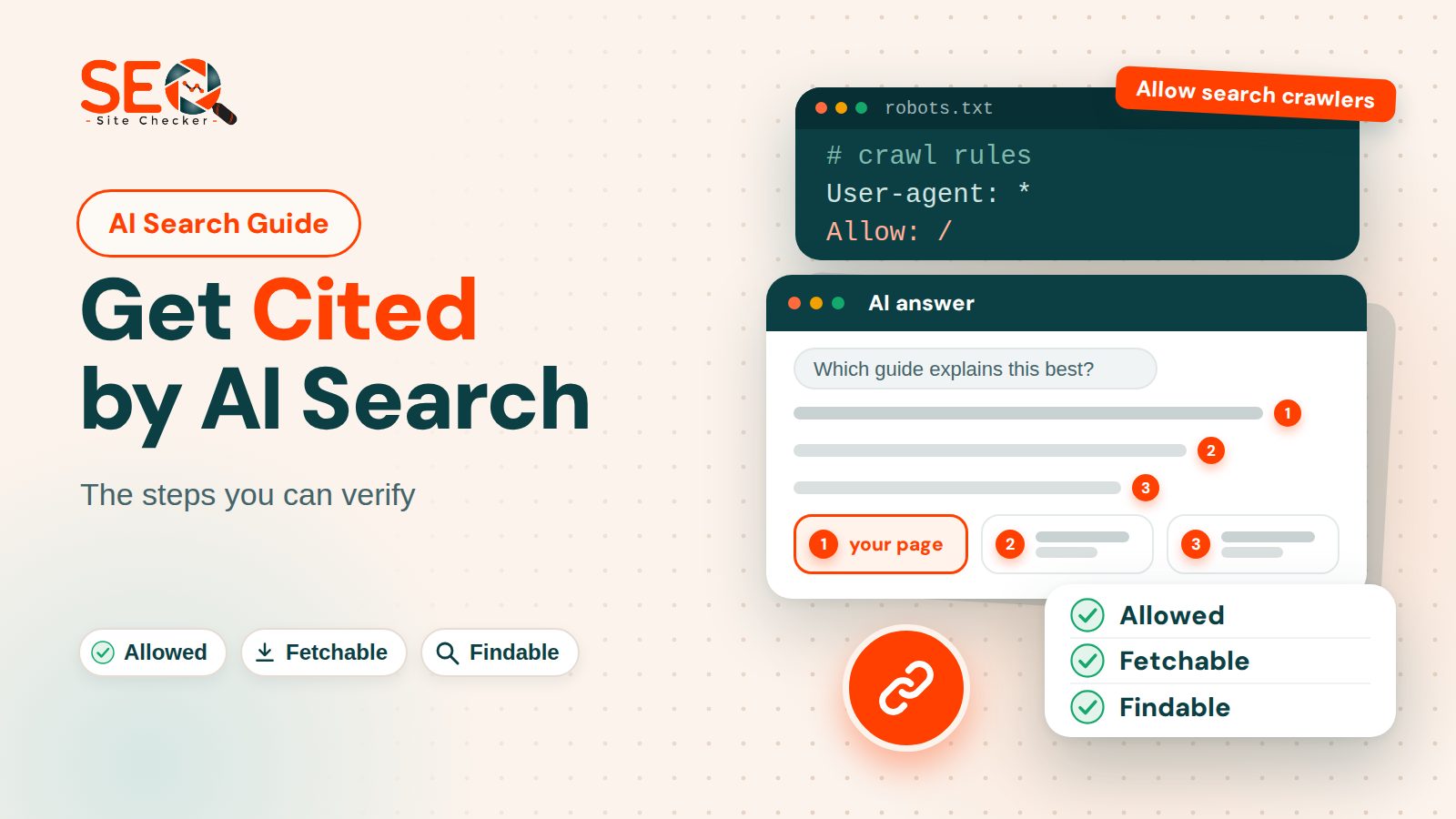
Quick answer: To get cited by ChatGPT and Perplexity, let their search crawlers (OAI-SearchBot and PerplexityBot) read your pages, keep your firewall from blocking them, put the answers in plain HTML, and confirm the visits in your logs. Neither company documents how pages are chosen, so these steps promise no citation.
This covers how to get cited by ChatGPT as a source, not how to cite it in an essay.
| Step | What to do | How you verify it |
|---|---|---|
| 1 | Allow the crawlers | Robots.txt tester |
| 2 | Keep the firewall open to them | Your logs |
| 3 | Keep pages fetchable | Noindex checker, curl |
| 4 | Write pages that are easy to cite | Read the page source |
| 5 | Check logs and referrals | Published IP ranges |
What ChatGPT and Perplexity Document, and What They Do Not
OpenAI says OAI-SearchBot "is used to surface websites in search results in ChatGPT's search features," and Perplexity says PerplexityBot is "designed to surface and link websites in search results on Perplexity."
We read both pages end to end and found no selection criteria, no citation frequency, nothing on whether their crawlers run JavaScript, and nothing on how their crawlers treat noindex or llms.txt. So this post covers eligibility for AI citations, not selection. Most advice we read on how to get cited by ChatGPT lists tactics and omits OAI-SearchBot and PerplexityBot.
Our guide to showing up in AI search has the full crawler table and the prompt audit.
Step 1: Allow OAI-SearchBot and PerplexityBot in robots.txt
In OpenAI's crawler documentation, OAI-SearchBot is the search crawler and GPTBot the training crawler, as separate settings, so a site can allow the first and disallow the second. This group re-opens both search crawlers:
User-agent: OAI-SearchBot
User-agent: PerplexityBot
Allow: /
Consecutive User-agent lines share one group, and a group that names a crawler beats the wildcard group, so these lines work even when a wildcard group says Disallow: /. We tested exactly that on November 16, 2026: both crawlers were allowed on / and on /post/x, while GPTBot stayed blocked. Both vendors say changes can take about a day.
OpenAI says ChatGPT-User visits start with a person, so "robots.txt rules may not apply," and Perplexity says Perplexity-User "generally ignores robots.txt rules." In our view, a firewall rule is the most dependable control left for those two user-initiated fetchers, since neither crawler page offers another opt out.
Test your file with the robots.txt tester: pick a crawler under Crawler to test, then press Test robots.txt. On our live file, OAI-SearchBot, PerplexityBot and ChatGPT-User were allowed on / and blocked on /payments/x. Syntax is in our guide to robots.txt files.
Step 2: Stop Your Firewall and CDN From Blocking the Crawlers
A crawler that robots.txt allows can still get a 403 response or a challenge page from a firewall, a CDN rule or bot protection. OpenAI recommends allowing "requests from our published IP ranges," and Perplexity's crawler documentation says a site behind a web application firewall "may need to explicitly allow" its bots.
Perplexity's Cloudflare recipe is one WAF skip rule: match the user agent and that bot's published IP ranges, set the action to Skip, and place it above every rule that blocks or challenges. Bot Fight Mode "can't be skipped with WAF custom rules."
These were the prefix counts in the vendors' JSON lists on November 16, 2026. Perplexity says to refresh WAF rules from them on a schedule.
| Crawler | List | Prefixes | Created |
|---|---|---|---|
| OAI-SearchBot | openai.com/searchbot.json | 39 | 2026-01-02 |
| GPTBot | openai.com/gptbot.json | 18 | 2026-09-22 |
| ChatGPT-User | openai.com/chatgpt-user.json | 237 | 2026-11-06 |
| PerplexityBot | www.perplexity.ai/perplexitybot.json | 13 | 2026-10-28 |
| Perplexity-User | www.perplexity.ai/perplexity-user.json | 10 | 2026-10-28 |
A user agent is a claim, and an address is evidence. Perplexity says to combine both, and our logs show why. Between November 2 and 16, 2026, 367 requests in our logs carried the OAI-SearchBot user agent, and 258 came from addresses in OpenAI's list as fetched on November 16. The other 109 mostly got a 403 or 404, and 51 asked for .env paths. Lists change, so being outside one is not proof of a fake, and the path asked for says more.
Our report shows a banner on bot protection pages, which hints at a firewall rule but proves nothing about these two crawlers.
Step 3: Make Every Page Fetchable and Indexable
A correct robots.txt is not enough: a redirect chain, a stray noindex or an answer hidden in a script can get in the way. The redirect checker follows up to 10 hops and shows every header, and the final answer should be a plain 200 response.
The noindex checker (Check for noindex) reads the X-Robots-Tag header and the meta robots, Googlebot and Bingbot tags without running JavaScript. On our AI search guide it returned HTTP 200 and No noindex rule found. Its robots.txt row speaks about Googlebot, and the vendor pages do not say how their crawlers treat noindex, so check it anyway.
Then fetch the page with curl and search for one of its sentences. Our guide came back as 200 with 167,081 bytes, and the sentence sat in the raw HTML. Google says it can process JavaScript "as long as it isn't blocked," but the crawler pages we read say nothing about JavaScript rendering, so keep the text in the HTML. Google says its AI features need an indexed page eligible for a snippet; how Google crawls websites covers indexing.
Step 4: Write Pages That Are Easy to Cite
Neither OpenAI nor Perplexity publishes content guidance on the pages we read, so the only vendor guidance we found is Google's. Google's guide to optimizing for generative AI search says a unique point of view and first-hand experience stand out from a summary of what is already online, and that "there's no special schema.org markup you need to add."
What follows is our view, not a documented rule. Use descriptive headings, lead each section with the direct answer, show an author byline and an honest updated date, cite the primary source for any figure, and include one number you measured yourself. Keep one page per topic: Google says separate pages for every query variation, made to manipulate rankings, break its scaled content abuse policy.
Keep your JSON-LD identical to the visible text and check it with the schema markup validator. Google says its AI features do not require structured data, and neither crawler page mentions it, so do not count on it.
Step 5: Check Whether ChatGPT and Perplexity Fetch and Cite Your Pages
Search your server logs for OAI-SearchBot, ChatGPT-User, PerplexityBot and Perplexity-User. OpenAI says its crawlers may add a robots.txt marker to the user agent string when they fetch robots.txt. On a combined format log this counts status codes, because the ninth field is the HTTP status code:
grep -E "OAI-SearchBot|PerplexityBot|ChatGPT-User|Perplexity-User" access.log | awk '{print $9}' | sort | uniq -c | sort -rnThis is our site's snapshot for November 2 to 16, 2026, across 245,661 log lines, not a benchmark. Outside means outside the lists fetched on November 16.
| User agent | Requests | From published ranges | Status of those requests |
|---|---|---|---|
| OAI-SearchBot | 367 | 258 | 200 (238), 301 (20) |
| PerplexityBot | 277 | 153 | 200 (136), 301 (17) |
| ChatGPT-User | 145 | 36 | 200 (35), 404 (1) |
| Perplexity-User | 112 | 0 | None |
Most requests from outside the ranges got a 403 or 404. Perplexity-User is the extreme case: 112 requests, none from its published list,.
For AI referral traffic we can show only our own logs. Eleven landing GET requests from November 2 to 16 carried utm_source=chatgpt.com. Five used an ordinary browser user agent, six named a crawler or link preview fetcher, and none sent a referrer. Filter analytics by source chatgpt.com and count landing page requests, not every line with the string: 98 of our log lines held it, mostly because page assets carry the page address as the referrer.
A fetch proves only that the crawler could read the page. A citation is something you see in an answer, so run the manual prompt audit from our AI search guide and look for a link to your page. For Google only, Google Search Console has a Generative AI performance report.
What Not to Do
- Do not use IP blocks to opt out of a crawler that reads robots.txt. Anthropic says blocking its addresses "may not work correctly" because its bots can no longer read robots.txt. Its search crawler is Claude-SearchBot.
- Do not allow a crawler by user agent alone, or treat blocking GPTBot as blocking ChatGPT search. OpenAI documents them as independent.
- Do not chase inauthentic mentions. Google says mentions are not "as helpful as it might seem."
- Do not expect llms.txt to earn ChatGPT citations. Google Search ignores it, and the vendor pages say nothing about how their crawlers treat one.
- Do not promise a citation to yourself or a client. No vendor promises one.
What Our AI Search Readiness Check Shows and Leaves Out
The free SEO Site Checker report has an AI Search Readiness card. Its AI crawler access row reads your robots.txt for six AI crawler tokens and asks whether each is blocked from the whole site: passed when none is, warning when one or two are, failed when three or more are. For the wider picture of what answer engine optimization is and is not, see our guide to answer engine optimization.
Edge case: A file that blocks only the four training tokens (GPTBot, ClaudeBot, CCBot and Google-Extended) leaves OAI-SearchBot and PerplexityBot open, yet the row reads failed. Blocking only those two reads warning, and our own live file reads passed. The row's message calls GPTBot, ClaudeBot and Google-Extended training controls, so read the sentence.
The row does not test ChatGPT-User, Perplexity-User, Claude-SearchBot, Claude-User, firewalls, IP ranges, your logs or any citation, and the report shows no mention rate. To read the rest, see how to read an SEO audit report.
Frequently Asked Questions
Frequently Asked Questions (FAQs) is a list of common questions and answers provided to quickly address common concerns or inquiries.
Can ChatGPT cite my site if I block GPTBot?
Yes, in principle. OpenAI documents OAI-SearchBot (search) and GPTBot (training) as independent settings, so a site can allow one and disallow the other. A site that opts out of OAI-SearchBot can still show up as a plain link. No citation is promised.
Does robots.txt stop ChatGPT-User and Perplexity-User?
Not reliably. OpenAI says robots.txt rules may not apply to ChatGPT-User because users start those visits, and Perplexity says Perplexity-User generally ignores robots.txt rules. Use robots.txt for OAI-SearchBot and PerplexityBot. In our view, a firewall rule is the most dependable control left for the other two.
How do I know if ChatGPT or Perplexity visited my site?
Search your access log for OAI-SearchBot, ChatGPT-User, PerplexityBot and Perplexity-User, then compare each address with the vendor's published IP ranges, because a user agent is only a claim. A visit shows the crawler could read the page, not that you were cited.
How long does it take to get cited by ChatGPT or Perplexity?
Neither OpenAI nor Perplexity documents a timeline for citations, so treat any promise as a guess. The only delay either documents is about a day: OpenAI says search systems can take roughly 24 hours to adjust after a robots.txt update, and Perplexity says up to 24 hours.
Do I need an llms.txt file or special schema to get cited?
Not according to the vendors we could read. Google says Google Search ignores llms.txt and that no special schema.org markup is needed, and the OpenAI and Perplexity crawler pages say nothing about how their crawlers treat either. Keep structured data accurate and llms.txt optional.
Does ranking on Google help me get cited by ChatGPT or Perplexity?
The documentation does not say. ChatGPT search and Perplexity search name their own crawlers as what surfaces sites in their results, while Google's AI features need a page indexed in Google Search. Check each product separately instead of assuming one predicts the other.
How does ChatGPT decide which pages to cite?
OpenAI and Perplexity do not publish how pages are chosen. They document what OAI-SearchBot and PerplexityBot are for, not ranking factors. Learning how to get cited by ChatGPT starts with what you can verify: robots.txt access, firewall access and answers in plain HTML.