How to Read an SEO Audit Report (and Know What to Fix First)
 Kendall Chris
Oct 14 /
10 hours ago
Kendall Chris
Oct 14 /
10 hours ago

You ran an SEO audit, or someone handed you one, and now you are staring at a wall of scores, color-coded errors, and terms like crawlability, canonical, and Core Web Vitals. It is easy to feel lost, or to start fixing the wrong things while the real problems sit untouched.
This guide fixes that. An SEO audit report is a health check for your website, and once you know how to read one, you stop being at the mercy of the jargon. We will walk through what each section means, how to tell a genuine finding from padded filler, and most importantly, what to fix first. You do not need to be a technical SEO to read a report well. If you want to follow along with a real one, run a free SEO audit and keep it open as you read.
What Is an SEO Audit Report?
An SEO audit report is a detailed assessment of how well your website is set up to be found in search. A complete one looks at three areas. Technical SEO is the behind-the-scenes health of your site: can search engines find, crawl, and index your pages. On-page SEO is how well your individual pages are optimized, their titles, descriptions, headings, and content. Off-page SEO is the authority your site has earned through links from other websites.
A good report tells you what is working, what is broken, and what the biggest opportunities are. In 2026, the best reports also cover a fourth area: how visible your content is to AI search engines, whether assistants like ChatGPT and Perplexity can access and cite your pages. The report has distinct sections, and each one is read a little differently, which is what the rest of this guide covers.
Start Here: How to Approach Any Audit Report
Before you read a single finding, adopt the right habit: read the executive summary first, not the full report. A well-built audit opens with a one or two page summary of the biggest issues and opportunities. If you only read one section, make it this one. It orients you so the detail that follows makes sense.
Two more rules save you from the most common mistakes. First, do not try to fix everything at once. A report can list a hundred issues, and treating them as equally urgent is a recipe for spinning your wheels. You prioritize by impact, which we cover below. Second, open your own Google Search Console next to the report and sanity-check its claims. If the audit says 200 pages are not indexed but Search Console shows 40, that discrepancy is worth questioning before you act. Finally, set a re-audit date four to six weeks out, so you can measure whether your fixes actually moved anything.
How to Read the Overall Health Score
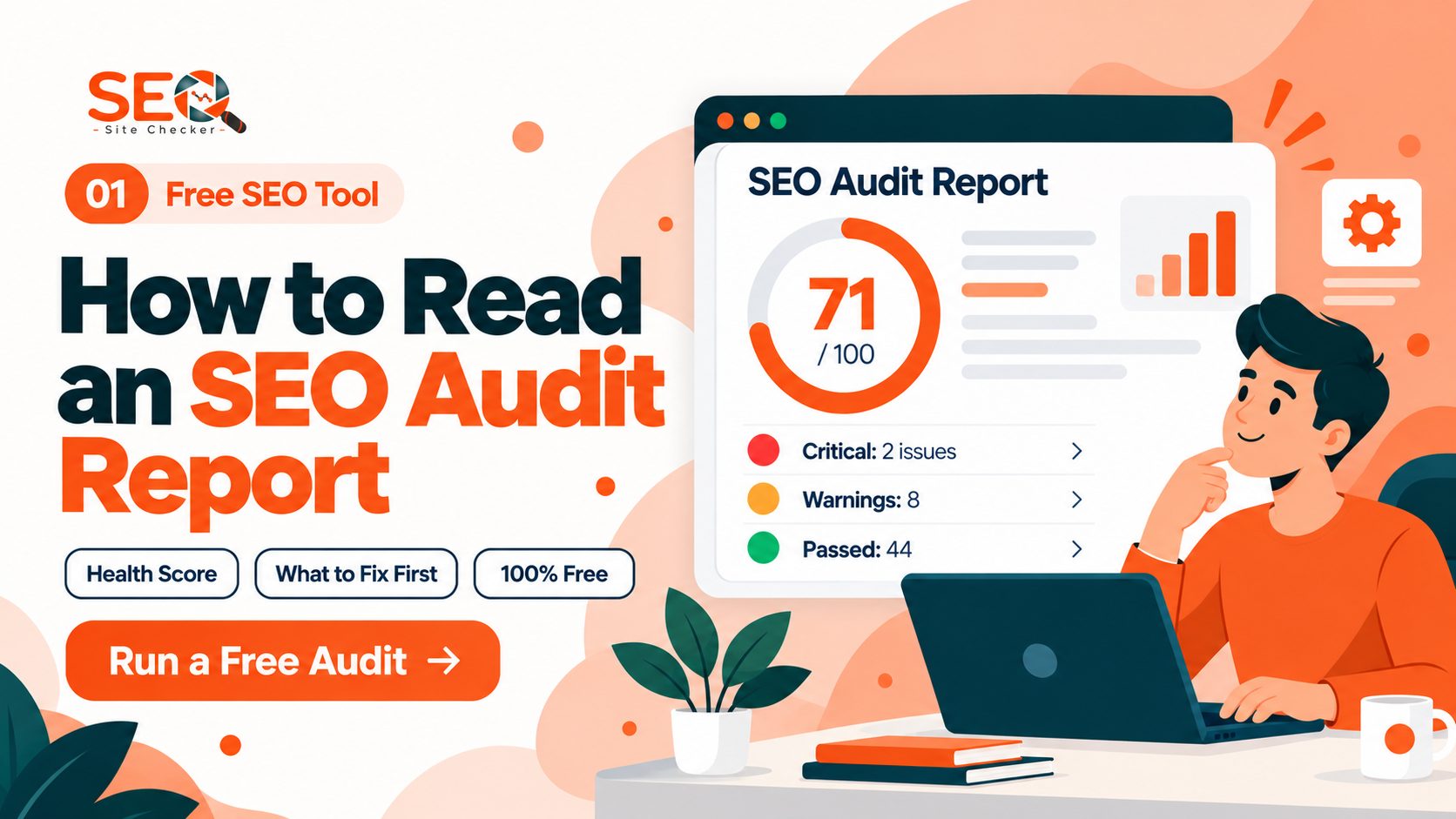
Nearly every SEO audit report opens with an overall score or grade, usually on a 0 to 100 scale or an A to F grade. It is a quick indicator of your site's SEO health, based on the number and severity of issues found. As a rough guide:
- 80 to 100 (A): your site follows SEO standards well. Focus on refinements.
- 60 to 79 (B or C): real room for improvement. Work through the issues identified.
- Below 60 (D or F): significant problems need attention. Prioritize the critical fixes.
Here is the part many reports do not tell you plainly: the score is a summary, not a ranking guarantee. A high score does not mean you will rank at the top, and a low score does not mean you cannot rank at all. Plenty of pages with average scores outrank polished ones because they better match what searchers want. Treat the score as a useful health signal and a way to track progress over time, not as a verdict. Our free SEO score checker shows this score computed from real on-page checks, with the specific issues behind it, rather than a number with no explanation.
Errors, Warnings, and Notices: How to Read Severity
Most reports group findings into severity levels, and understanding them is the single most useful reading skill. The labels vary, but the tiers are consistent.
Errors, or critical issues, are the ones that actively hurt you: a page blocked by robots.txt, an accidental noindex tag on an important page, a broken canonical pointing somewhere wrong, or broken internal links. These can stop pages from being indexed or ranked, so they come first.
Warnings are real problems that are less urgent: missing meta descriptions, title tags that are too long, duplicate tags, or images without alt text. Many of these are quick wins, small fixes that add up.
Notices are minor or informational. They are worth knowing but should never distract you from the critical issues above them.
The key judgment: a report that lists everything at the same severity, with no sense of what matters more, is a low-quality report. Severity tiering is exactly how you know where to start.
The Technical SEO Section: What to Look For
The technical section answers one question: can search engines and AI crawlers find, crawl, render, and index your pages. If they cannot, nothing else in the report matters.
Start with crawlability and indexation. Look at how many pages are indexed versus excluded, any crawl errors, and pages marked "crawled, currently not indexed," which usually signals a content quality issue. Check that your robots.txt and XML sitemap are correct, since a mistake here can hide your whole site.
Next, site speed and Core Web Vitals. Reports label pages Good, Needs Improvement, or Poor. A failing score here is concrete: it might mean your homepage takes 4.2 seconds to show its main content on mobile, nearly double the recommended threshold. For the full picture, cross-check with Google's page experience guidance. Then review mobile-friendliness, HTTPS, and structured data, confirming your schema validates without errors.
In a 2026 report, this section should also show whether AI crawlers (GPTBot, ClaudeBot, PerplexityBot, Google-Extended) can access your pages, since that affects whether you get cited in AI answers. Throughout, apply one test to every finding: does it name the where and the so what. "Thin content" alone is useless. "Your /services page has 187 words, below the roughly 500 needed to rank" is useful. For a deeper walk through the technical side, see our technical SEO checklist.
The On-Page SEO Section: Reading Content Findings
The on-page section covers everything Google sees when it reads an individual page: titles, meta descriptions, headings, content, and internal links.
Title tags are among the highest-value findings, because they are important and fast to fix. Missing or duplicate titles are real problems, and titles over about 60 characters get truncated in results. Meta descriptions do not directly affect rankings, but a good one improves click-through, and they truncate past roughly 155 characters. You can check any page's tags with our meta tag analyzer.
The report may also flag heading structure problems, such as an H2 appearing before the H1, skipped heading levels, or multiple H1s on one page. Watch for thin content (pages under about 300 words) and keyword stuffing, where keywords are forced in unnaturally. Finally, check the internal linking notes, including anchor text: links should describe the destination page, not read as "click here" or "read more." These are usually straightforward fixes that improve how clearly search engines understand each page.
The Off-Page and Authority Section
The off-page section looks outside your site, at the links pointing to it and the authority they carry. A report typically shows your backlink profile: the number of referring domains, the authority of the sites linking to you, and any toxic or spammy backlinks flagged for review.
You will often see Domain Authority and Page Authority scores here. It is worth knowing these are metrics created by Moz, not Google, and Google does not use a Domain Authority score to rank pages. They are useful as a comparative estimate, for sizing up a competitor or tracking your own trend, not as an official ranking factor. You can check any site's score with our Domain Authority checker. A toxic backlink is a link from a spammy or manipulative site that could put you at risk of a penalty, which is why audits flag them for you to review and, if needed, disavow.
Signal vs Noise: How to Spot a Padded Report
Not every SEO audit report is honest with you, and learning to spot filler is what separates a report you can act on from one that just looks impressive. Here are the red flags.
Findings with no specific page named. A statement like "optimization opportunities across multiple categories" or "significant technical debt affecting crawlability" sounds serious but tells you nothing. If a finding cannot be tied to a specific page and a specific action, it is filler.
Everything listed at equal severity. A report that dumps every issue into one long list, with no sense of what matters most, is often a raw tool export dressed up as analysis. Good audits tier findings by real impact.
A missing outcomes angle, or vanity metrics. A report that celebrates raw traffic numbers without tying them to leads, calls, or sales is dodging the question that actually counts.
An auditor who cannot explain a finding in plain English. Anyone worth working with can tell you what a canonical tag is or why a Core Web Vitals failure matters, in language a non-technical owner understands. The test for every finding is simple: does it tell you which page, and why it matters to your business.
What to Fix First: Turning the Report Into an Action Plan
Reading the report is only useful if it becomes a plan. The rule is to prioritize by impact versus effort, not by the order the report happens to list things.
First, fix anything blocking indexing. Broken robots.txt rules, accidental noindex tags, broken canonicals, these make pages invisible, and an invisible page cannot rank no matter how good it is. These criticals come before everything else.
Second, grab the quick wins. Missing meta descriptions, broken links, duplicate or overlong titles, these take minutes each and often deliver fast, visible results. Third, schedule the bigger projects, the content rewrites and technical work that need real time.
Extract every issue into a single prioritized list, tag each as critical, quick win, or project, and work down it in that order. Then set your re-audit date four to six weeks out to measure what changed. The fastest way to start is to generate a free SEO report, read it with this guide in hand, and begin with the critical issues at the top.
Frequently Asked Questions
Frequently Asked Questions (FAQs) is a list of common questions and answers provided to quickly address common concerns or inquiries.
How do I read an SEO audit report?
Start with the executive summary for the top findings, then read the overall health score, then work through issues by severity: criticals first, warnings next, notices last. Open Google Search Console alongside it to sanity-check the claims, and turn the findings into a prioritized action list.
What is the most important section of an SEO audit report?
The executive summary and the critical issue tier. The summary orients you to the biggest problems and opportunities, and the critical issues, anything blocking crawling or indexing, are what to fix first, because no other improvement matters if your pages cannot be indexed.
What does an SEO audit report include?
A complete report includes an executive summary with an overall score, a technical SEO section (crawlability, indexing, site speed, mobile, schema), an on-page section (titles, meta descriptions, headings, content), an off-page and authority section (backlinks, domain authority), and a prioritized list of recommendations.
How do you interpret SEO audit results?
Read each finding for two things: the specific page it affects and why it matters. Group issues by severity, fix indexing-blockers first, then quick wins like missing meta descriptions and broken links, then larger content and technical projects. Ignore vague findings that name no page.
Do I need technical knowledge to understand an SEO audit?
No. A good report explains findings in plain language and names the specific page and business impact for each one. If a report or auditor cannot explain a finding simply, that is a sign of a low-quality report, not a gap in your knowledge.
How do I know if my SEO audit report is good quality?
A quality report prioritizes findings by real ranking impact, names specific pages, and explains why each issue matters. Low-quality reports list everything at equal severity, use generic recommendations, or read like a raw tool export with no interpretation or action plan.
What should I do first after receiving an SEO audit?
Fix anything that blocks indexing: broken robots.txt, accidental noindex tags, or broken canonicals, because invisible pages cannot rank. Then collect the quick wins, missing meta descriptions, broken links, and title fixes. Schedule the larger projects and set a re-audit date four to six weeks out.