
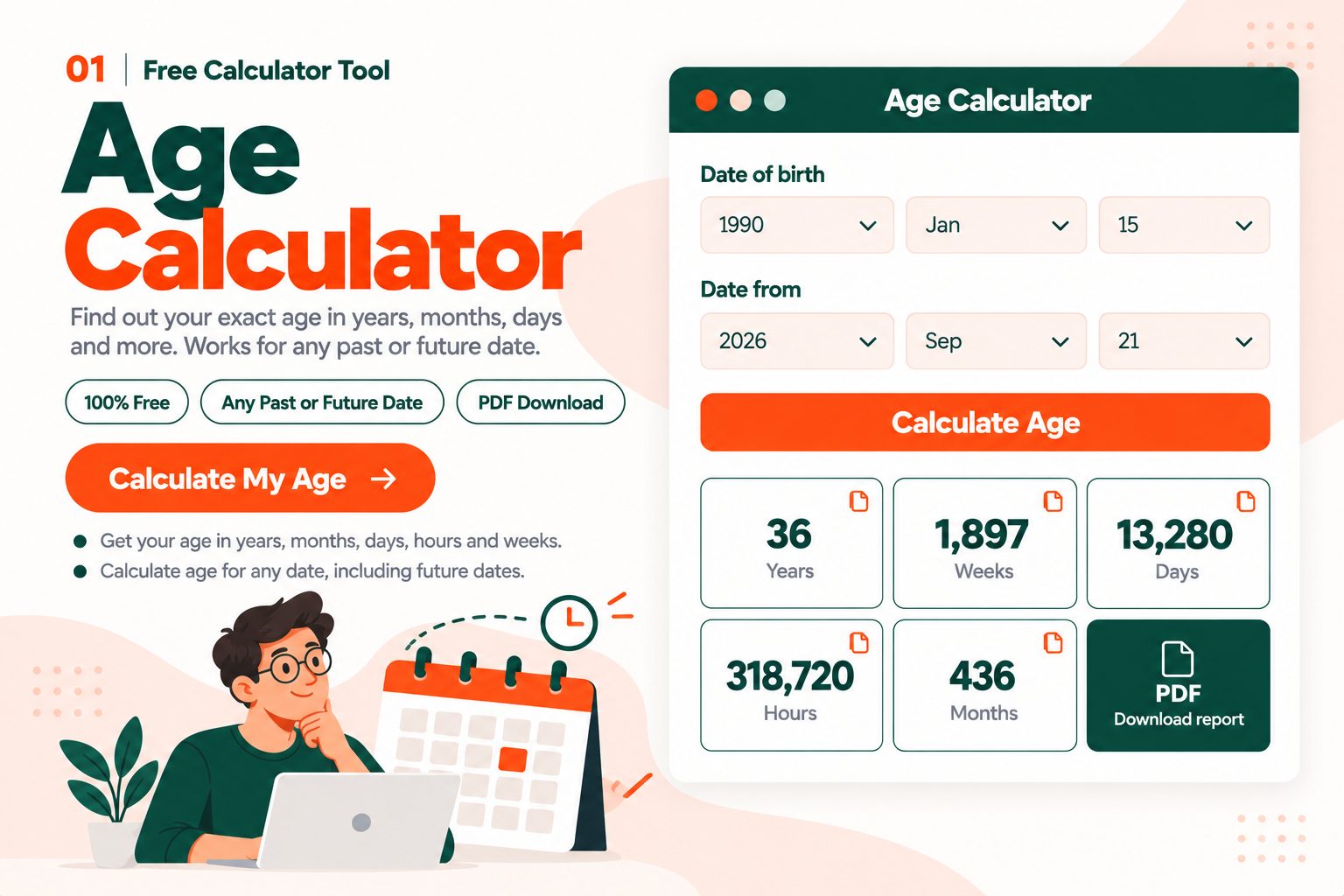
Enter your date of birth and this free age calculator gives you your exact age in seven units at once: years, months, weeks, days, hours, minutes and seconds. Every result has a copy button, and you can download the whole thing as a PDF if you need it for a form or a record. There is no sign-up and no limit on how often you use it.
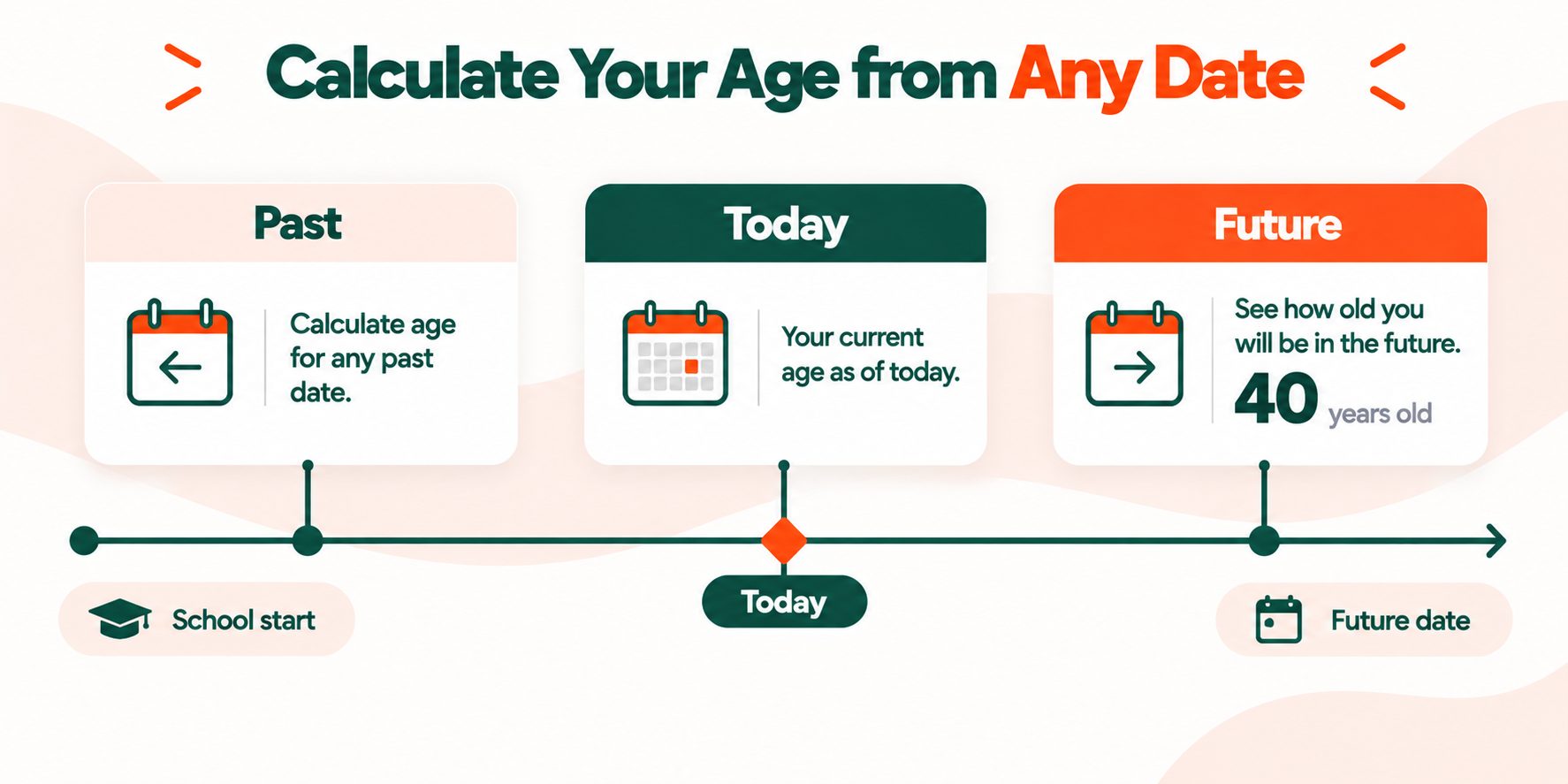
The calculator also has a "Date From" field, which defaults to today but accepts any date you like. That means it answers how old you were on a particular day in the past, and how old you will be on a date in the future.
One thing worth knowing before you start: the age a calculator gives you is not always the age a form expects. An insurer, a government office and a school can each want a different number for the same person on the same day, and the section on official age explains when and why.
How to Calculate Age Online: Free Age Calculator
Step 1. Enter your date of birth. Use the year, month and day dropdowns. Because you pick each part separately, there is no date format to get wrong, which matters more than people expect. Written as 03/04/2020, a date means 3 April to a British reader and 4 March to an American one.
Step 2. Set the "Date From" field. It defaults to today, so leave it alone if you want your age right now. Change it to any past or future date to measure your age at that moment instead.
Step 3. Click Calculate Age.
Step 4. Read your seven results. You get years, months, weeks, days, hours, minutes and seconds, each with a copy button so you can paste the figure straight into a form or a document.
Step 5. Download the PDF if you need a record rather than a number. This is handy for school enrolment paperwork, visa or benefit applications, or anything where you want the calculation written down.
Example: someone born on 14 May 1990, measured on 22 September 2026, is 36 years, 4 months and 8 days old. That is 13,280 days, or 1,897 weeks, or 318,720 hours.
Open the Age Calculator at the top of this page whenever you need it. It runs in the browser, so it works the same on a phone as it does on a desktop.
How Age Calculation Actually Works
Age is not a division problem, which is why dividing your days lived by 365 gives an answer that is close but wrong.
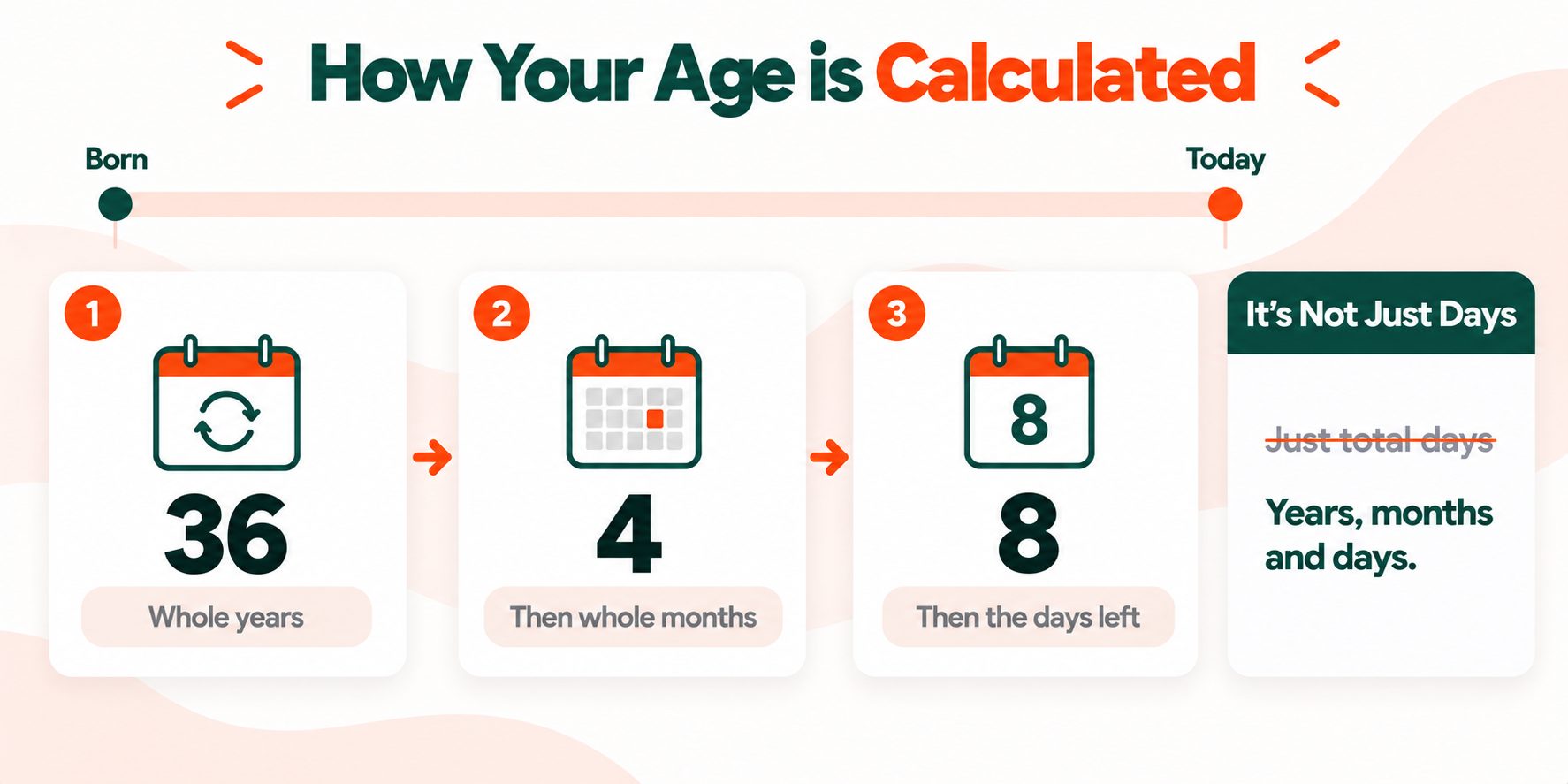
The correct method counts calendar dates in three steps. First, count the whole years from your birth date to the target date. Then count the whole months from that anniversary. Then count the days left over. That is how you arrive at "36 years, 4 months and 8 days" rather than a decimal.
Leap years need no special handling. Because the method works on real calendar dates, the extra days are already in the total. Someone born on 14 May 1990 has lived through nine leap days by 22 September 2026, and every one of them is counted in that 13,280 day figure without any adjustment.
Month-end dates are genuinely ambiguous, though. Take 28 February 2022 to 31 March 2022, which is exactly 31 days. You could call that one month and three days, counting 28 February to 28 March as the month and adding the rest. You could also call it one month, since it runs from the end of one month to the end of the next. Both readings are defensible, and different calculators give different answers. If a result near a month boundary looks off by a day or two, this is usually why.
One last note: the seconds figure is calculated at the moment you press the button, so it is a snapshot rather than a live counter.
Your Age on Any Date, Past or Future
The "Date From" field is what separates a useful age calculator from a basic one, because plenty of questions are not about today.
How old was I when that happened? Set Date From to the date of the event. Forms and applications often ask for your age at the time of something rather than your age now, and guessing is an easy way to get a date wrong by a year.
How old will I be in 2050? Set Date From to a future date. Someone born on 2 March 2005 will be 44 years, 9 months and 30 days old on 1 January 2050. Most calculators cannot answer this at all.
How old is someone else? Enter their date of birth instead of yours. This comes up constantly with family records, and with school and sports eligibility.
That last case is worth spelling out. School enrolment and youth sports almost always work from a cutoff date, so what matters is a child's age on 1 September or 31 December, not their age today. Setting Date From to the cutoff answers the question directly.
The Age You Give Depends on Who's Asking
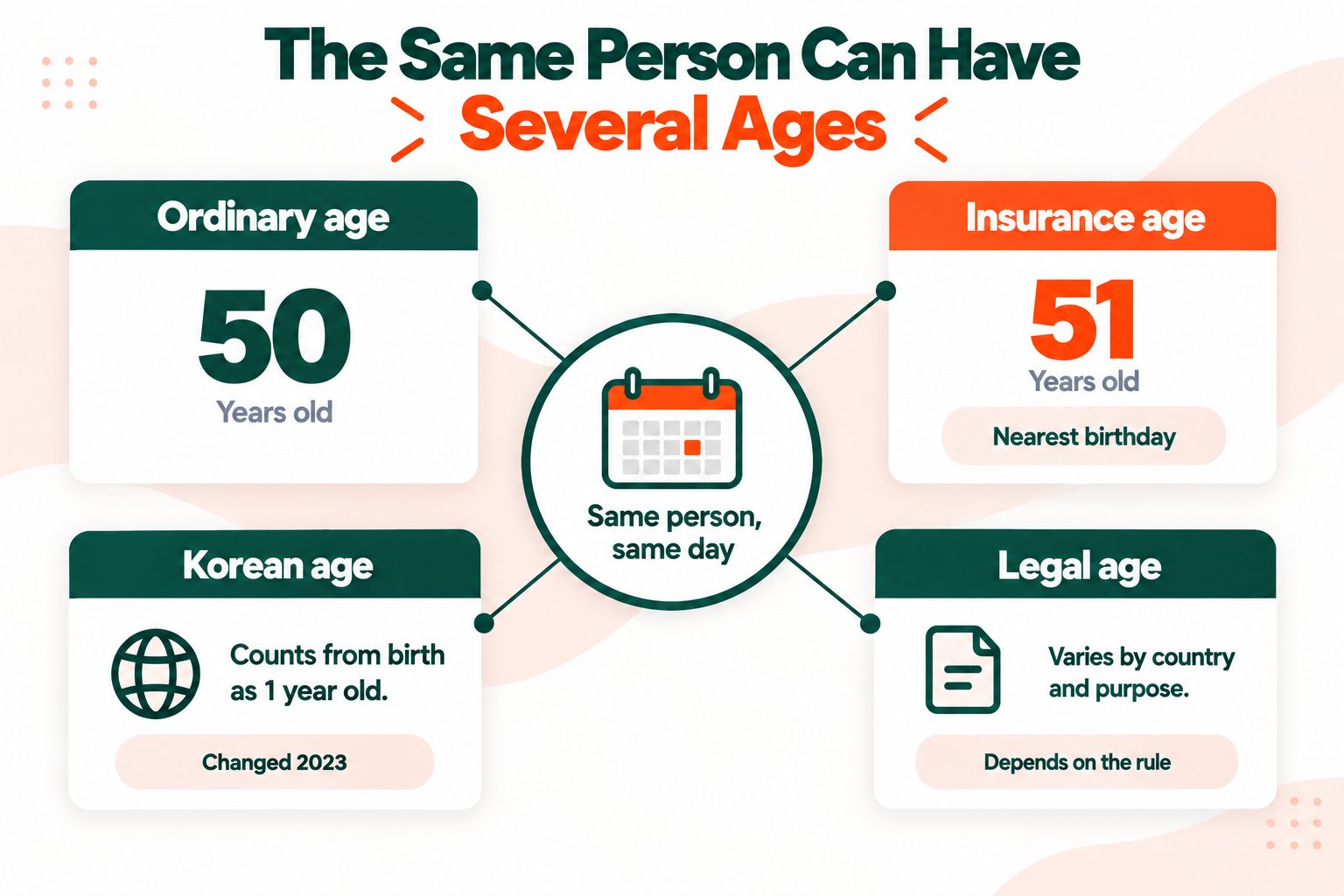
Most calculators treat age as one number. In practice, the same person can have several ages on the same day, depending on who is asking.
Insurance age. Many life insurers rate you at your age nearest birthday rather than the birthday you have actually had. Someone born on 10 November 1975 is 50 years old on 22 September 2026, but their next birthday is only 49 days away, which is closer than their last one. To that insurer they are 51, and the premium reflects it. This is standard practice rather than an error, and it is why a quote sometimes shows an age you do not recognise.
Official and legal age. Some entitlements depend on your year of birth rather than a birthday at all. In the US, full retirement age rises with birth year and reaches 67 for anyone born in 1960 or later, according to the Social Security Administration's retirement age planner. No age calculator can tell you that, because it is a rule rather than a calculation.
Korean age. South Korea used to run three age systems side by side: Korean age, where you are born at one and everyone gains a year at Lunar New Year, international age as used everywhere else, and calendar age, which is simply the current year minus your birth year. The country unified on international age on 28 June 2023, though calendar age still applies in some statutes, including military service. The Library of Congress explains all three systems.
Leap-day birthdays. If you were born on 29 February, your birthday comes round properly only once every four years. Whether you legally turn a year older on 28 February or 1 March in other years depends on the jurisdiction, and calculators do not agree either. If it matters for a legal deadline, check your local rule rather than trusting any tool.
Milestone Ages and Day Counts
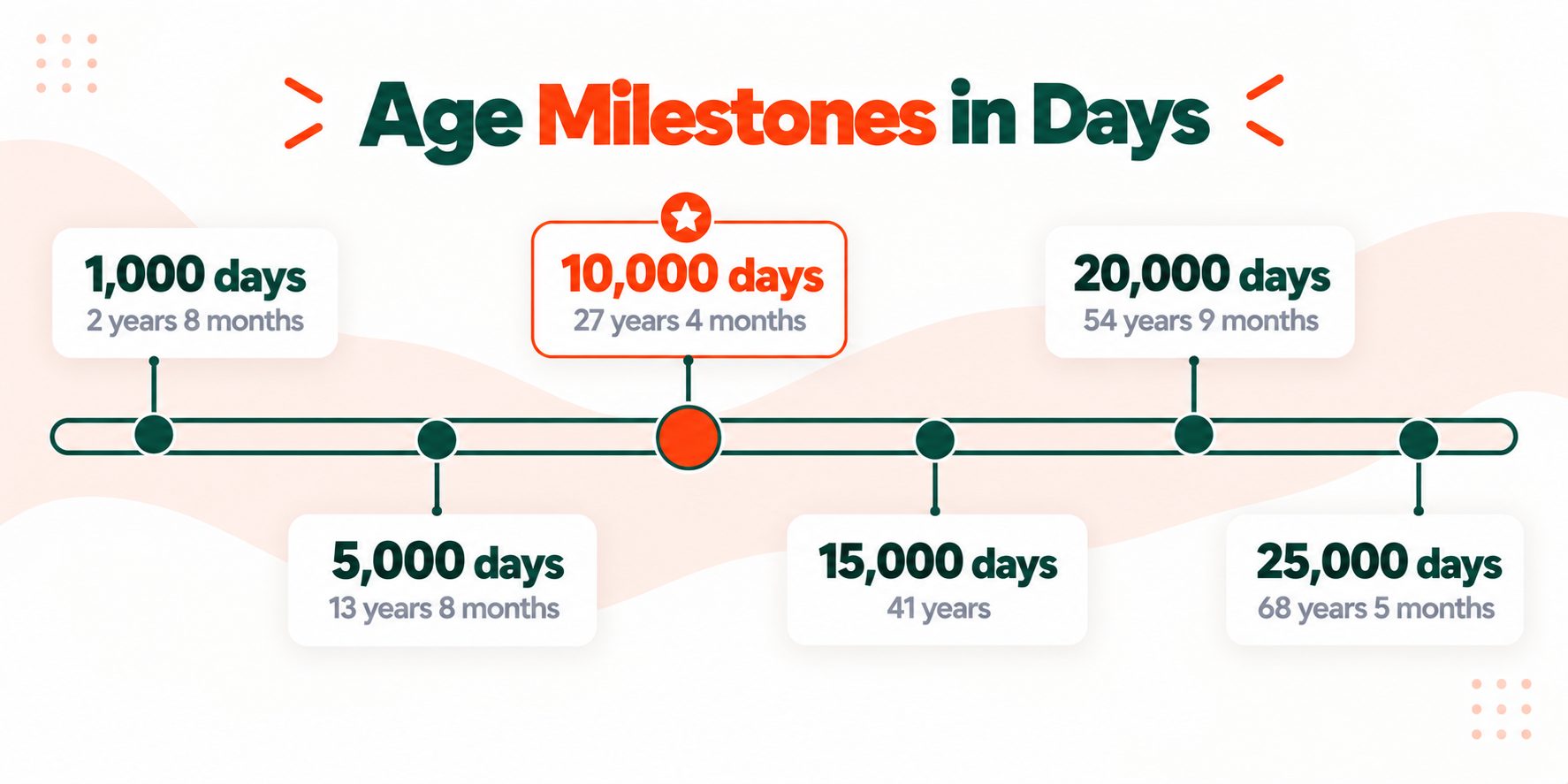
Day-count milestones fall between birthdays, which is part of why people like marking them.
| Milestone | Roughly |
|---|---|
| 1,000 days | 2 years 8 months |
| 5,000 days | 13 years 8 months |
| 10,000 days | 27 years 4 months |
| 15,000 days | 41 years |
| 20,000 days | 54 years 9 months |
| 25,000 days | 68 years 5 months |
These hold steady whatever your birth date, give or take a few days. For a precise example, someone born on 14 May 1990 reached 10,000 days on 29 September 2017, which was 27 years, 4 months and 15 days after they were born.
To find your own milestone date, set the Date From field forward and adjust it until the days figure lands on the number you want.
Calculating Age in Excel and Google Sheets
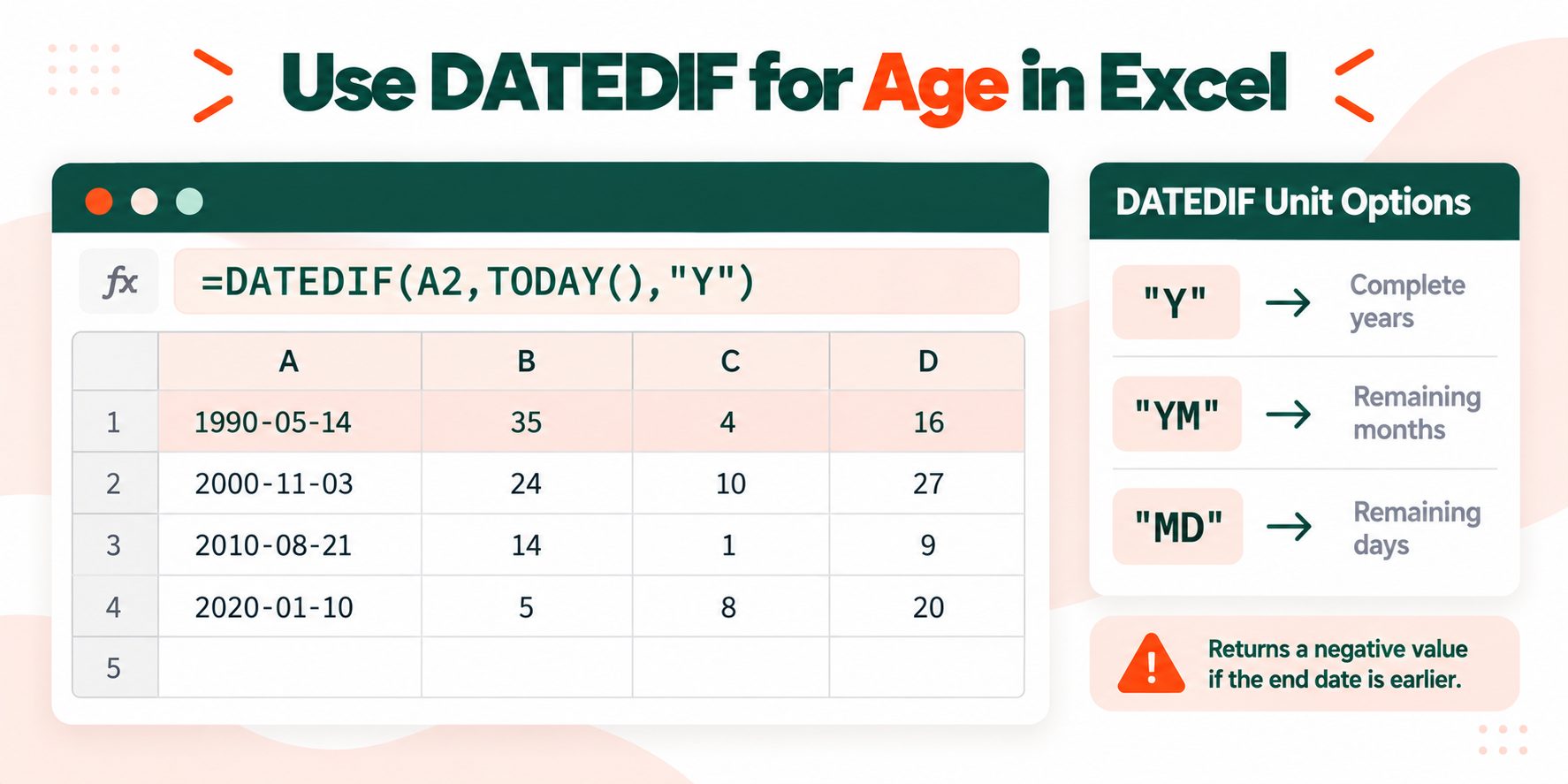
If you need ages for a whole list of people rather than one person, a spreadsheet handles it in one column. With a date of birth in cell A2:
Whole years:    =DATEDIF(A2,TODAY(),"Y")
Extra months:   =DATEDIF(A2,TODAY(),"YM")
Extra days:     =DATEDIF(A2,TODAY(),"MD")
Total days:     =TODAY()-A2
Two things catch people out here. DATEDIF is a hidden function, so it does not appear in Excel's autocomplete suggestions, but it works perfectly well when you type it out in full. And the "YM" and "MD" units are the ones that give you the remaining months and days, which is what turns a bare year count into "36 years, 4 months and 8 days".
The same formulas work unchanged in Google Sheets. Microsoft's DATEDIF documentation has the full list of unit arguments, and it notes that the function "is useful in formulas where you need to calculate an age".
Quick Reference
| I want to know | Do this |
|---|---|
| My age right now | Enter date of birth, leave Date From as today |
| My age on a past date | Set Date From to that date |
| My age in the future | Set Date From forward |
| A child's age at a school cutoff | Set Date From to the cutoff date |
| When I reach a day milestone | Move Date From until the days figure matches |
| A record for a form | Download the PDF |
Frequently Asked Questions
Frequently Asked Questions (FAQs) is a list of common questions and answers provided to quickly address common concerns or inquiries.
How do I calculate my age online?
Enter your date of birth and the date you want to measure to. The calculator returns your exact age in years, months, weeks, days, hours, minutes and seconds.
How old am I if I was born in 2005?
It depends on the month and day. Someone born on 2 March 2005 was 21 years, 6 months and 20 days old on 22 September 2026. Enter your own date for an exact figure.
How many days have I lived?
Enter your date of birth and read the days figure. Someone born on 14 May 1990 had lived 13,280 days by 22 September 2026.
What age is 10,000 days?
About 27 years and 4 months. It falls between birthdays, which is part of why people like to mark it.
How do leap years affect my age?
They do not complicate it. The calculation counts real calendar dates, so leap days are already included in both the day total and the year figure.
Can I calculate my age in the future?
Yes. Set the "Date From" field to a future date and the calculator tells you how old you will be on that day.
How do I calculate my age on a past date?
Set "Date From" to that date. The result is your age exactly as it was on that day, which is what forms mean when they ask your age at the time of an event.
When do people born on 29 February have a birthday?
On the date itself every four years. In other years, whether they age on 28 February or 1 March depends on local rules, so check your jurisdiction if it affects a legal date.
Why does my insurance quote show a different age?
Many life insurers use age nearest birthday. Within six months of your next birthday, they count you as a year older than you currently are, and price the policy accordingly.
How do I calculate age in Excel?
Use =DATEDIF(A2,TODAY(),"Y") for whole years, then "YM" and "MD" in place of "Y" for the remaining months and days.