Page Authority vs Domain Authority: What Each Score Means and What Google Uses
 Kendall Chris
Updated

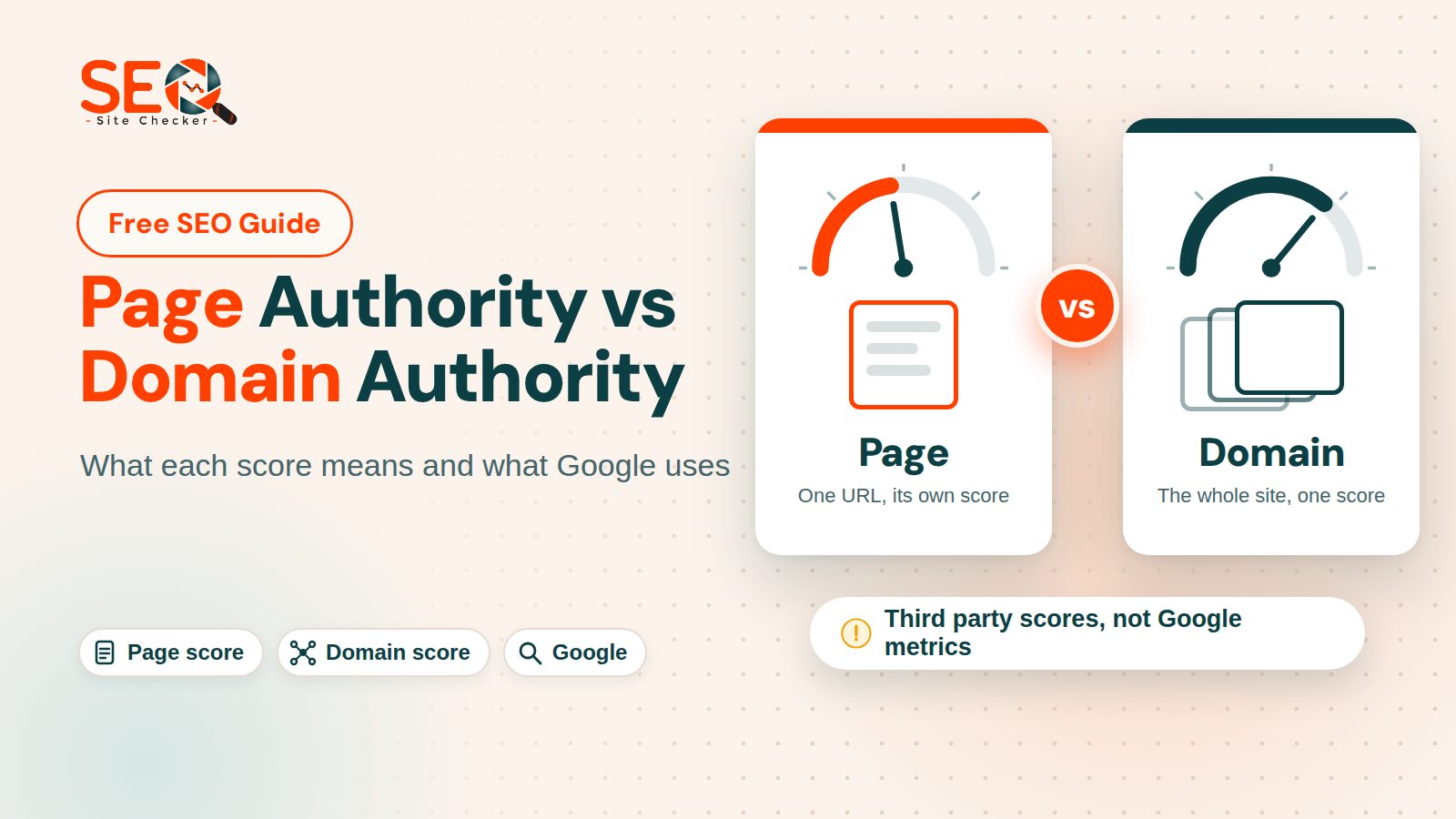
Page Authority vs Domain Authority: The Short Answer
Quick answer: Page Authority vs Domain Authority is a question of scope. Page Authority (PA) scores one URL and Domain Authority (DA) scores a whole domain, both on a 1 to 100 scale. Moz, an SEO software company, created both scores, and Google did not. Use them to compare like with like, and do not read either one as a Google input.
A small business owner, a blogger, a marketer or a freelancer will meet these scores in some report sooner or later. Below: how each is built, what Google's documentation says it works from, which score suits which job, and what free data to check first.
| Compared on | Page Authority | Domain Authority |
|---|---|---|
| What it scores | One URL | A whole domain or subdomain |
| Closest free Google data | Search Console Links report, Top linked pages | Search Console Links report, Top linking sites |
| Good for | Choosing which page to improve or earn a link to | Comparing your site with competitors |
| Easy to misread as | A promise that this page will rank | Google's opinion of your whole site |
| Same tool or not | Compare only scores from one tool | Compare only scores from one tool |
Read the table as a map, not a verdict. Both numbers estimate link strength inside one vendor's index, and neither says anything about content quality, search intent or traffic. Before acting on a score, check the link data Google shows you in Google Search Console, covered in a later section.
What Page Authority and Domain Authority Measure
What is Domain Authority, and what is Page Authority? Domain authority vs page authority sounds like a contest, but it is closer to a zoom level: the same kind of score at two scopes. New to links and rankings? Start with what SEO is and come back. Each score is defined below in its creator's own terms.
Domain Authority (DA)
Domain Authority is a predictive score: its creator presents it as an estimate of how well a whole website will do in search results against competing sites, from 1 to 100. It covers "an entire domain or subdomain", so a subdomain can be scored on its own. DA is a relative metric: it compares your site with other sites, so no single score counts as good or average everywhere. Its creator says a brand-new website always starts at 1.
Page Authority (PA)
Page Authority applies the same 1 to 100 idea to a single URL, which makes it a URL-level score. Its creator says it is calculated the way DA is, only at the individual page level, and that the two are "more alike than they are different". They are not independent, though: the Page Authority guide lists the authority of the host domain as a significant factor in a page's score.
Page Authority sits on a logarithmic scale, so each point near the top is much harder to earn than a point near the bottom. The creator's own example is that growing from 20 to 30 is significantly easier than growing from 70 to 80.
The difference between Domain Authority and Page Authority is scope, not method. Whether either number is a Google input is a separate question, and Google's own pages are the place to look.
How the Scores Are Calculated and Why They Move
The creator describes Domain Authority as the output of a machine learning model that leans mainly on link data: how many linking root domains point at a site, and the link quality behind them. A linking root domain is one unique domain that links to you, however many links it sends. Page Authority weighs more than 40 factors by the creator's count, among them linking URLs, followed links, nofollowed links, anchor text distribution and a spam score. It calls PA "link-centric", but no weights are published, so treat any formula you see online as a guess.
Score fluctuation is normal, even when your own site stays exactly as it was. The creator lists these causes:
- A link index update. The creator's web index found more or fewer linking domains than before.
- Your own links. You gained or lost an inbound link, sometimes unnoticed.
- Other sites moving. Scores are relative, so when other sites shift, yours shifts against them. The creator's example is a very large site gaining a billion links.
- Links that carry little weight. The creator also names links earned from sources that add little to search rankings.
- A model update. The creator names its 2019 rollout of Domain Authority 2.0 and says it constantly updates the Page Authority algorithm.
As an illustration only, not a measurement: if a score drops two points the week after a competitor lands a big link, check that list before you touch your site. Two tools also give different numbers for the same site, because each vendor builds its own web index and formula, so compare scores from one tool only.
No schedule: the creator's two guides publish no update schedule, so treat any claim about how often scores refresh as unsourced.
Does Google Use Page Authority or Domain Authority?
What Google's documentation says
According to Google's guide to its ranking systems, its systems are "designed to work on the page level", using many signals to understand how to rank individual pages. Site-wide signals and classifiers feed in too, but the guide cautions that some good site-wide signals do not mean all content from a site will rank highly, and some poor ones do not mean it all ranks poorly.
On links, the same guide says Google has systems that understand how pages link to each other, and that PageRank "continues to be part of our core ranking systems". The SEO Starter Guide keeps that in proportion: PageRank uses links and is one of the fundamental algorithms at Google, but there is much more to Search than links.
Our reading: PageRank is Google's own system. Page Authority and Domain Authority are separate scores made by a third party, so neither is a Google number.
We also read eight Google pages on October 31, 2026, covering ranking systems, spam policies, the Links report, disavowing, how Search works and the SEO Starter Guide. The terms Domain Authority and Page Authority appear on none of them. So the careful statement is that Google's documentation does not list either score among its ranking systems. That is narrower than saying the scores have no effect, and we are not claiming that.
What the score's creator says about its own score
Moz, the company behind both scores, is blunt about them in its own guides. The Domain Authority guide calls DA "not a Google ranking factor" with no effect on the results pages, and its list of misconceptions says DA is "not used by Google" to rank sites. The Page Authority guide asks whether PA counts as a ranking factor and answers no: it is not an acknowledged one.
The same guide explains why scores and results line up anyway: it says many link-based factors behind PA have long been considered among the factors that most affect rankings. Links matter to Google, but a score that estimates link strength is not a Google input.
Our reading: Google reasons about pages first and adds some site-wide signals, so a page score plus a site score is a sensible mental model. But each number is one vendor's estimate, and a good one does not make a page rank. More claims checked against Google's own pages are in SEO myths checked against Google.
Which Score Should You Use, and for What Job?
Page authority vs domain authority is a decision question as much as a definition question. Whether a report writes PA vs DA or DA vs PA, ask what choice the number supports, and check it against free first-party data.
Comparing your site with competitors
For competitor benchmarking, use a domain-level score from one tool for every site in the comparison, and note the tool and the day. It is a rough benchmark of link strength, not of content, intent match or traffic. Before the number goes into reporting, ask what decision it supports, and drop it if the answer is none.
Choosing which of your pages needs attention
A page-level score points at a weakly linked page, and Google shows you the same thing for free. In Search Console, open the Links report, then External links, then Top linked pages to prioritize pages by the links other sites give them. Internal links, then Top linked pages, shows the pages your own site links to most. Few links is not automatically a problem, because Google says good site-wide signals do not mean every page will rank well. Check what the page is meant to do first.
Judging a site that might link to you
For link prospecting, a score is a quick screen of a site you would like a link from, and link vetting needs more than that. Google's link spam policy lists buying or selling links for ranking purposes, including exchanging money for links, so a high score does not make a bought link acceptable. The exception is advertising: such links are fine when labeled with a nofollow or sponsored rel value, which makes them ads, not a way to raise authority. Our guide to nofollow and sponsored links covers the values.
Deciding where to add internal links
The creator's Page Authority guide lists page structure, including header tags and internal links, among the factors that can influence a page's score. Google's SEO Starter Guide says the "vast majority" of the new pages Google finds every day are found through links. An internal link is the one lever fully in your hands, because you pick the target and the link text. The last section covers the how-to.
What Is a Good Score? Compare Like With Like
In the page authority vs domain authority debate, nobody can hand you a good number: there is no universal good Domain Authority score and no universal good Page Authority score. The creator calls both relative metrics, so treat each as a comparative metric and compare yours with the sites that already rank for your phrase. Fixed score bands have no source, so this page offers none. A five-minute search results comparison works instead.
- Search your target phrase. Use Google and the exact phrase you want to rank for.
- Note five domains. Write down the first five different domains in the results.
- Look each one up. Use the same tool for all of them, on the same day, yours included.
- Tabulate it. Put each domain and its score in a small table.
- Read the gap. A wide gap is a long-term link project. A narrow gap points at the page itself and how well it matches the search.
A score does not explain why a page ranks. A page can rank for reasons a link score cannot see, such as how well it answers the search.
To show the scale, we ran our own Domain Authority Checker on October 31, 2026. It returned a Common Crawl link-graph rank score from the August to October 2026 release, and its note says the figure is not a Domain Authority or Page Authority score, so none of the numbers below is DA or PA. The rank score is a log-scaled version of a domain's position in Common Crawl's harmonic centrality ranking: position 1 would score 100 and the last domain 0.
| Domain | Rank score | Global rank |
|---|---|---|
| wikipedia.org | 86 out of 100 | 15 |
| example.com | 78 out of 100 | 63 |
| seositechecker.pro | 11 out of 100 | 17,118,138 |
Our own site is small and young, and Common Crawl's graph knows only one host for it, so a rank score of 11 is no verdict on its quality. The source and figures can change whenever the checker's data does.
What You Can Check for Free Instead of a Third-Party Score
Google shares real link data for the sites you own, and we offer two free tools that add a domain look-up and a page audit. Start with Google's data.
- Open the Links report. In Search Console, choose Links. Google's help page for the Search Console Links report describes every table. You need access to your own site's property, so it works for your sites, not a competitor's.
- Read External links. Top linked pages shows which of your pages have the most links from other sites. Top linking sites lists the root domains that link to you most, a partial view of your referring domains. Top linking text shows the anchor text people use.
- Export a copy. Export a CSV file or a Google Sheet. A single table exports up to 1,000 rows, and the landing-page export holds up to 100,000 rows of sample links (Latest links and More sample links).
Know what the report leaves out. Tables stop at 1,000 rows, the report is a sample and not a comprehensive list of every link, and sites are grouped by root domain. It includes links found over time that may since have been removed, and it does not say whether a link is nofollow.
Our free Domain Authority Checker looks up a domain, not a page. Paste a full address and it reduces it to the domain, so blog.example.co.uk/post becomes example.co.uk. Guests check one domain per submission, and signed-in users can check up to five. Our step-by-step guide to checking domain authority shows how to read each kind of result.
The note beside each result names its source, so read it first. With the score vendor's data, the result shows DA, the PA of that domain's home page, a spam score and a count of linking domains. While that access is paused, it shows a free Common Crawl link-graph rank out of 100 with a global rank, labeled as not DA or PA. Either way, the checker never lists who links to you.
For the page you want to lift, run the free SEO Site Checker report. It audits one page address with 60+ checks, from titles, descriptions, headings and structured data to HTTPS and server settings. Its In-page Links check tests the first 30 testable links on the page for broken targets (mailto, tel and in-page anchor links are skipped). It has no backlink check and no authority score, so it shows how the page is built, not who links to it.
How to Raise Both Without Chasing a Number
The dependable way to earn links is to publish something other sites would cite for their own readers, such as original data, a clear explainer or a free tool, and to tell people who already know your work. Don't pay for links, and don't ask for exact anchor text. Our link building tips post lists ways to do it, and our off-page SEO guide covers the rules around it.
Internal links are the part you fully control. Link from your strongest pages to the ones you want to lift, and use descriptive link text that says what the target page is about. Google's SEO Starter Guide covers writing good link text, and our internal links guide shows how to find the broken ones.
Several SEO articles call some links toxic, but none of the Google pages we read uses that word. According to Google's Disavow links help page, Google can usually assess which links to trust without additional guidance, so most sites will not need the tool.
The page calls the Disavow links tool an advanced feature to be used with caution, and warns that using it incorrectly can potentially harm your site's performance in Google Search results. Google first recommends removing spammy or low-quality links from the web where you can. It says to consider disavowing only when a considerable number of your links are spammy, artificial or low quality, and they have already triggered a manual action for unnatural links or probably will. A spam score from any tool is not that condition.
Three mistakes still cost people time:
- Treating a score as a vanity metric instead of watching organic traffic and conversions.
- Reading a one-point change in a score as news.
- Buying links to lift a score, which runs into the link spam policy covered above.
Rule of thumb: if a tactic only makes sense because it moves a score, skip it. If it would still make sense with the score hidden, keep it.
Once links are handled, the wider plan lives in our seven-step SEO plan.
Frequently Asked Questions
Frequently Asked Questions (FAQs) is a list of common questions and answers provided to quickly address common concerns or inquiries.
Is Domain Authority a Google ranking factor?
No. Moz, which created the score, says DA is not a Google ranking factor and that Page Authority is not an acknowledged one either. Google's ranking systems guide lists page-level systems, some site-wide signals and PageRank, and does not name either score. Links still matter to Google, so scores and rankings tend to line up.
Which is more important, page authority or domain authority?
Neither, because neither is a Google input. Use a domain score to compare the sites you compete with and a page score to choose which page needs links or a refresh. Google says its systems work at the page level with some site-wide signals, so a strong site does not ensure a strong page.
What is a good Domain Authority or Page Authority score?
There is no universal good score. Its creator calls both relative metrics, so the useful comparison is with the sites that already rank for your phrase. New sites start at 1 and rise as they earn links. Skip fixed bands, which have no source, and use the five-step comparison in the section on good scores.
Does Domain Authority affect Page Authority?
Yes, by the creator's own account. Its Page Authority guide lists the authority of the domain a page is hosted on as a significant factor in the page's score, next to the links pointing at the page itself. So the two scores are linked, and a page on a well-linked domain gets help from it.
Why did my Domain Authority drop when I changed nothing?
Moz lists several causes: its link index found fewer linking domains, you lost links, other sites' scores moved the relative scale, or the model was updated, as with Domain Authority 2.0 in 2019. Check those before changing your site, and compare against competitors in the same tool. Its guides give no update schedule.
How can I check page authority and domain authority for free?
There are two free routes. The Search Console Links report shows your own top linked pages and top linking sites as a sample, with tables of up to 1,000 rows and a landing-page export of up to 100,000. Our Domain Authority Checker looks up a domain, not a page, and names its source beside each result.
Is Domain Authority the same as the scores other SEO tools publish?
No. Other SEO tools publish domain-level scores under their own names, each built from its own link index and formula, so the same site gets different numbers and the scores cannot be swapped. Pick one tool, compare sites inside it, and treat every score as an estimate of link strength, not a Google measurement.
Do I need to disavow toxic links to improve my authority score?
Usually not. Google's disavow help says it can usually assess which links to trust, so most sites will not need the tool, and it calls the tool an advanced feature that can harm performance if misused. Consider it only with a considerable number of spammy links and a manual action or a likely one.