What Is Answer Engine Optimization (AEO)? What It Means and What Google Says

What Is Answer Engine Optimization (AEO)?
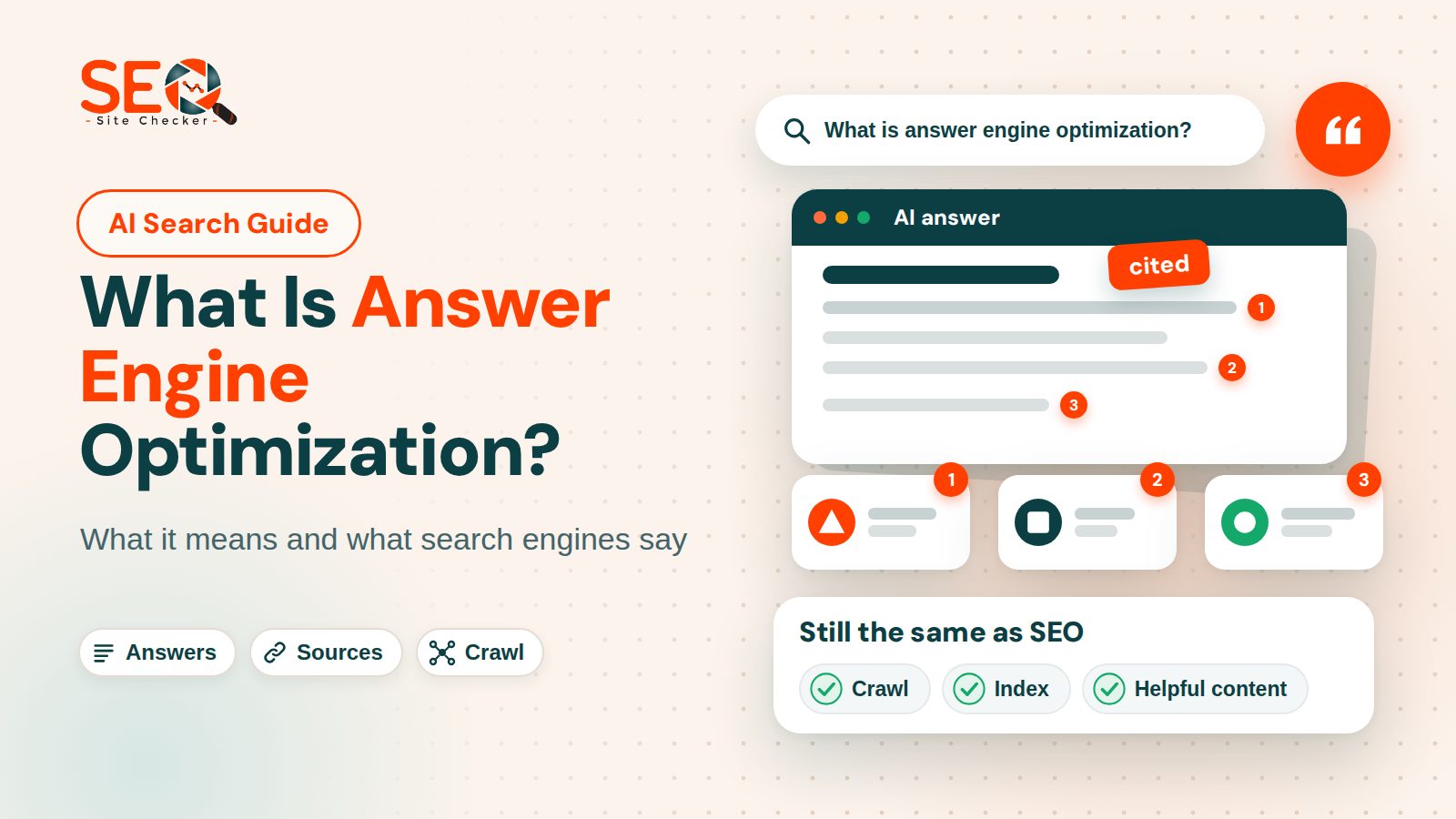
Quick answer: Answer engine optimization (AEO) is the work of making a page easy for an answer engine to find, understand and use as a source when it writes a direct answer. An answer engine gives that answer with sources instead of only a list of links. Google's guide says that, from its Search perspective, optimizing for generative AI search is still SEO.
If you searched for what is AEO, you have probably met two definitions. Some guides use it narrowly, for earning featured snippets, People Also Ask boxes or a spoken reply from voice assistants. Others use it broadly, for appearing in AI-generated answers. This post uses the broad AEO meaning, as Google's guide does: work focused on improving visibility in AI search experiences.
This page separates what Google, OpenAI, Microsoft and Perplexity document from what marketing pages claim, shows what you can measure and says what our free report checks. For practical steps instead of definitions, start with our practical guide to showing up in AI search.
What an Answer Engine Is and Why AEO Has Two Meanings
Perplexity's help center, last modified August 25, 2026, defines an answer engine as a tool designed to give direct, detailed answers, where a traditional search engine makes you sift through a list of links.
Google's AI features page (last updated December 10, 2025) and generative AI guide (last updated July 10, 2026) describe the mechanism in the most detail. AI Overviews and AI Mode show a generated response with links to supporting pages. They rely on retrieval-augmented generation (grounding): the core ranking systems pull pages from the Search index, and the model writes the answer from them. They may also use query fan-out, which Google describes as issuing multiple related searches across subtopics and data sources. For a question about fixing a weedy lawn, the extra searches might cover herbicides, chemical-free removal and prevention.
The other engines publish less. On the pages we read in November 2026, OpenAI says OAI-SearchBot is used to surface websites in ChatGPT's search features, and for Perplexity and PerplexityBot the wording is similar. Microsoft's October 8, 2025 post says Copilot experiences are powered by Bing's search index. None of them publishes a scoring formula.
The definitions disagree because several ranking guides stop at snippets and voice replies, others cover AI-written answers, and some add that ranking is replaced by something else. Google's documentation says its generative AI features are rooted in its core Search ranking and quality systems, so that last claim does not describe Google.
AEO vs GEO vs AI SEO vs LLM SEO: Which Name Means What
The sources do not draw a hard line between these names. Google's generative AI guide lists AEO and GEO together as terms for work on visibility in AI search experiences, and its third-party SEO advice page names "AEO" or "GEO" tools as one category. Microsoft's October 8, 2025 post opens with "Whether you call it GEO, AIO, or SEO" and then says visibility is everything.
| Term | Spells out | Where a primary source uses it | How it is usually used |
|---|---|---|---|
| AEO | Answer engine optimization | Google's generative AI guide, last updated July 10, 2026 | Visibility in direct answers |
| GEO | Generative engine optimization | A research paper (November 16, 2023) and Bing's Webmaster blog (February 10, 2026) | Visibility inside generative engine responses |
| AI SEO | No single spelled-out meaning | Not defined in the primary sources we read | Optimizing for AI search, or doing SEO work with AI tools, so check which |
| LLM SEO and LLMO | Large language model SEO and optimization | Not defined in any primary source we read | Optimizing for large language model answers |
In the research paper that introduced GEO (arXiv 2311.09735, accepted to KDD 2024), the authors built a query benchmark. The abstract reports a visibility gain of up to 40 percent in generative engine responses and says results vary by domain. That is the authors' own benchmark result, not a forecast for any site.
Our reading: AEO tends to be the term people search for, GEO is the one the research paper and Bing's tooling use, and the work behind both is the same set of crawlable, helpful, well-organized pages. Some practitioner guides split them, using AEO for being the answer and GEO for brand mentions and citations inside a generated response, while saying they overlap.
AEO vs SEO: What Stays the Same and What Changes
For Google's AI features the requirements are the same as for Search. To be a supporting link in AI Overviews or AI Mode, a page must be indexed (here is how Google crawls, renders and indexes a page) and eligible to be shown with a snippet. Google says there are no additional technical requirements and no other special optimizations are necessary. For the crawler and robots.txt steps that apply to ChatGPT and Perplexity, see our guide to getting cited by ChatGPT and Perplexity.
| Question | SEO | AEO |
|---|---|---|
| What you are trying to earn | A ranked link on a results page | A place in a written answer, or in the links that support it |
| What makes a page eligible | For Google, being indexed and eligible for a snippet | The same for Google's AI features; each other engine sets its own rules |
| Who controls access | Googlebot rules in robots.txt | The same for Google, plus a crawler setting per engine, such as OAI-SearchBot and GPTBot |
| How you see results | The Performance report: clicks, impressions and position | The Generative AI performance report (impressions) and Bing's AI Performance (citation counts) |
Query fan-out can turn one question into several searches, which Google says brings in a wider and more diverse set of supporting links. That a page can be shown for a sub-question it was not written around is our inference. Google adds that AI Overviews often do not trigger and that AI Mode and AI Overviews may use different models, so answers and links vary. Google counts this traffic in the Performance report under the Web search type, so the Generative AI report adds a view of those features and does not replace it.
Our view: treat AEO as a way to prioritize and report on SEO work you already do, not as a second team or strategy. If you need the basics first, read our plain-language guide to what SEO is.
What Google Says About AEO and the Tactics Sold Under That Name
Google's guide to optimizing for generative AI features names AEO and GEO, calls them terms you may see used, and says that from Google Search's perspective optimizing for generative AI search is optimizing for the search experience, and thus still SEO. Those statements cover Google Search only, not ChatGPT, Perplexity or Claude, whose companies set their own rules.
| Tactic | What Google says for Google Search | What else we found |
|---|---|---|
| Lead with the direct answer | Organize for readers with clear headings; no special style | Microsoft's October 2025 post recommends concise answers, question and answer blocks and headings |
| Break pages into tiny chunks | No requirement, and no ideal page length | Not asked for on the OpenAI or Perplexity crawler pages we read |
| Publish llms.txt | Google Search ignores it, so creating one neither helps nor harms there | OpenAI and Perplexity publish one for their own docs but do not say it changes citations |
| Add special schema | None needed; keep structured data matching the visible text | Microsoft's post also recommends schema markup |
| One page per fan-out variation | Doing it mainly to manipulate responses violates its scaled content abuse spam policy | Nothing in the pages we read recommends it |
| Seek or fake mentions | Inauthentic mentions are not as helpful as they seem | Not covered in the pages we read |
Google says unique, non-commodity content will likely influence presence in generative AI search in the long run more than any other suggestion in its guide. That is the tactic worth your time.
Our post ten SEO myths checked against what Google says covers the same guidance in more detail. If you add structured data, validate it with the schema markup validator, which checks schema.org and JSON-LD markup for syntax and required fields. It says nothing about whether an assistant will cite the page.
How Answer Engines Pick Sources: What Is Documented and What Is Guesswork
None of the engines we read about publishes how it scores passages. What exists is documentation about access, eligibility and controls. First, what the companies document:
- Google. A page must be indexed and eligible to be shown with a snippet, and Google does not promise to index or serve every page that meets the rules. The Search generative AI setting in Search Console must not exclude your site. Noindex, nosnippet, data-nosnippet and max-snippet limit what Google shows. Our Noindex and X-Robots-Tag checker lists the robots meta tags and X-Robots-Tag lines a page sends, nosnippet and max-snippet included, but it does not read data-nosnippet.
- OpenAI. A site opted out of OAI-SearchBot will not be shown in ChatGPT search answers but can still appear as a navigational link. OAI-SearchBot and GPTBot are independent settings, ChatGPT-User acts on a user's request so robots.txt rules may not apply to it, and a robots.txt change can take about 24 hours to take effect for search. Read how robots.txt groups and precedence work, then try the robots.txt tester. It matches a file against 11 crawlers, OAI-SearchBot and PerplexityBot included, and never fetches the tested URLs.
- Perplexity. PerplexityBot is designed to surface and link sites in Perplexity search results and is not used to crawl content for AI foundation models. Its user fetcher, Perplexity-User, generally ignores robots.txt rules because a person requested the fetch.
- Microsoft. Bing says it respects robots.txt and other content owner controls.
Next, the guesswork that no company documents:
- Any ranking factor list for citations (a schema weight, FAQ blocks, word count, freshness, list formatting) presented as a rule.
- Any claim about what an AI system supposedly likes.
- Any score from a tool that samples prompts, presented as a rank.
A missing source does not make a tactic useless, but you cannot cite one, so write "we think" and test the idea on your own pages.
How to Measure AEO Without Fooling Yourself
Two first-party reports exist from the engines we read about: Google Search Console and its Generative AI performance report, and AI Performance in Bing Webmaster Tools. We found no first-party citation report for ChatGPT, Perplexity or Claude in the documentation we read, though one may exist.
- Google. Search Console's Generative AI performance report shows impressions in AI Overviews and AI Mode by page, country, date and device, split into Web text-based and Web multimodal search, with the same 1,000 row limit as the Performance report. Google says it reached all websites worldwide on August 31, 2026. If it is missing, the site may lack enough impressions or may be excluded under Settings, then Search generative AI.
- Microsoft. AI Performance launched in public preview on February 10, 2026. It shows total citations, average cited pages, a sample of grounding queries and page-level citation counts across Microsoft Copilot, AI summaries in Bing and select partner integrations. Microsoft says the counts do not show ranking, authority or placement. Later preview additions include Intents, Topics, Citation Share and Compare.
- Other assistants. Keep a fixed list of prompts, run it on a schedule and record the date, the tool, the exact wording and whether your page was cited. This manual prompt tracking is only a sample, because answers change between runs.
- One log. Write down the date, the source, the number and what you changed on the site. Never add numbers from two sources together, because they count different things.
Neither report lists ChatGPT or Perplexity among its sources, and Google's figures are impressions, not clicks. A score from a third-party tool that samples prompts is an estimate built from those samples. Treat every number as a trend, not a ranking.
What the SEO Site Checker Report Checks for AEO, and What It Does Not
The free SEO Site Checker report has a separate AI Search Readiness section under its overview: a score out of 100 from ten weighted checks, where a warning earns half the weight. It does not change the main score, which comes from more than 60 checks. It lists signals an answer engine needs before it can use your page, and it does not predict that one will.
| Group | Checks | Weights | Where the rule comes from |
|---|---|---|---|
| Access | AI crawler access and the llms.txt file | 3 and 1 | The vendors' crawler pages; llms.txt is optional because Google says Search ignores it |
| Eligibility | Indexable with no noindex, and Content depth | 2 and 2 | Google's eligibility rule; 600 visible words passes and 250 to 599 warns, our rule of thumb, not Google's |
| Understanding | JSON-LD, a single H1, meta description, canonical URL, Open Graph tags and declared language | 3, 2, 1, 1, 1 and 1 | Our reading; Google says no special schema.org markup is needed |
The crawler check reads robots.txt for six crawlers: GPTBot, OAI-SearchBot, ClaudeBot, PerplexityBot, Google-Extended and CCBot. Only a Disallow rule for the whole site, in a bot's own group or the wildcard group, counts as blocked. One or two blocked is a warning and three or more is a fail. Its message calls OAI-SearchBot and PerplexityBot the search crawlers of ChatGPT and Perplexity and says blocking them can keep the page out of their answers. It calls GPTBot, ClaudeBot and Google-Extended training controls, yet all six count alike, so three blocked training crawlers fail the row.
It has limits. It does not test Claude-SearchBot, ChatGPT-User, Claude-User, Perplexity-User or Googlebot, and it cannot see CDN or firewall blocks or the Search generative AI setting. It reads the page after a browser has run its JavaScript, so it cannot say whether your text and links sit in the raw HTML that a crawler without JavaScript receives. It never asks ChatGPT, Gemini or Perplexity anything, so it cannot say whether anyone mentions you. The card states that last limit itself.
On November 16, 2026, example.com scored 44 out of 100 on AI readiness in our report, and our own post about showing up in AI search scored 100 out of 100. We still cannot say whether any assistant cites that post.
You can run the free report on your page and read the AI Search Readiness section for yourself. Our guide on how to read an SEO audit report explains every section.
Answer Engine Optimization Tools and Services: How to Judge the Advice
Google's page on third-party SEO advice, last updated June 5, 2026, lists AEO and GEO tools as a category. It says Google does not evaluate third-party services, that no third-party tool has access to its internal ranking data, and that none can promise performance. It recommends Search Console as the first-party source.
- Does the advice cite a primary source, or say plainly that it is opinion based on data or experience?
- Does it keep Google separate from ChatGPT, Perplexity and Microsoft, instead of blending them into one set of rules?
- If it reports a number from an AI visibility tracker, does it say how many prompts it samples, how often and in which country?
- Does it promise citations, or ask you to publish a page for every query variation mainly to move AI answers? Google's guide says that violates its scaled content abuse policy.
Frequently Asked Questions
Frequently Asked Questions (FAQs) is a list of common questions and answers provided to quickly address common concerns or inquiries.
What does AEO stand for in SEO?
AEO stands for answer engine optimization: work aimed at making a page easy to find, understand and use as a source in the direct answers that AI tools and search features write. Google's guide names AEO and GEO as terms you may see used and treats the work as SEO. An answer engine gives a direct answer with sources.
Is answer engine optimization the same as SEO?
Mostly, aimed at a different surface. Google says the SEO fundamentals remain relevant for its AI features and that no additional requirements apply, so from Google's side it is still SEO. What changes is the access settings of each engine and the reports you read. It does not replace SEO, because an indexed page that can show a snippet is the entry requirement.
What is the difference between AEO and GEO?
The sources draw no bright line. Google lists both as terms for work on visibility in AI search experiences, GEO comes from a 2023 research paper, and some practitioner guides use AEO for being the answer and GEO for how a response cites a brand. Others treat them as the same. Our reading: the work overlaps almost completely, so pick one label and do the work.
How does answer engine optimization work?
It does not trick an engine, it removes reasons a page cannot be used. An engine retrieves candidate pages, then writes an answer and links some of them, which Google calls grounding. So the page has to be crawlable, indexed, eligible for a snippet and clear enough to supply one part of an answer. No engine publishes a scoring formula.
What is an answer engine?
An answer engine is a tool that gives a direct answer with sources instead of only a list of links, which is how Perplexity's help center defines the term. ChatGPT search, Google's AI Overviews and AI Mode, and Microsoft Copilot are the products the sources name, and each sets its own rules for which sites it can use.
How do I measure answer engine optimization results?
Use the first-party reports. Search Console's Generative AI performance report shows impressions in AI Overviews and AI Mode worldwide since August 31, 2026, and Bing Webmaster Tools AI Performance shows citations in Copilot and Bing AI summaries. For other assistants, run a fixed prompt list on a schedule and log the results as a sample.
How long does answer engine optimization take to work?
Nobody can give a date. Google says crawling can take anywhere from several days to several months and that it does not promise to index or serve a page. OpenAI says a robots.txt change can take about 24 hours to take effect for search. Those are access timelines, not results timelines.
Can an AEO tool or agency guarantee that AI will cite my site?
No. Google says third-party tools have no access to its internal ranking or AI systems and cannot promise performance, and no engine publishes citation criteria. Judge any offer with the four questions in the previous section, and use the first-party reports as your check. We do not name or recommend any vendor.