Free Semrush Alternative: What Can You Get Without Paying?
 Kendall Chris
Aug 11 /
2 months ago
Kendall Chris
Aug 11 /
2 months ago


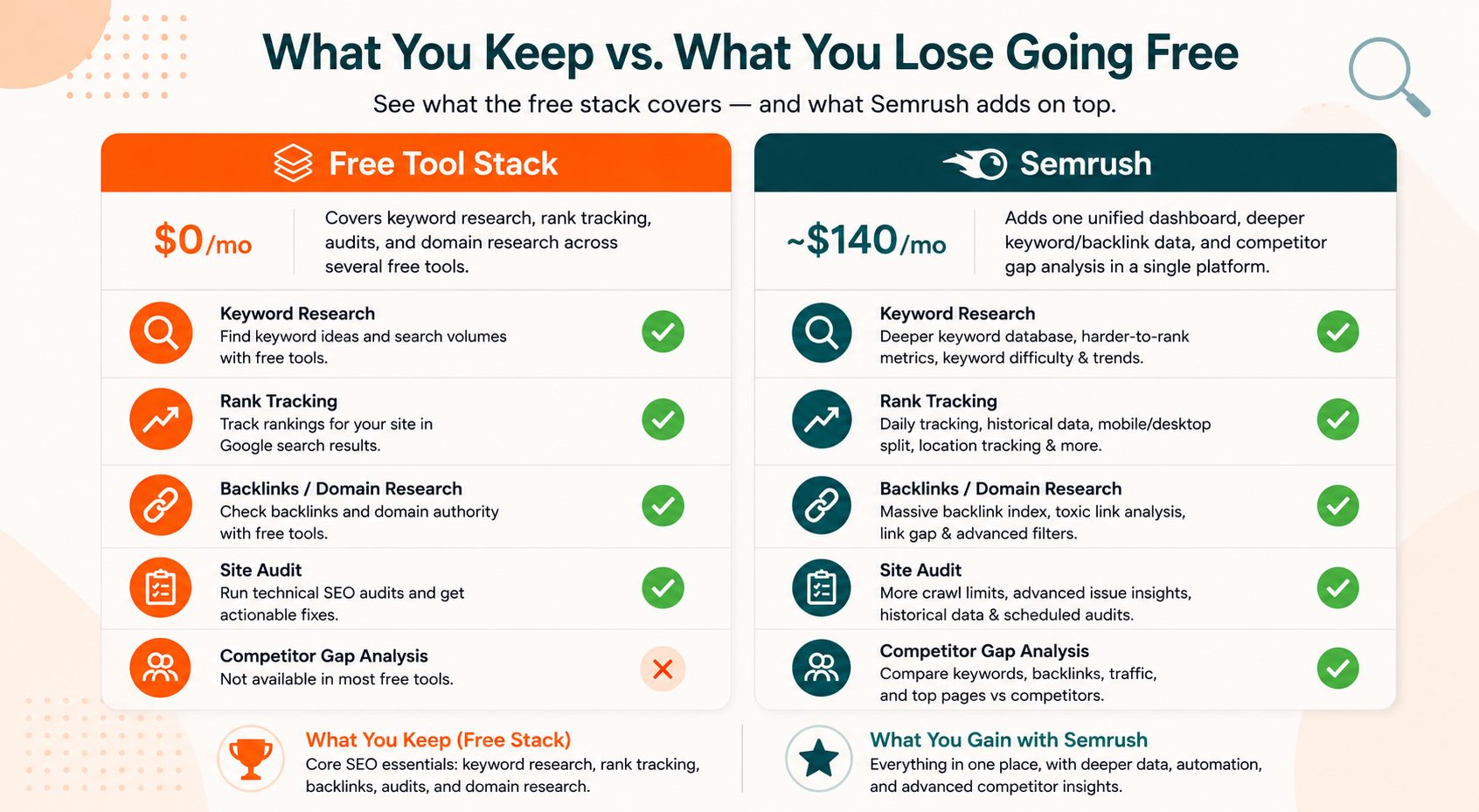
Semrush's Pro plan runs about $140 a month. That's a real barrier for a solo blogger, a freelancer, or a small business just getting started with SEO, before you've even confirmed the tool is worth it for your specific situation, and long before you've seen a single dollar of return from it.
This guide gives an honest, specific answer, not a vague "yes, there are free options," but exactly which free tools cover which Semrush features, what genuinely can't be replicated for free, and how to combine a handful of free tools into a real, working stack you can actually start using today.
What Semrush Actually Does (So You Know What You're Trying to Replace)
Semrush is an all-in-one SEO and marketing platform bundling keyword research, rank tracking, site auditing, backlink analysis, and competitor research into a single dashboard, alongside additional features like content optimization and PPC research depending on the plan.
The value isn't any single feature on its own, it's having all of them connected and cross-referenced in one place. You can go from a keyword idea to a competitor's ranking page to that page's backlink profile without switching tools, which is exactly what makes it hard to fully replicate with a collection of separate free tools that don't talk to each other.
Understanding this upfront sets realistic expectations for everything that follows, rather than promising a seamless, one-to-one swap that doesn't actually exist and would just leave you disappointed halfway through building your free stack.
The Honest Answer: No Single Free Tool Replaces Semrush
Better to address this directly and early, since it's the actual, correct answer, and most people searching this already suspect it before they even land on a page like this one.
No free tool bundles keyword research, rank tracking, backlink analysis, and site auditing into one dashboard the way Semrush does. If a tool claims to do all of that for free, it's worth being skeptical about how deep any single feature actually goes underneath the marketing copy.
What you can do instead: combine 2 to 4 specialized free tools, each covering one piece genuinely well, to functionally replace most of what an individual or small business actually uses Semrush for on a day-to-day basis. It's not a perfect substitute, but it's a genuinely workable one for most real-world use cases.
Free Tools That Cover Each Semrush Feature
Here's the specific breakdown, matched feature by feature rather than as a generic list of unrelated free tools that happen to be free.
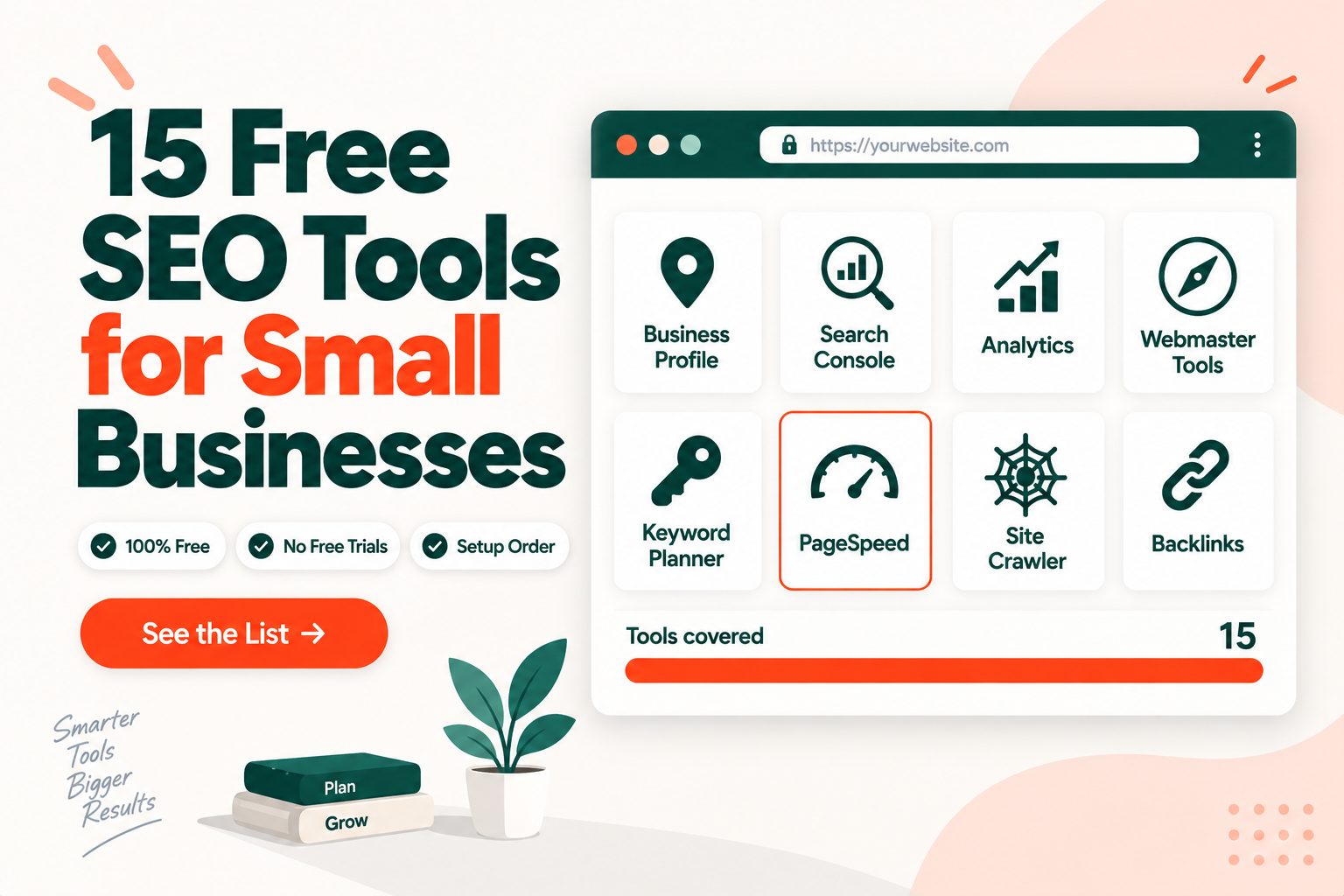
For keyword research, Google's Keyword Planner tool gives real search volume data straight from Google's own advertising system, the most accurate free source available anywhere since it's coming directly from Google rather than a third party estimating Google's own data from the outside. It requires a free Google Ads account, no ad spend necessary to access the tool itself.
For rank tracking, Google Search Console shows your exact current rankings and click data for your own site, first-party and free with no daily limits whatsoever. It won't track a competitor's rankings the way Semrush's position tracking does, but for your own site's performance, it's genuinely unmatched by any paid tool either, since nothing replicates first-party Google data.
For backlink analysis, Ahrefs Webmaster Tools' free tier gives verified site owners a real, if limited, look at their own backlink profile. It's genuinely useful despite being tied to a Semrush competitor rather than Semrush itself, and it's one of the few free tools that unlocks a normally paid-only feature at no cost, provided you can verify ownership of the domain in question.
For site auditing, SEO Site Checker's Website SEO Score Checker covers the technical and on-page audit basics: meta tags, page speed signals, mobile-friendliness, and general SEO health, without needing an account or a payment method on file just to see your results.
For domain and competitor research, SEO Site Checker's Domain Authority Checker and SEO Site Checker's WHOIS lookup cover authority benchmarking and ownership research. It's useful for sizing up a competitor's domain quickly, even without Semrush's deeper competitive intelligence layered on top, particularly when you just need a fast gut-check before deciding whether a domain is worth pursuing further.
Building a Free "Semrush Replacement" Stack
Here's a concrete, practical stack rather than an abstract list: Google Search Console and Analytics for tracking, Google Keyword Planner for research, Ahrefs Webmaster Tools for backlinks, and seositechecker.pro's free SEO tools for site auditing and domain research.
This combination genuinely covers the most commonly used slice of what individuals and small businesses actually do inside Semrush day to day. It just requires opening a few tabs instead of working from one unified dashboard, a real but manageable adjustment once it becomes routine.
Worth being honest about the real tradeoff here: more tools to manage individually, no automatic cross-referencing between them the way Semrush connects its own features internally, but zero monthly cost in exchange. For a lot of people, particularly anyone not yet generating meaningful revenue from their site, that trade is genuinely worth it, and it buys time to figure out whether a paid tool would actually earn back its cost before committing to one.
What You Genuinely Lose Going Free
To stay fair, there are real gaps worth knowing about before you commit to a fully free stack, and glossing over them would undercut the honesty this whole guide is built on.
Keyword data depth is the clearest one. Semrush shows exact volume, keyword difficulty scores, and thousands of related terms surfaced at once. Free tools show ranges and far fewer suggestions per search, meaning more manual digging and more separate searches to build out a full keyword list for a single content piece.
Backlink database size matters too. Semrush's backlink index is dramatically larger and updated more frequently than any free tool's necessarily partial view, which matters most if link building or backlink monitoring is a core, ongoing part of your strategy rather than an occasional check.
Historical and trend data is another real gap. Semrush retains years of historical ranking and traffic data you can dig back through to spot long-term patterns. Most free tools show only a current or recent snapshot, without that longer memory to draw on.
And the biggest practical loss isn't any single feature at all, it's the convenience of cross-referencing keyword, competitor, and technical data without switching tools constantly. That friction is real, even if it's not a dealbreaker for most individual site owners who aren't doing this dozens of times a day.
Free Semrush Alternatives Worth Naming
A few dedicated tools come up repeatedly as free-tier-friendly Semrush alternatives, worth knowing by name even without a full review of each one here.
Mangools offers a genuinely usable free tier for basic keyword and SERP research, positioned as a simpler, less overwhelming interface than Semrush for anyone newer to SEO tools generally and not yet ready for a platform with dozens of features to learn at once.
Ubersuggest combines keyword research, a basic site audit, and limited competitor analysis in one free tool, though daily search caps apply once you're using it heavily, which is worth knowing before you build a workflow around it.
Answer Socrates focuses specifically on question-based keyword research and content clustering, a strong free option if content ideation is your primary need rather than full-spectrum technical SEO work, particularly useful for planning out a content calendar around real reader questions.
None of these single-handedly replace Semrush either. The same combine-multiple-tools principle applies regardless of which specific names you end up choosing to work with, and it's worth testing two or three before settling into a routine.
When It's Worth Paying for Semrush (or a Cheaper Alternative) Anyway
Agencies managing multiple client accounts genuinely benefit from unified reporting and dashboard convenience across many sites at once, something a stitched-together free stack handles far less gracefully once you're juggling ten or more separate client dashboards.
Anyone who needs deep, continuously updated competitor keyword gap analysis as a core, recurring part of their actual workflow will hit the limits of free tools quickly and repeatedly, since this is exactly the kind of feature that stays locked behind a paywall almost universally.
For some teams, the time saved by working from one dashboard genuinely outweighs the monthly cost. That's worth doing the math on honestly, factoring in actual hourly value of the time saved, rather than assuming free is automatically the right call just because it's free.
And if cost specifically is the only real barrier, several cheaper paid alternatives run well under Semrush's pricing and might be worth considering before assembling a fully free stack from scratch, a reasonable middle ground between paying full price and cobbling together five separate tools.
Free Tools Checklist for a DIY Semrush Replacement
Here's every free tool mentioned in this guide, consolidated in one place: Google Search Console, Google Analytics, Google Keyword Planner, Ahrefs Webmaster Tools, and SEO Site Checker's free SEO and domain tools.
Bookmark this section rather than rebuilding the list from memory the next time you need to check something, since you'll likely reach for this same combination repeatedly.
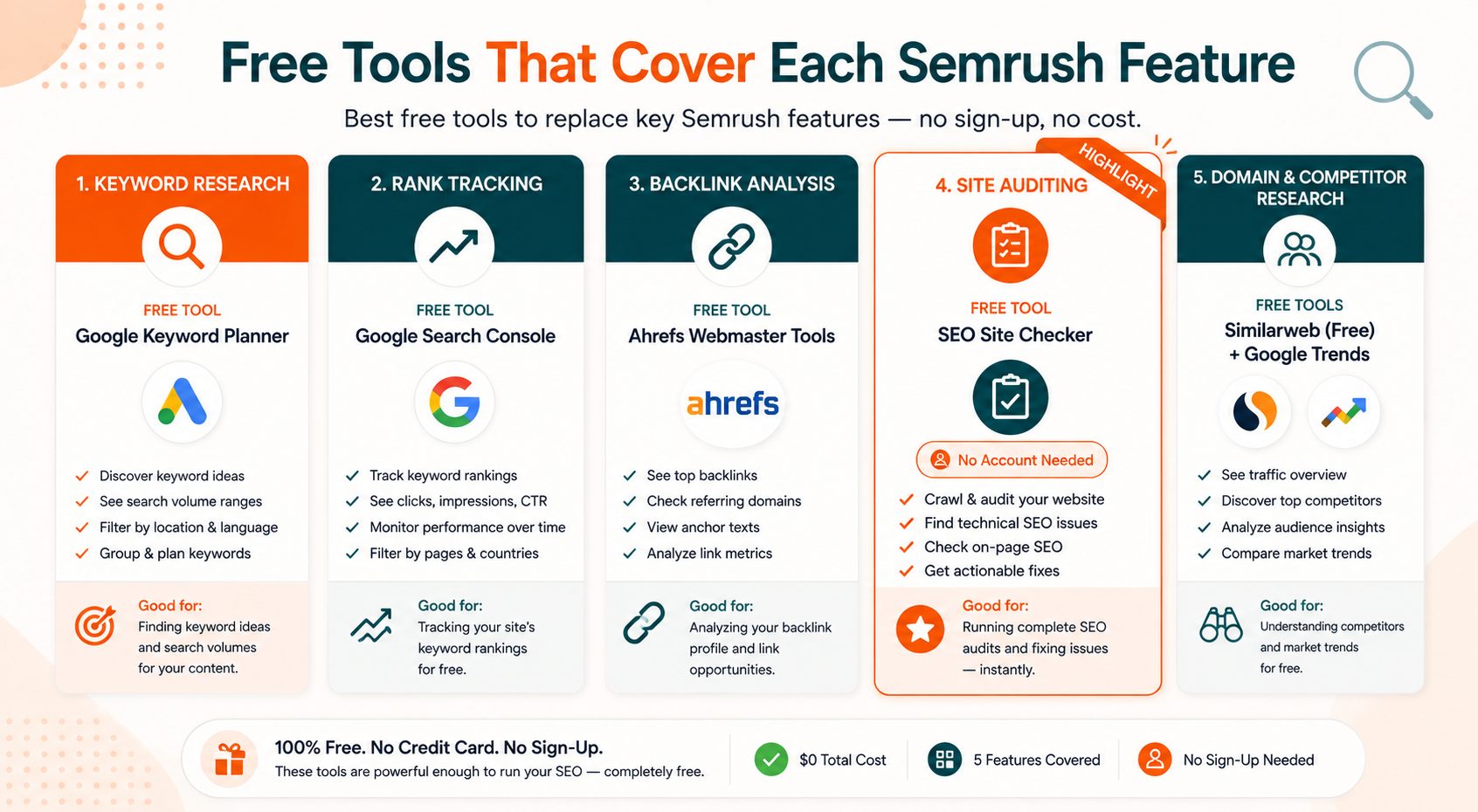
Quick Reference: Semrush Feature-to-Free-Tool Cheat Sheet
| Semrush Feature | Free Tool That Covers It | What's Missing |
|---|---|---|
| Keyword research | Google Keyword Planner | Exact volume, fewer suggestions per search |
| Rank tracking | Google Search Console | No competitor tracking |
| Backlink analysis | Ahrefs Webmaster Tools | Smaller backlink database |
| Site audit | Website SEO Score Checker | No large-scale multi-page crawls |
| Domain/competitor research | Domain Authority Checker, WHOIS | No deep competitive gap analysis |
Final Thoughts
No single free tool replaces Semrush, and pretending otherwise wouldn't do you any favors. But Google Search Console, Keyword Planner, Ahrefs Webmaster Tools, and a solid site auditor genuinely cover most of what individuals and small businesses actually use Semrush for, without a monthly bill attached.
The real decision isn't free versus Semrush in the abstract. It's whether the time saved by one unified dashboard is actually worth the monthly cost for your specific situation, and that's a question only you can answer honestly based on your own workflow and budget.
SEO Site Checker's free SEO tools are a solid starting point for the auditing and domain research portion of that stack, no account or payment required to see what you're working with.
Frequently Asked Questions
Frequently Asked Questions (FAQs) is a list of common questions and answers provided to quickly address common concerns or inquiries.
Is there a truly free alternative to Semrush?
Not a single one that replicates every feature. Combining Google Search Console, Keyword Planner, Ahrefs Webmaster Tools, and a free site auditor covers most core use cases.
What's the closest free tool to Semrush?
No single tool matches it fully. Ahrefs Webmaster Tools comes closest for backlinks and audits, while Google's own tools cover keyword and rank data separately.
Can I do SEO without paying for Semrush at all?
Yes, for most individuals and small businesses. Free tools cover keyword research, rank tracking, technical audits, and basic backlink data adequately for typical needs.
Does Google offer a free Semrush alternative?
Not as a single product, but Google Search Console, Analytics, and Keyword Planner together cover a meaningful share of what Semrush offers, entirely free.
Is Ahrefs a good free alternative to Semrush?
Ahrefs Webmaster Tools, its free tier, is genuinely useful for backlinks and site audits on your own verified domain, though its free features are more limited than Semrush's paid ones.
How much does Semrush actually cost?
Semrush's Pro plan runs approximately $140 per month, with higher tiers costing more. Current pricing is available on Semrush's own pricing page.
What do I lose by using free tools instead of Semrush?
Mainly keyword data precision, backlink database depth, historical trend data, and the convenience of one unified dashboard instead of several separate tools.
Should I use one free tool or several?
Several, matched to specific tasks. No single free tool covers everything Semrush does, so combining 2 to 4 specialized tools works better than searching for one all-in-one replacement.