
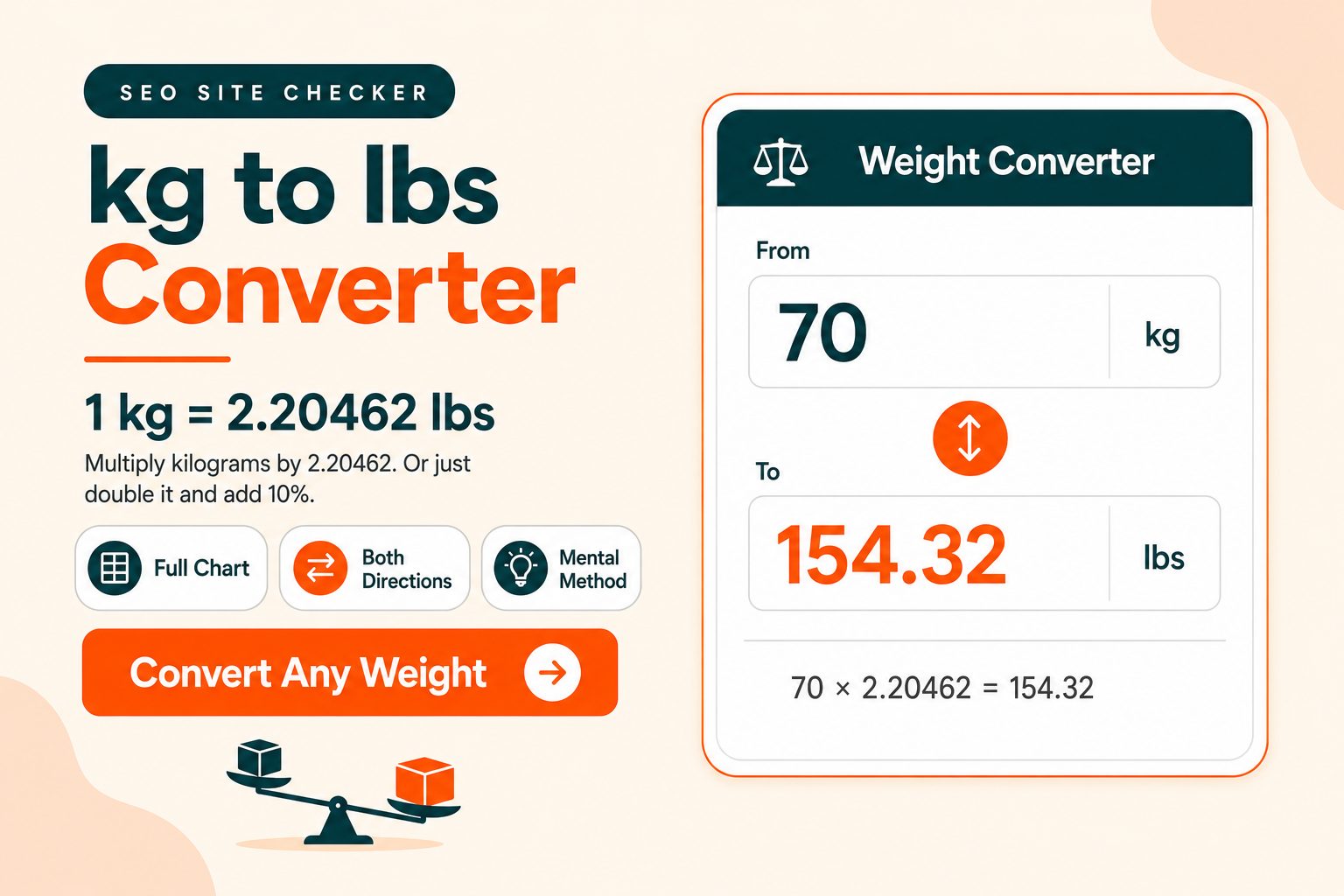
To convert kilograms to pounds, multiply by 2.20462. For a quick estimate, multiply by 2.2.
Below you will find the formula, worked examples, a full conversion table, the reverse conversion from pounds back to kilograms, and a couple of tricks for doing it in your head.
How to Convert kg to lbs: Free Weight Converter
Three steps:
- Take your weight in kilograms
- Multiply by 2.20462
- The result is your weight in pounds
Example: 70 kg × 2.20462 = 154.32 lbs
That is all there is to it. For everyday purposes you can do this on a phone calculator in five seconds.
A converter earns its place in three situations. When you are working with decimals, because 73.4 × 2.20462 is not something anyone wants to do by hand. When you are converting several weights in a row and the arithmetic starts to compound. And when precision matters, which covers shipping weights, medical dosing, and anything that goes on a document someone else relies on.
The free Weight Converter handles kilograms and pounds along with the other common weight units, with no signup and no usage limit.
The kg to lbs Formula
Pounds = Kilograms × 2.20462
Here is where that number comes from, which most conversion pages skip.
One pound is defined as exactly 0.45359237 kilograms. That is not an approximation someone settled on. It is a legal definition agreed internationally in 1959 and used by every country that still works in pounds.
Divide 1 by 0.45359237 and you get 2.20462262. That is the conversion factor, and it is exact to as many decimal places as you care to take it.
So how many decimals do you actually need?
| Factor | Use it for |
|---|---|
| 2.2 | Rough estimates, body weight, gym plates, mental math |
| 2.205 | General accuracy, most practical purposes |
| 2.20462 | Shipping, medical, engineering, anything documented |
The gap matters more than it looks. On 100 kg, using 2.2 instead of 2.20462 puts you nearly half a pound out. On a single suitcase that is irrelevant. On a pallet, or a prescription, it is not.
Worked Examples
70 kg to lbs 70 × 2.20462 = 154.32 lbs
50 kg to lbs 50 × 2.20462 = 110.23 lbs
80 kg to lbs 80 × 2.20462 = 176.37 lbs
100 kg to lbs 100 × 2.20462 = 220.46 lbs
62 kg to lbs 62 × 2.20462 = 136.6864, which rounds to 136.69 lbs
A note on rounding. For body weight, one decimal place is more than enough and most people round to the nearest whole pound. For anything shipped, billed, or dosed by weight, follow whatever precision the recipient asks for rather than rounding to whatever looks tidy. Rounding down a shipping weight to a neat number is a good way to get an invoice you did not expect.
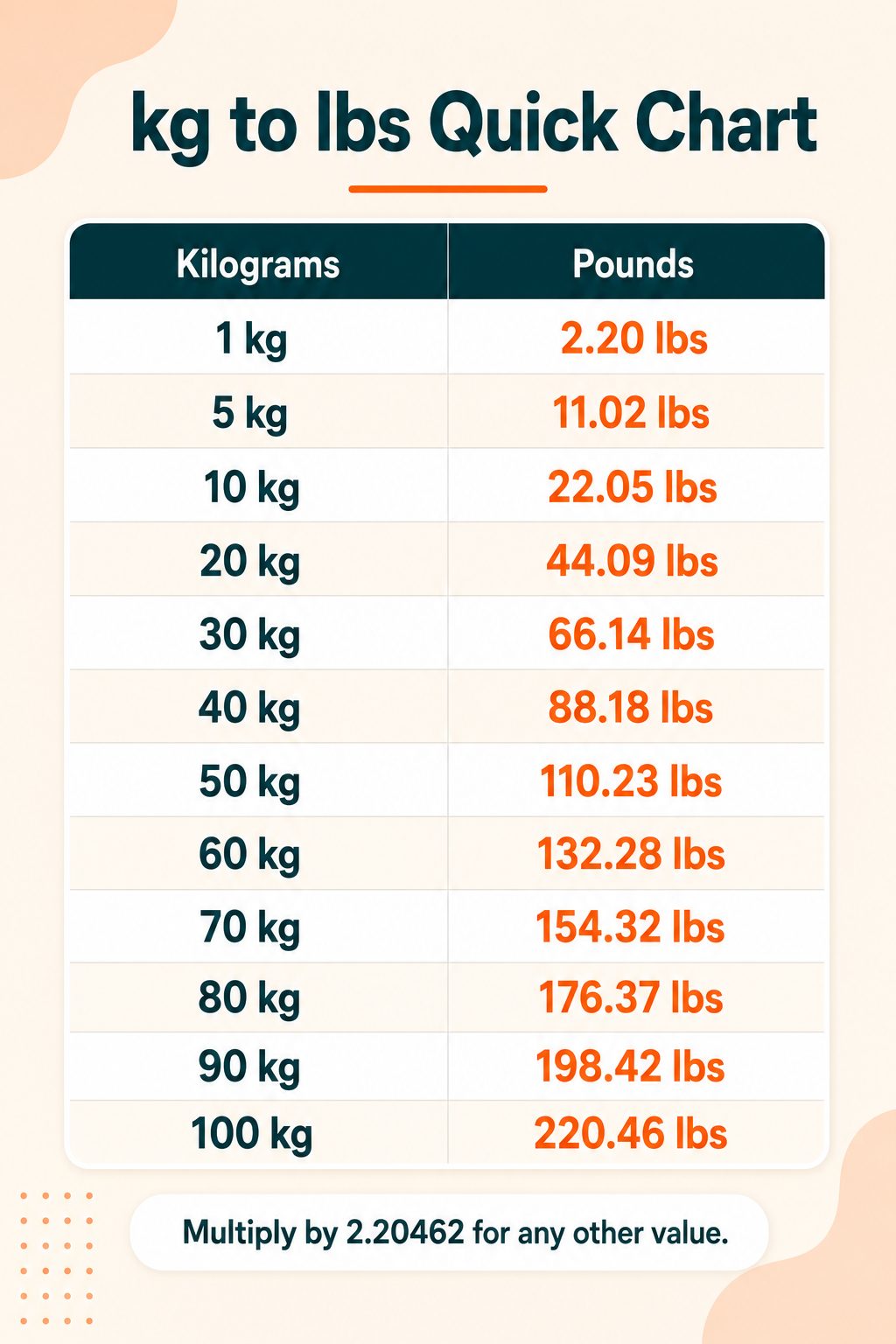
kg to lbs Conversion Table
Common weights, converted and rounded to two decimal places.
| Kilograms | Pounds |
|---|---|
| 1 kg | 2.20 lbs |
| 2 kg | 4.41 lbs |
| 3 kg | 6.61 lbs |
| 4 kg | 8.82 lbs |
| 5 kg | 11.02 lbs |
| 6 kg | 13.23 lbs |
| 7 kg | 15.43 lbs |
| 8 kg | 17.64 lbs |
| 9 kg | 19.84 lbs |
| 10 kg | 22.05 lbs |
| 15 kg | 33.07 lbs |
| 20 kg | 44.09 lbs |
| 25 kg | 55.12 lbs |
| 30 kg | 66.14 lbs |
| 40 kg | 88.18 lbs |
| 50 kg | 110.23 lbs |
| 60 kg | 132.28 lbs |
| 70 kg | 154.32 lbs |
| 75 kg | 165.35 lbs |
| 80 kg | 176.37 lbs |
| 90 kg | 198.42 lbs |
| 100 kg | 220.46 lbs |
| 110 kg | 242.51 lbs |
| 120 kg | 264.55 lbs |
| 150 kg | 330.69 lbs |
| 200 kg | 440.92 lbs |
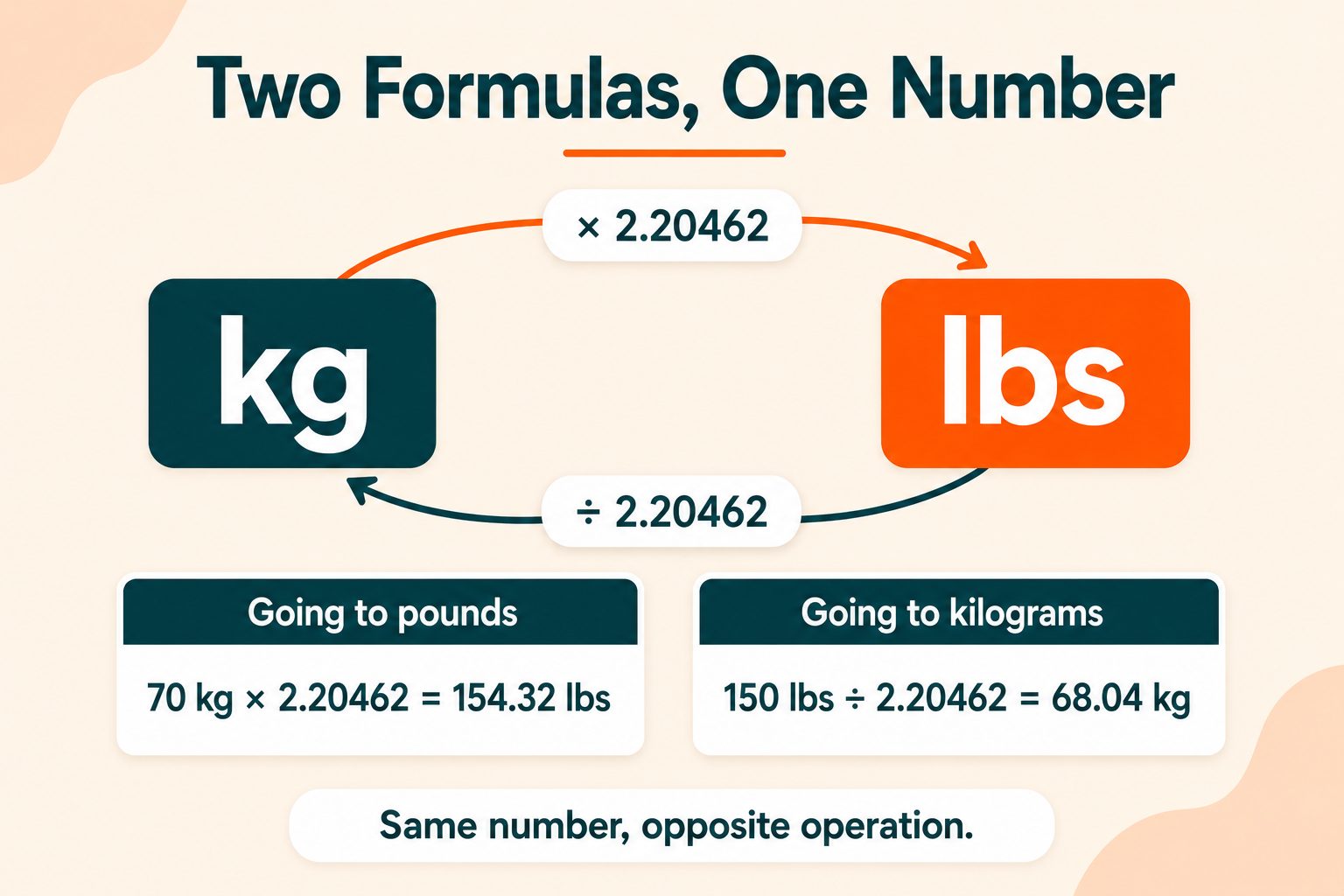
Converting lbs to kg
Going the other way:
Kilograms = Pounds ÷ 2.20462
Or multiply by 0.453592, which is the same operation written differently. Use whichever you find easier to remember.
150 lbs ÷ 2.20462 = 68.04 kg 180 lbs ÷ 2.20462 = 81.65 kg 200 lbs ÷ 2.20462 = 90.72 kg
| Pounds | Kilograms |
|---|---|
| 10 lbs | 4.54 kg |
| 25 lbs | 11.34 kg |
| 50 lbs | 22.68 kg |
| 100 lbs | 45.36 kg |
| 120 lbs | 54.43 kg |
| 140 lbs | 63.50 kg |
| 150 lbs | 68.04 kg |
| 160 lbs | 72.57 kg |
| 180 lbs | 81.65 kg |
| 200 lbs | 90.72 kg |
| 250 lbs | 113.40 kg |
If you are working in stone, which is still common in the UK for body weight, one stone is 14 lbs or about 6.35 kg. So 70 kg is 154.32 lbs, which is 11 stone 0.3 lbs.
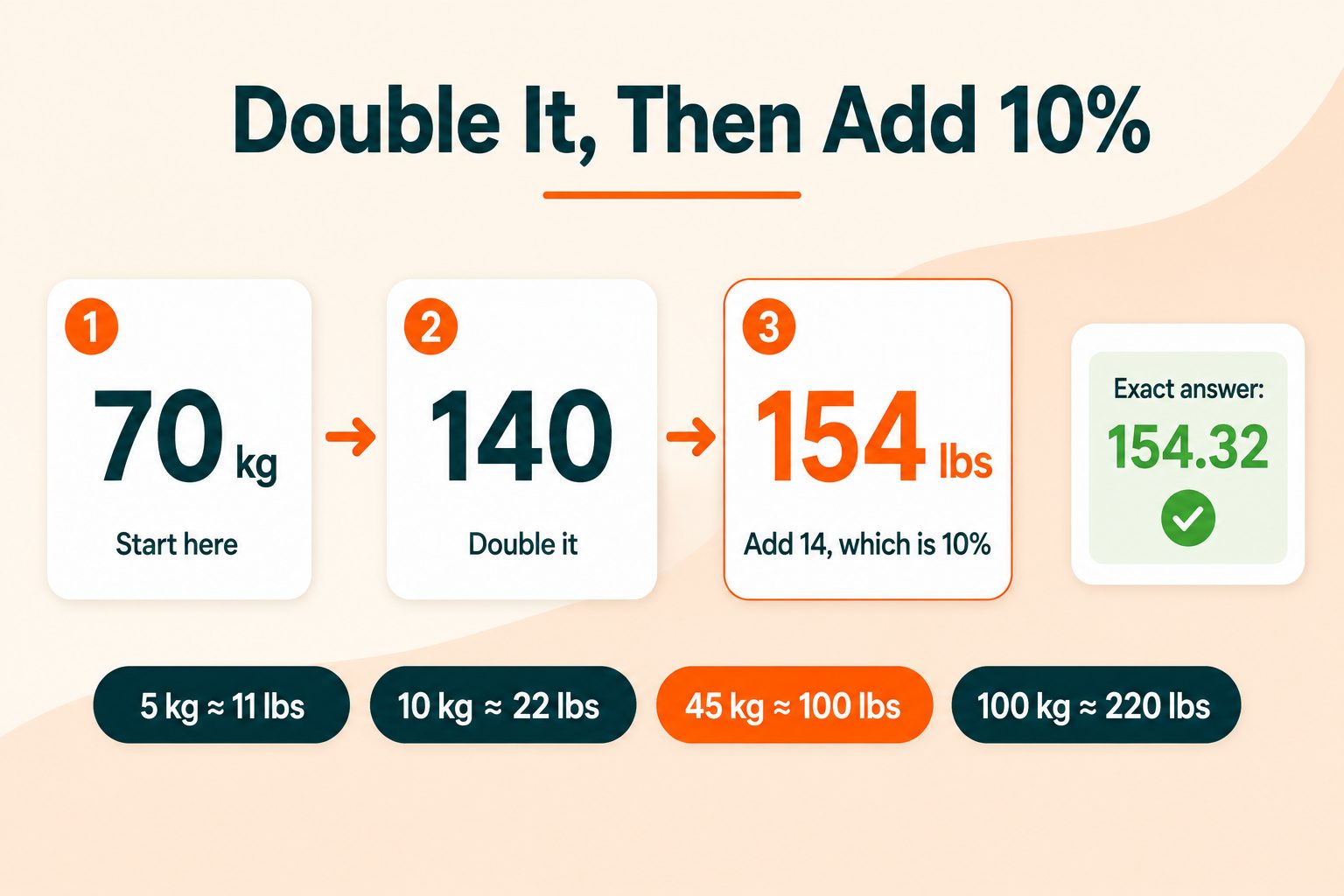
How to Convert kg to lbs in Your Head
You can get very close without a calculator.
The double and add method. Double the kilograms, then add 10 percent of that doubled figure.
70 kg → double it to 140 → add 14 → 154 lbs
The exact answer is 154.32, so you are within a third of a pound. That is good enough for almost anything outside a laboratory.
Another example: 45 kg → double to 90 → add 9 → 99 lbs. The exact answer is 99.21.
Anchors worth memorising. These cover most everyday situations without any arithmetic at all:
- 1 kg ≈ 2.2 lbs
- 5 kg ≈ 11 lbs
- 10 kg ≈ 22 lbs
- 20 kg ≈ 44 lbs
- 45 kg ≈ 100 lbs
- 100 kg ≈ 220 lbs
That 45 kg to 100 lbs anchor is genuinely useful, because it gives you a reference point in the middle of the range where most body weights sit.
Always sense check. Converting kilograms to pounds always makes the number bigger, and always more than double. If your answer is smaller than what you started with, or less than double it, you have divided when you should have multiplied.
What Are Kilograms and Pounds?
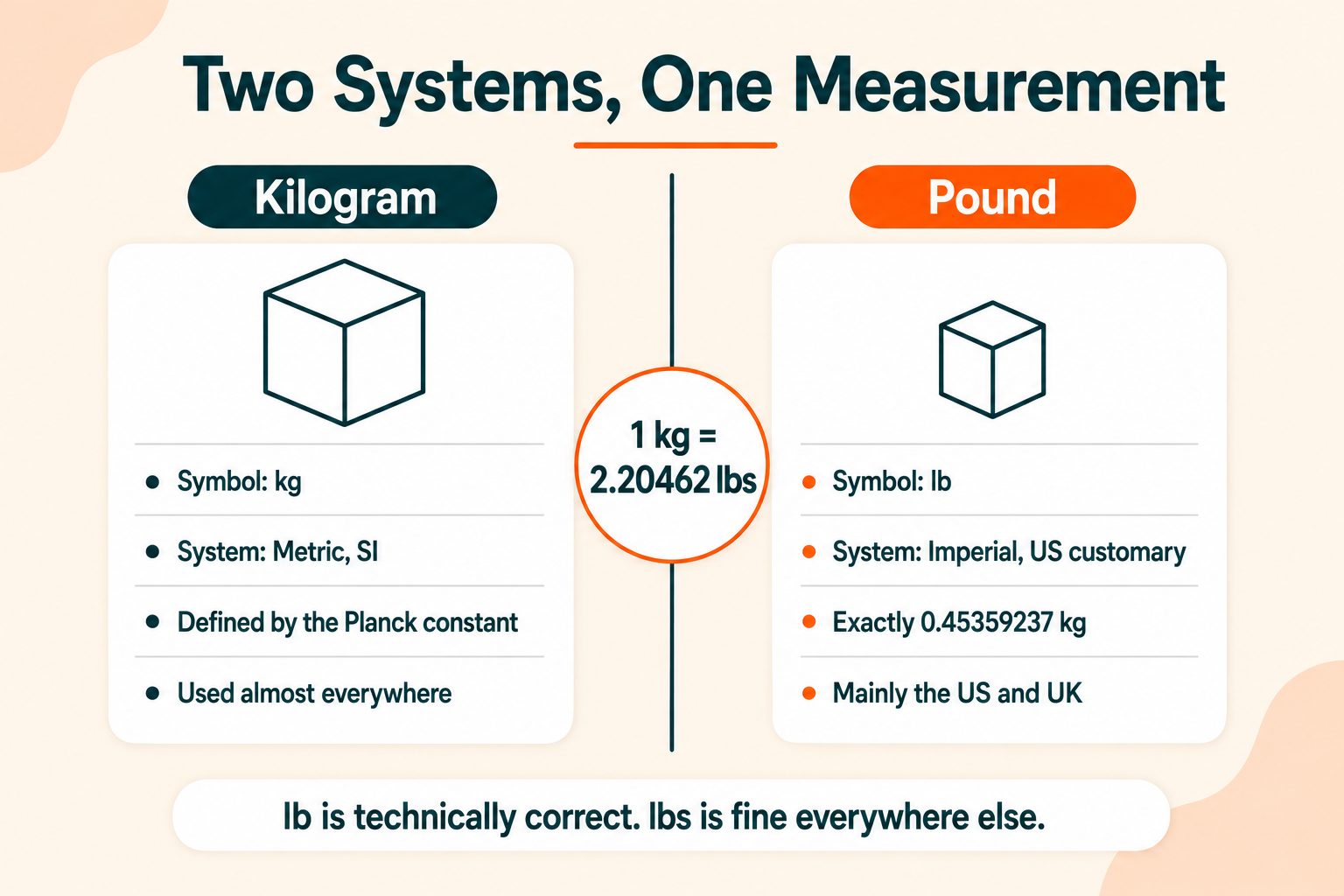
The kilogram (kg) is the base unit of mass in the International System of Units. Since 2019 it has been defined using the Planck constant rather than a physical metal prototype kept in a vault in France. The size of the unit did not change when the definition did, so nothing you owned suddenly weighed differently. The BIPM's definition of the kilogram has the formal wording.
The pound (lb) is a unit of mass in the imperial and US customary systems. The international avoirdupois pound, which is the one everyone means today, is defined as exactly 0.45359237 kilograms. One pound is 16 ounces. NIST Special Publication 811 documents that definition and the correct notation conventions.
Is it lb or lbs? Both appear constantly and nobody will misunderstand either. Technically, lb is correct for both singular and plural. It comes from the Latin libra, and abbreviations of Latin units do not take an s. In practice lbs is so widespread in everyday writing that it has become normal. Use lb in technical or formal documents, use whichever you like everywhere else.
Where Each Unit Is Used
Kilograms are the standard in nearly every country, and in science, medicine, and industry worldwide. That includes the United States, where kilograms are used in scientific, medical, industrial, government, and military contexts even though they are uncommon in daily life. NIST's guidance on metric units covers US metric usage in more detail.
Pounds dominate everyday use in the United States, and remain common in daily British usage alongside stones for body weight, even though the UK is officially metric.
The situations that send people looking for a converter are predictable: international shipping and freight, imported product specifications, recipes written in another country's units, airline baggage allowances, gym equipment, and moving medical records between systems.
Common Conversion Mistakes
- Dividing instead of multiplying. Kilograms to pounds always produces a bigger number. If yours got smaller, you went the wrong way.
- Using 2.2 when precision matters. Fine for estimating your bodyweight. Not fine for a shipping manifest.
- Confusing pounds with stones. 154 lbs is 11 stone, not 154 stone. Easy to do when reading UK sources.
- Rounding too early. In a multi-step calculation, round at the end, not in the middle.
- Assuming lb and lbs are different units. Same unit, different notation habits.
- Using the rough factor for medication dosing. Medical calculations use the full factor for a reason, and this is not a place to estimate.
- Mixing up mass and weight. They are technically different quantities, though on Earth the distinction almost never matters for everyday conversions.
Quick Reference
kg to lbs: multiply by 2.20462 lbs to kg: divide by 2.20462 In your head: double it, then add 10 percent
The table above covers the weights people convert most often. Bookmark it if you do this regularly.
Frequently Asked Questions
Frequently Asked Questions (FAQs) is a list of common questions and answers provided to quickly address common concerns or inquiries.
How many pounds is 1 kg?
One kilogram equals 2.20462 pounds. For quick estimates, 2.2 is close enough for most everyday purposes.
How do you convert kg to lbs?
Multiply the number of kilograms by 2.20462. For example, 70 kg × 2.20462 = 154.32 lbs.
Is 1 kg equal to 2.2 lbs?
Approximately. The exact figure is 2.20462 lbs. Using 2.2 is fine for estimates but loses accuracy on larger weights.
What is 70 kg in pounds?
70 kg equals 154.32 lbs. Multiply 70 by the conversion factor 2.20462 to get the result.
How many kg is 150 lbs?
150 lbs equals 68.04 kg. Divide pounds by 2.20462, or multiply by 0.453592, to convert to kilograms.
Why is 1 kg equal to 2.2 pounds?
Because one pound is defined as exactly 0.45359237 kilograms. Dividing 1 by that figure gives 2.20462, the conversion factor.
What is the difference between kg and lbs?
Kilograms are the metric base unit of mass used worldwide. Pounds are an imperial unit used mainly in the United States. One kilogram is heavier than one pound.
Is it lb or lbs?
Technically lb is correct for both singular and plural, from the Latin libra. lbs is widely used informally and is understood everywhere.
How do I convert kg to lbs without a calculator?
Double the kilograms, then add 10 percent of that doubled figure. For 70 kg: double to 140, add 14, giving 154 lbs.
What is the exact conversion factor from kg to lbs?
2.2046226218 pounds per kilogram. This comes from the international definition of one pound as exactly 0.45359237 kilograms.