Time Converter: Convert Hours, Minutes and Seconds in One Click
 Kendall Chris
Jul 19 /
3 months ago
Kendall Chris
Jul 19 /
3 months ago


"Time converter" means different things to different peopl
"Time converter" means different things to different people. Some want to convert 2.5 hours into minutes for a timesheet. Others want to know what time it is in Tokyo right now for a call. This guide focuses on the first kind, unit conversion, with a free tool you can use right now, plus a clear reference for converting between seconds, minutes, hours, days, and beyond, including the decimal time conversions that quietly trip up payroll and billing calculations all the time.
What Is a Time Converter, and Which Kind Do You Need?
Two genuinely different tools share this same name, and it's worth being clear about which one you actually need before diving in.
A time unit converter converts between seconds, minutes, hours, days, weeks, and beyond, the kind of conversion you need for payroll, video durations, cooking times, and general math. A time zone converter, on the other hand, compares the current clock time across different cities or regions, useful for scheduling calls and meetings across the world.
This article is entirely about the first kind. If you actually need to compare times across cities, that's a genuinely different tool with different requirements, and it's worth acknowledging honestly rather than pretending otherwise. There's a short section further down pointing you in the right direction if that's what you're after.
Try It Now: Free Time Converter
Before getting into the math, here's the fastest path to an answer. Enter a value into SEO Site Checker's Time Converter, pick your starting unit and target unit, and get an instant, accurate result. It's free and doesn't require creating an account.
It also sits within a broader SEO Site Checker's Unit Converter tools hub, which is worth knowing about if you find yourself needing to convert other measurements, like length, weight, or speed, in the same session.
How Time Unit Conversion Actually Works
Time runs on a base-60, or sexagesimal, system rather than the base-10 decimal math most of us default to. This dates back to ancient Babylonian mathematics, and it's exactly why time conversion trips people up in a way that, say, converting meters to kilometers never does.
Here's the trap most people fall into: 1.5 hours is not "1 hour 50 minutes." It's 1 hour 30 minutes. The 0.5 isn't a straightforward decimal fraction of 100, it needs to be converted through base-60 math, since there are 60 minutes in an hour, not 100.
The reliable way to handle any time conversion is to convert everything down to the smallest common unit first, usually seconds, then convert back up to whatever unit you actually need. This avoids the compounding rounding errors that creep in when you try to convert directly between two arbitrary units.
Time Unit Conversion Reference Chart
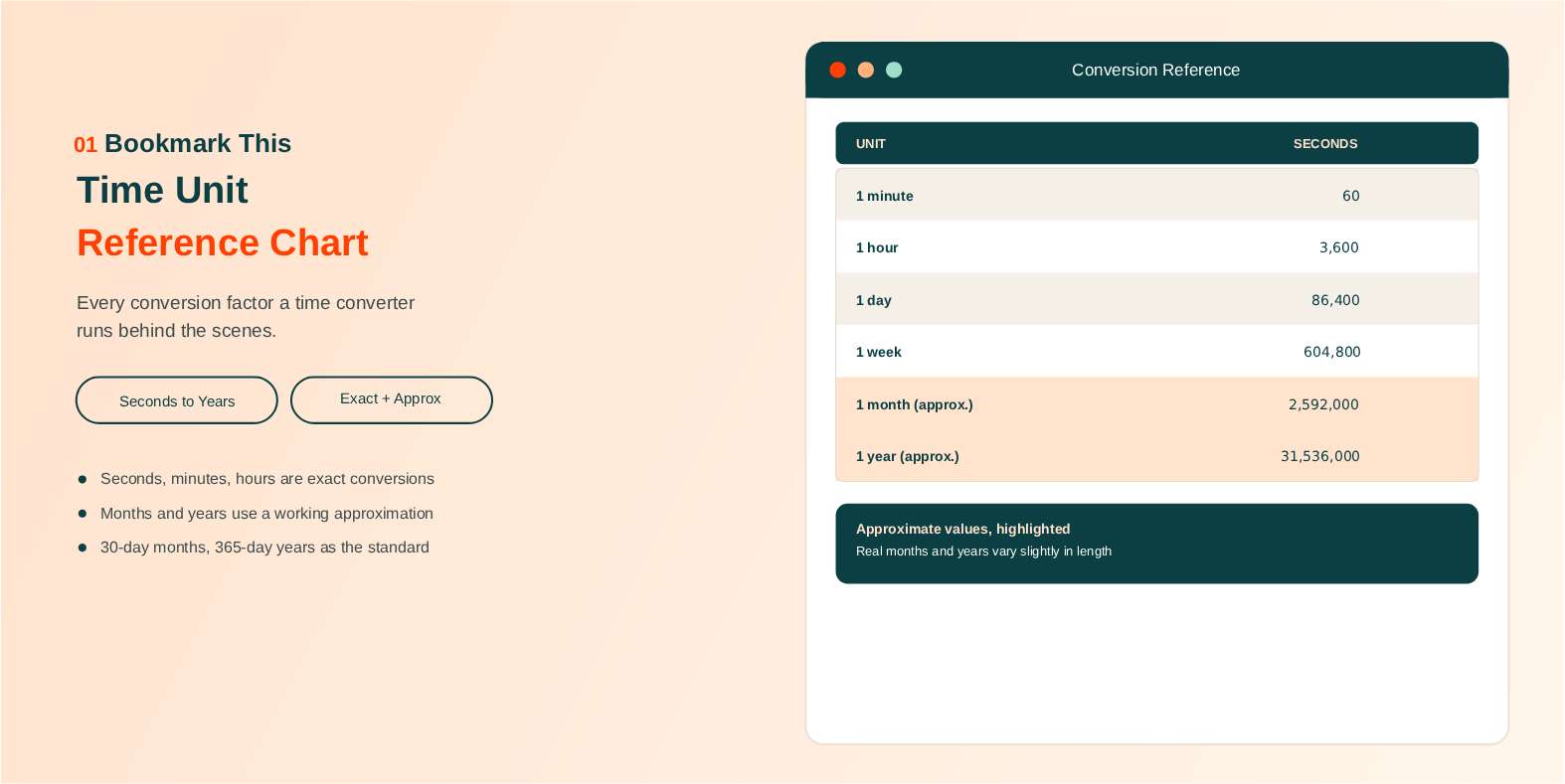
Here's a full reference for converting between the most common time units. Bookmark this table for quick lookups, since these are the exact factors any accurate time converter runs behind the scenes.
| Unit | Equivalent in Seconds |
|---|---|
| 1 minute | 60 seconds |
| 1 hour | 3,600 seconds |
| 1 day | 86,400 seconds |
| 1 week | 604,800 seconds |
| 1 month (approx.) | 2,592,000 seconds |
| 1 year (approx.) | 31,536,000 seconds |
Worth noting: months and years are approximations, not exact conversions. Calendar months vary from 28 to 31 days, and years vary depending on leap years, so most conversion tools use a working standard of 30-day months and 365-day years. This is accurate enough for the overwhelming majority of everyday use, but it's worth knowing when precision genuinely matters, like scientific work or legal date calculations. For the authoritative technical definition behind all of this, the international SI definition of the second is the source every other unit in this chart is ultimately built on.
How to Convert Decimal Time to HH:MM:SS (and Back)
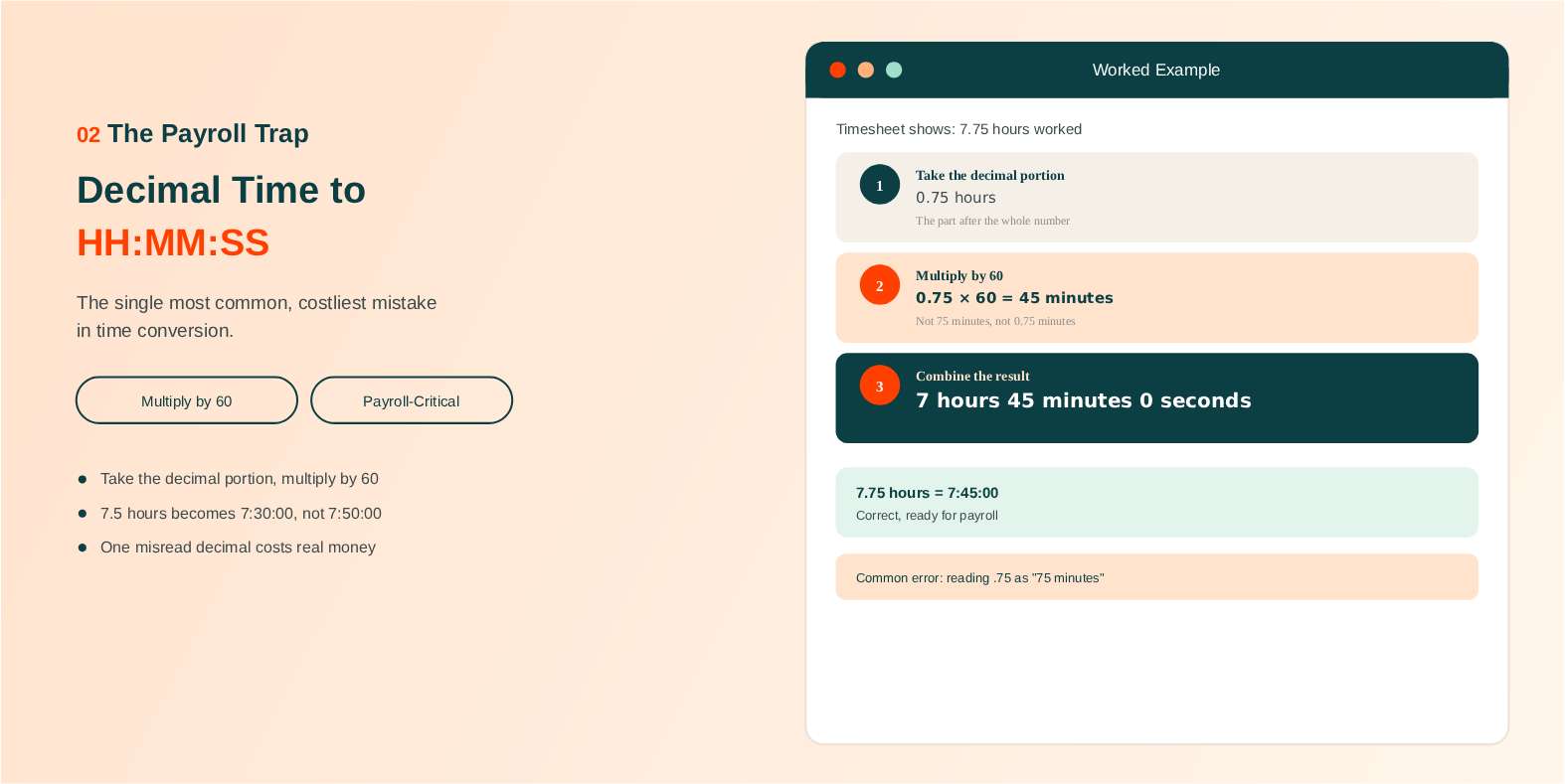
This is the single most common real-world pain point in time conversion: turning a decimal value like 7.75 hours into a standard 7:45:00 format, and back again.
The math works like this. Take the decimal portion (the .75 in 7.75), multiply it by 60 to get minutes, giving you 45 minutes. If there's still a decimal remaining after that step, multiply it by 60 again to get seconds. So 7.75 hours becomes 7 hours, 45 minutes, 0 seconds.
This matters enormously for payroll and billing specifically. An employee whose timesheet shows "7.5 hours" worked 7 hours and 30 minutes, not 7 hours and 50 minutes. That single misread costs money in either direction, underpaying the employee or overpaying them, depending on which way the mistake goes, and it's a genuinely common error precisely because decimal time doesn't behave the way decimal math normally does.
Common Time Conversion Use Cases
Time conversion comes up constantly across a surprising range of everyday and professional contexts.
Payroll and billing rely on it heavily, converting worked hours from decimal timesheet formats into accurate pay calculations, exactly the kind of math covered above. A freelancer billing 22.25 hours for a project needs that number translated correctly into 22 hours and 15 minutes before an invoice goes out, and the same logic applies in reverse when a time-tracking tool exports hours in decimal format for accounting software.
Video and audio editing depends on converting frame counts, timestamps, and clip durations between formats, especially when working across different frame rates or export requirements. A 90-second clip at a given frame rate needs to be expressed in exact frame counts for some editing software and in minutes:seconds for others, and getting that conversion wrong throws off sync across an entire timeline.
Cooking and baking benefit from it too, particularly for multi-step recipes that mix minutes and hours across different stages of preparation, like a recipe calling for 1.5 hours of total prep time split across several smaller steps measured in minutes.
Sports and race timing rely on converting split times and total durations between formats, especially when comparing results recorded in slightly different conventions, such as a marathon split reported in decimal minutes needing to be converted to a standard minutes:seconds format for comparison against other results.
And programming and data work use it constantly, converting between seconds, milliseconds, and human-readable durations for logs, timers, and general time-based calculations, particularly when raw timestamp data needs to be presented in a format a non-technical reader can actually understand.
How to Add or Subtract Time (Hours, Minutes, Seconds)
Adding time values isn't simple addition, and this is where a lot of manual math goes wrong.
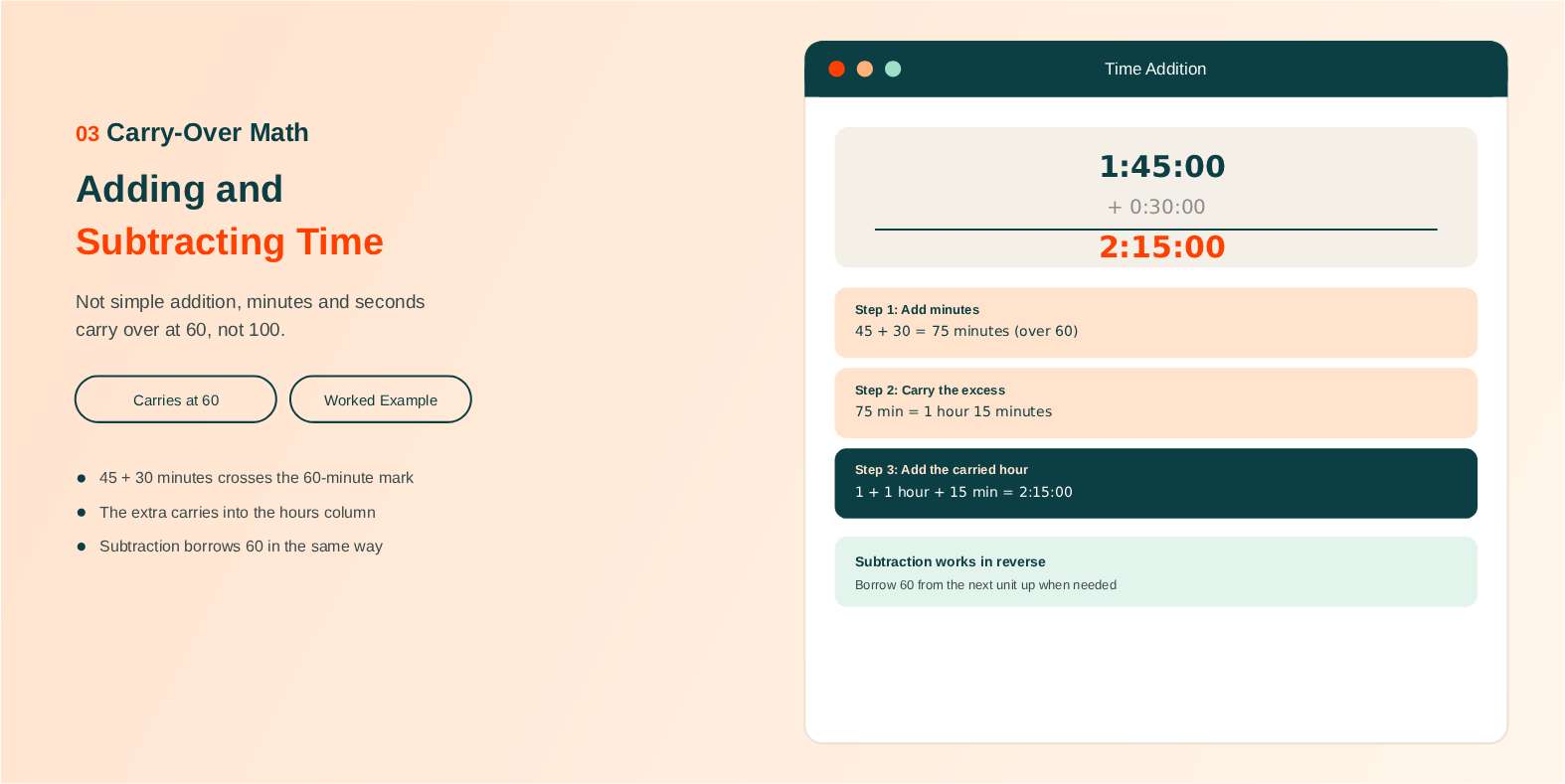
Take 1:45:00 plus 0:30:00. Adding the minutes columns directly gives 45 + 30 = 75 minutes, but minutes only go up to 59 before carrying over into the next hour. So 75 minutes becomes 1 hour and 15 minutes, which then gets added to the hours already in play: 1 hour plus 1 hour equals 2 hours, plus the 15 minutes, giving a final result of 2:15:00.
Subtraction works the same way in reverse. If you're subtracting a larger minute or second value from a smaller one, you borrow 60 from the next unit up before completing the subtraction, the same logic as borrowing in standard column subtraction, just working in base-60 instead of base-10.
If You Actually Need a Time Zone Converter
If you're actually trying to compare the current time in different cities for a meeting or call, that's a genuinely different tool than the one covered on this page, and it's worth saying so plainly rather than leaving you stuck.
Time zone conversion depends on more than simple math. It accounts for UTC offsets, daylight saving time changes that shift twice a year in many regions, and even occasional political changes to time zone boundaries over time. This is meaningfully more complex than the fixed, mathematical conversions covered above.
Most reliable time zone tools are built on the IANA Time Zone Database, the authoritative, continuously maintained source of time zone data used across the vast majority of software and scheduling tools. If world clock comparison is what you actually need, look for a tool built specifically around that database.
Common Time Conversion Mistakes to Avoid
A handful of errors account for most time conversion mistakes, and nearly all of them trace back to treating time like ordinary decimal math instead of respecting the base-60 system it actually runs on. Knowing these ahead of time is the fastest way to avoid repeating them.
Treating decimal time as base-10 is the big one, the "7.5 hours equals 7 hours 50 minutes" error covered earlier, which shows up constantly in manual payroll and billing calculations.
Forgetting that months and years are approximations trips people up when genuine precision matters, since a "month" in a conversion tool isn't the same as a specific calendar month with its own exact day count.
Mixing up 12-hour and 24-hour formats causes real confusion specifically when converting time-of-day values rather than durations, since 3:00 could mean either 3 AM or 3 PM depending on context.
And not accounting for carry-over when manually adding or subtracting time values is the most common source of outright wrong answers, exactly the kind of error the worked example above walks through avoiding.
Quick Reference: Time Conversion Cheat Sheet
| Unit | Equivalent | Quick Example |
|---|---|---|
| 1 minute | 60 seconds | 2 minutes = 120 seconds |
| 1 hour | 60 minutes | 1.5 hours = 1 hour 30 minutes |
| 1 day | 24 hours | 2 days = 48 hours |
| 1 week | 7 days | 2 weeks = 14 days |
| 1 month (approx.) | 30 days | 3 months ≈ 90 days |
| 1 year (approx.) | 365 days | 2 years ≈ 730 days |
Final Thoughts
Time unit conversion looks simple on the surface, but the base-60 system trips up manual math constantly, especially in payroll and billing contexts where a single misread decimal can cost real money. That's exactly why a dedicated converter earns its keep over doing the math by hand.
Convert your first value now and see how quickly it resolves. SEO Site Checker's Time Converter is the fastest way to get started.
e. Some want to convert 2.5 hours into minutes for a timesheet. Others want to know what time it is in Tokyo right now for a call. This guide focuses on the first kind, unit conversion, with a free tool you can use right now, plus a clear reference for converting between seconds, minutes, hours, days, and beyond, including the decimal time conversions that quietly trip up payroll and billing calculations all the time.
What Is a Time Converter, and Which Kind Do You Need?
Two genuinely different tools share this same name, and it's worth being clear about which one you actually need before diving in.
A time unit converter converts between seconds, minutes, hours, days, weeks, and beyond, the kind of conversion you need for payroll, video durations, cooking times, and general math. A time zone converter, on the other hand, compares the current clock time across different cities or regions, useful for scheduling calls and meetings across the world.
This article is entirely about the first kind. If you actually need to compare times across cities, that's a genuinely different tool with different requirements, and it's worth acknowledging honestly rather than pretending otherwise. There's a short section further down pointing you in the right direction if that's what you're after.
Try It Now: Free Time Converter
Before getting into the math, here's the fastest path to an answer. Enter a value into SEO Site Checker's Time Converter, pick your starting unit and target unit, and get an instant, accurate result. It's free and doesn't require creating an account.
It also sits within a broader SEO Site Checker's Unit Converter tools hub, which is worth knowing about if you find yourself needing to convert other measurements, like length, weight, or speed, in the same session.
How Time Unit Conversion Actually Works
Time runs on a base-60, or sexagesimal, system rather than the base-10 decimal math most of us default to. This dates back to ancient Babylonian mathematics, and it's exactly why time conversion trips people up in a way that, say, converting meters to kilometers never does.
Here's the trap most people fall into: 1.5 hours is not "1 hour 50 minutes." It's 1 hour 30 minutes. The 0.5 isn't a straightforward decimal fraction of 100, it needs to be converted through base-60 math, since there are 60 minutes in an hour, not 100.
The reliable way to handle any time conversion is to convert everything down to the smallest common unit first, usually seconds, then convert back up to whatever unit you actually need. This avoids the compounding rounding errors that creep in when you try to convert directly between two arbitrary units.
Time Unit Conversion Reference Chart
Here's a full reference for converting between the most common time units. Bookmark this table for quick lookups, since these are the exact factors any accurate time converter runs behind the scenes.
| Unit | Equivalent in Seconds |
|---|---|
| 1 minute | 60 seconds |
| 1 hour | 3,600 seconds |
| 1 day | 86,400 seconds |
| 1 week | 604,800 seconds |
| 1 month (approx.) | 2,592,000 seconds |
| 1 year (approx.) | 31,536,000 seconds |
Worth noting: months and years are approximations, not exact conversions. Calendar months vary from 28 to 31 days, and years vary depending on leap years, so most conversion tools use a working standard of 30-day months and 365-day years. This is accurate enough for the overwhelming majority of everyday use, but it's worth knowing when precision genuinely matters, like scientific work or legal date calculations. For the authoritative technical definition behind all of this, the international SI definition of the second is the source every other unit in this chart is ultimately built on.
How to Convert Decimal Time to HH:MM:SS (and Back)
This is the single most common real-world pain point in time conversion: turning a decimal value like 7.75 hours into a standard 7:45:00 format, and back again.
The math works like this. Take the decimal portion (the .75 in 7.75), multiply it by 60 to get minutes, giving you 45 minutes. If there's still a decimal remaining after that step, multiply it by 60 again to get seconds. So 7.75 hours becomes 7 hours, 45 minutes, 0 seconds.
This matters enormously for payroll and billing specifically. An employee whose timesheet shows "7.5 hours" worked 7 hours and 30 minutes, not 7 hours and 50 minutes. That single misread costs money in either direction, underpaying the employee or overpaying them, depending on which way the mistake goes, and it's a genuinely common error precisely because decimal time doesn't behave the way decimal math normally does.
Common Time Conversion Use Cases
Time conversion comes up constantly across a surprising range of everyday and professional contexts.
Payroll and billing rely on it heavily, converting worked hours from decimal timesheet formats into accurate pay calculations, exactly the kind of math covered above. A freelancer billing 22.25 hours for a project needs that number translated correctly into 22 hours and 15 minutes before an invoice goes out, and the same logic applies in reverse when a time-tracking tool exports hours in decimal format for accounting software.
Video and audio editing depends on converting frame counts, timestamps, and clip durations between formats, especially when working across different frame rates or export requirements. A 90-second clip at a given frame rate needs to be expressed in exact frame counts for some editing software and in minutes:seconds for others, and getting that conversion wrong throws off sync across an entire timeline.
Cooking and baking benefit from it too, particularly for multi-step recipes that mix minutes and hours across different stages of preparation, like a recipe calling for 1.5 hours of total prep time split across several smaller steps measured in minutes.
Sports and race timing rely on converting split times and total durations between formats, especially when comparing results recorded in slightly different conventions, such as a marathon split reported in decimal minutes needing to be converted to a standard minutes:seconds format for comparison against other results.
And programming and data work use it constantly, converting between seconds, milliseconds, and human-readable durations for logs, timers, and general time-based calculations, particularly when raw timestamp data needs to be presented in a format a non-technical reader can actually understand.
How to Add or Subtract Time (Hours, Minutes, Seconds)
Adding time values isn't simple addition, and this is where a lot of manual math goes wrong.
Take 1:45:00 plus 0:30:00. Adding the minutes columns directly gives 45 + 30 = 75 minutes, but minutes only go up to 59 before carrying over into the next hour. So 75 minutes becomes 1 hour and 15 minutes, which then gets added to the hours already in play: 1 hour plus 1 hour equals 2 hours, plus the 15 minutes, giving a final result of 2:15:00.
Subtraction works the same way in reverse. If you're subtracting a larger minute or second value from a smaller one, you borrow 60 from the next unit up before completing the subtraction, the same logic as borrowing in standard column subtraction, just working in base-60 instead of base-10.
If You Actually Need a Time Zone Converter
If you're actually trying to compare the current time in different cities for a meeting or call, that's a genuinely different tool than the one covered on this page, and it's worth saying so plainly rather than leaving you stuck.
Time zone conversion depends on more than simple math. It accounts for UTC offsets, daylight saving time changes that shift twice a year in many regions, and even occasional political changes to time zone boundaries over time. This is meaningfully more complex than the fixed, mathematical conversions covered above.
Most reliable time zone tools are built on the IANA Time Zone Database, the authoritative, continuously maintained source of time zone data used across the vast majority of software and scheduling tools. If world clock comparison is what you actually need, look for a tool built specifically around that database.
Common Time Conversion Mistakes to Avoid
A handful of errors account for most time conversion mistakes, and nearly all of them trace back to treating time like ordinary decimal math instead of respecting the base-60 system it actually runs on. Knowing these ahead of time is the fastest way to avoid repeating them.
Treating decimal time as base-10 is the big one, the "7.5 hours equals 7 hours 50 minutes" error covered earlier, which shows up constantly in manual payroll and billing calculations.
Forgetting that months and years are approximations trips people up when genuine precision matters, since a "month" in a conversion tool isn't the same as a specific calendar month with its own exact day count.
Mixing up 12-hour and 24-hour formats causes real confusion specifically when converting time-of-day values rather than durations, since 3:00 could mean either 3 AM or 3 PM depending on context.
And not accounting for carry-over when manually adding or subtracting time values is the most common source of outright wrong answers, exactly the kind of error the worked example above walks through avoiding.
Quick Reference: Time Conversion Cheat Sheet
| Unit | Equivalent | Quick Example |
|---|---|---|
| 1 minute | 60 seconds | 2 minutes = 120 seconds |
| 1 hour | 60 minutes | 1.5 hours = 1 hour 30 minutes |
| 1 day | 24 hours | 2 days = 48 hours |
| 1 week | 7 days | 2 weeks = 14 days |
| 1 month (approx.) | 30 days | 3 months ≈ 90 days |
| 1 year (approx.) | 365 days | 2 years ≈ 730 days |
Final Thoughts
Time unit conversion looks simple on the surface, but the base-60 system trips up manual math constantly, especially in payroll and billing contexts where a single misread decimal can cost real money. That's exactly why a dedicated converter earns its keep over doing the math by hand.
Convert your first value now and see how quickly it resolves. SEO Site Checker's Time Converter is the fastest way to get started.
Frequently Asked Questions
Frequently Asked Questions (FAQs) is a list of common questions and answers provided to quickly address common concerns or inquiries.
How do I convert decimal hours to hours and minutes?
Multiply the decimal portion by 60 to get minutes. For example, 6.25 hours is 6 hours plus 0.25 × 60, which equals 6 hours and 15 minutes.
How many seconds are in an hour?
There are 3,600 seconds in an hour, calculated as 60 seconds per minute multiplied by 60 minutes per hour.
Is a time converter the same as a time zone converter?
No. A time converter changes between units like seconds, minutes, and hours, while a time zone converter compares clock times across different cities or regions.
How do I convert minutes to hours for payroll or billing?
Divide the total minutes by 60. For example, 450 minutes divided by 60 equals 7.5 hours, which converts further to 7 hours and 30 minutes.
Why isn't 1.5 hours the same as 1 hour 50 minutes?
Because time uses a base-60 system, not base-10. The 0.5 represents half of 60 minutes, which is 30 minutes, not 50.
How many days are in a year for conversion purposes?
Most conversion tools use 365 days as a standard approximation, since exact year length varies slightly due to leap years.
Can I convert time without a calculator?
Yes, for simple conversions like minutes to seconds (multiply by 60), though decimal time conversions and larger values are far more error-prone to do by hand.
How do I correctly add two time values together?
Add each unit separately, then carry over any value of 60 or more into the next unit up, the same logic as carrying over in standard addition, just in base-60.