Free vs Paid SEO Tools: What Can You Actually Do for Free?
 Kendall Chris
Jul 21 /
2 months ago
Kendall Chris
Jul 21 /
2 months ago


Most "free vs paid" comparisons stay frustratingly vague. "Paid tools offer more features and deeper data" doesn't actually tell you anything useful when you're trying to decide whether to keep grinding away with free tools or finally open your wallet.
This guide answers the real question directly: exactly what you can accomplish with free SEO tools right now, where the genuine limits are, and the specific signals that mean it's actually time to pay for something. No vague hand-waving, just concrete examples throughout.
The Real Question Isn't "Which Is Better"
It's not free versus paid in the abstract. It's what stage you're at and what you're actually trying to accomplish.
A solo blogger, a small business owner managing one site, and an agency handling 40 client accounts have genuinely different needs, and the "right" answer depends entirely on which of those you actually are. A tool that's more than enough for the blogger would leave the agency stuck within a week, while a platform built for agency-scale reporting would be massive overkill for someone publishing two posts a month.
The goal here is to give concrete, specific answers rather than the vague "paid tools have more features" framing most comparisons default to. By the end, you should know exactly what's realistic to expect from free tools and exactly what signals mean you've genuinely outgrown them, rather than upgrading based on a vague feeling that you probably should.
What You Can Actually Do With Free SEO Tools
This is more than most people expect, and it's worth spelling out specifically rather than in generalities.
Keyword research is genuinely solid at the free tier. Google Keyword Planner gives you real search volume data straight from Google's own advertising system, AnswerThePublic surfaces question-based topic ideas, and Google Trends shows you whether interest in a topic is rising or fading. Together, that's enough to confidently validate a content idea before you invest hours writing it, which covers the single most important decision in the entire content process: whether a topic is even worth your time.
On-page optimization gets real, practical support too. Free WordPress plugins like Yoast or Rank Math give you live guidance while you write, covering meta tags, readability, and basic keyword usage, turning abstract on-page rules into a simple checklist rather than something you need to memorize and apply manually every time.
Technical health checks are more capable than people assume. PageSpeed Insights gives you a real diagnostic score with specific fixes, Search Console shows crawl errors and indexing status directly from Google, and most free site audit tools handle small-to-medium sites reasonably well, typically capped somewhere around 100 to 500 URLs depending on the tool. For a personal blog or small business site, that ceiling rarely becomes a practical problem.
Rank tracking works too, just with a scope limitation. Search Console gives you exact ranking data for your own site, though not for competitor sites, which is where the free tier draws its line. You'll know precisely where you stand, just not how you compare to who you're actually competing against in the results.
And domain and technical diagnostics are genuinely well covered for free. SEO Site Checker's free SEO toolkit covers domain authority, WHOIS ownership records, and DNS checks at no cost, genuinely comparable to what several paid platforms charge extra for as a bundled add-on feature rather than something included in a base plan.
What Free Tools Typically Can't Do (The Honest Limits)
To be fair to the other side of this, there are real limits worth being upfront about, and pretending otherwise would undercut the whole point of this article.
Deep backlink databases are the clearest gap. Free tools generally show a small fraction of a site's actual backlink profile, while paid platforms maintain databases tracking billions of links, updated continuously rather than in occasional snapshots. If you're trying to understand your full link profile or find every unlinked mention of your brand, free tools will only ever show you a partial picture.
Historical trend data is another consistent limitation. Most free tools show a current or recent snapshot only, without the multi-year historical tracking that paid platforms retain and let you dig back through. If you want to see how your rankings moved over the past two years, free tools generally won't have that archive available.
Large-scale site crawls hit a real ceiling. Free technical audits typically cap out in the low hundreds of URLs, which becomes a genuine problem once a site grows into the thousands of pages, exactly the point where technical issues become both more likely and harder to spot manually.
Competitor gap analysis, seeing exactly which keywords a competitor ranks for that you currently don't, is almost universally locked behind a paid plan. This is arguably the single feature free tools are weakest on across the board, and it's often the specific gap that finally pushes people toward a paid subscription.
Team collaboration and reporting stay paid-tier too. White-labeled reports, shared dashboards, and multi-user access are consistently features you won't find in a free version of anything, since they're built around supporting a team or client relationship rather than an individual user.
And API access is rare at the free tier. Free tools rarely offer programmatic access for pulling SEO data into other systems or automated workflows, which mostly matters once you're trying to build something custom on top of your SEO data rather than checking it manually.
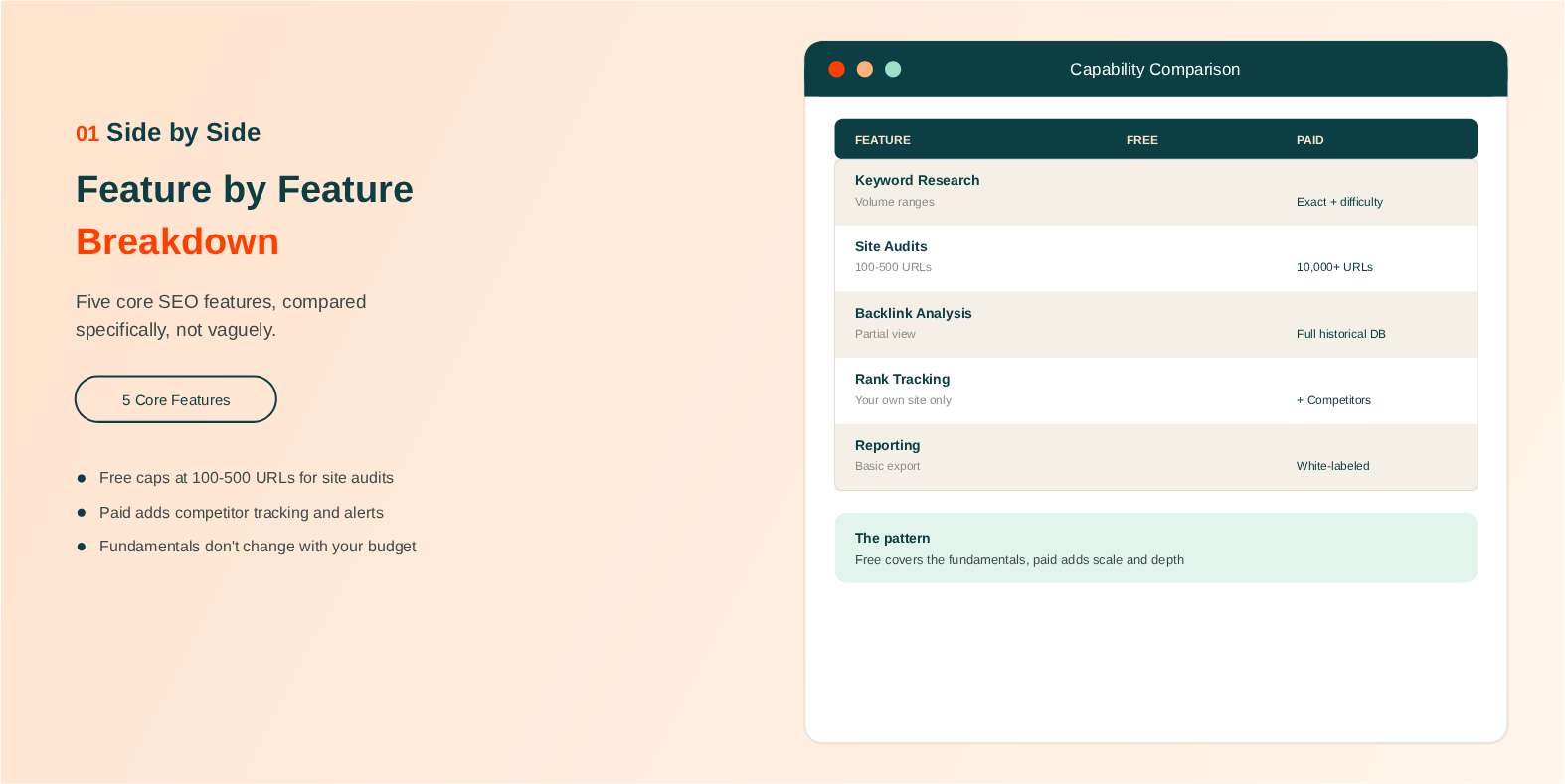
Free vs. Paid: Feature-by-Feature Breakdown
Laid out side by side, the pattern becomes pretty clear.
For keyword research, free gives you volume ranges and basic suggestions. Paid gives you exact volume numbers, keyword difficulty scores, and thousands of related terms surfaced at once instead of a handful you have to gather one search at a time.
For site audits, free typically caps at 100 to 500 URLs with the core issues flagged. Paid platforms crawl tens of thousands of pages with meaningfully deeper technical diagnostics layered on top, catching issues a smaller-scale free crawl would never even reach.
For backlink analysis, free shows a limited, partial view of your link profile. Paid shows a comprehensive, continuously updated database with historical link gain and loss tracked over time, letting you see not just what links you have now but how that profile has changed.
For rank tracking, free covers your own site's current rankings. Paid adds competitor tracking, historical position history, and automated alerts when something changes, turning rank tracking from a manual check into something that surfaces problems on its own.
For reporting, free tools offer basic exports at best. Paid tools offer fully customizable, white-labeled reports built specifically for client or stakeholder delivery, the kind of polish that matters once someone other than you is reading the output.
None of this is a mystery, and it's worth remembering that good SEO fundamentals haven't actually changed regardless of your budget. Google's own SEO Starter Guide covers the same core practices whether you're following them with a free toolkit or a $200-a-month platform. The tools change what you can measure and scale, not what actually makes a page rank well in the first place.
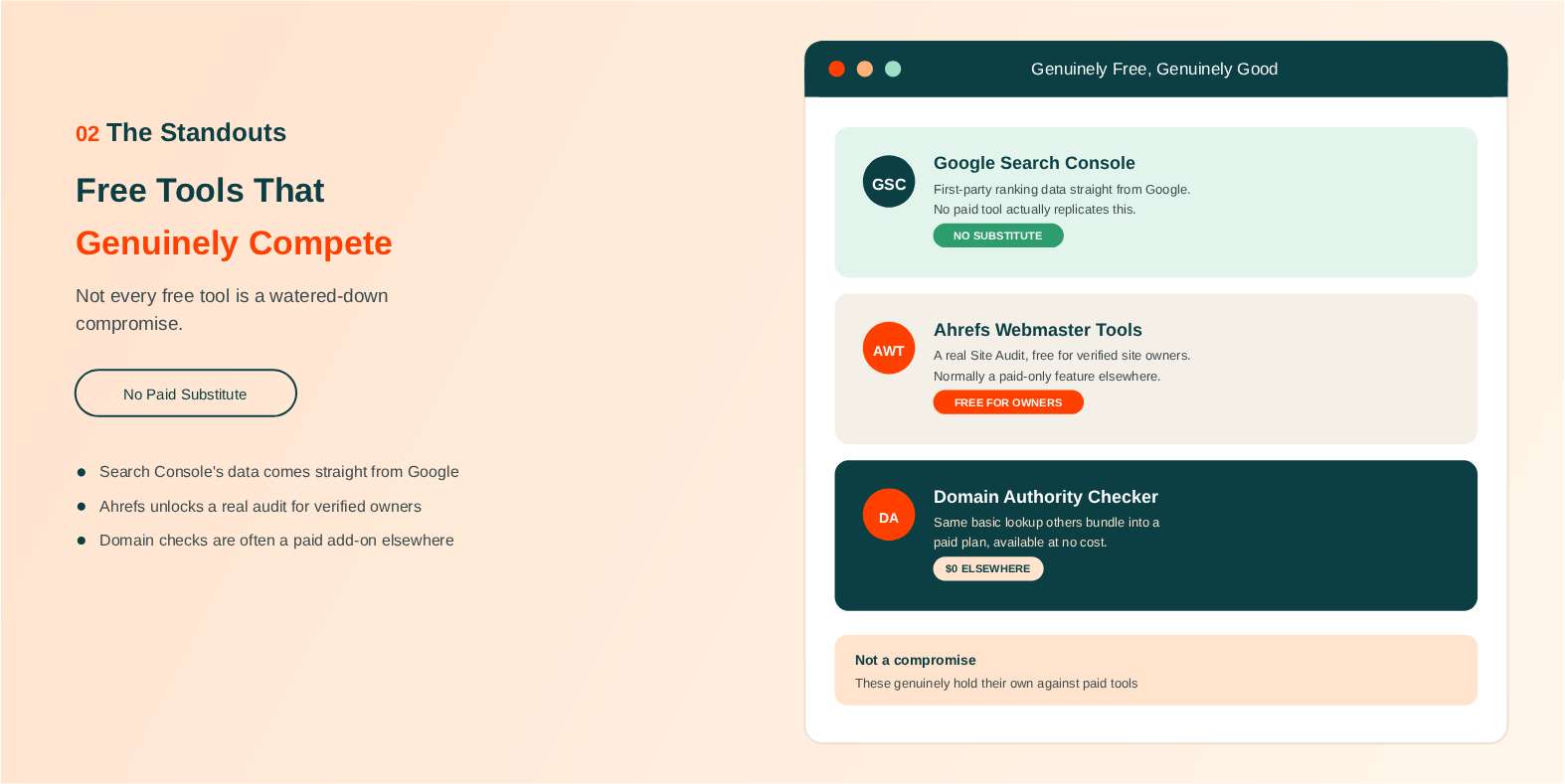
Free SEO Tools That Genuinely Compete With Paid Ones
Not every free tool is a watered-down compromise. A few genuinely hold their own against paid alternatives, and it's worth calling that out honestly.
Google Search Console is the clearest example. No paid tool actually replicates its data, because it comes directly from Google itself rather than being estimated or scraped. There's simply no paid substitute for first-party ranking and indexing data.
Ahrefs Webmaster Tools' free tier is another standout, giving verified site owners a real Site Audit and a limited Site Explorer, features that would otherwise sit entirely behind a paid plan for anyone else.
SEO Site Checker's Domain Authority Checker is a solid example in the domain-diagnostics space specifically, where several platforms charge for essentially the same basic lookup as part of a larger bundled subscription.
Where Paid Tools Clearly Win
To stay balanced, here's where the free tier genuinely runs out of road.
Scale is the big one. Managing multiple sites, or a single large site with thousands of pages, genuinely requires the crawl limits and data depth that only paid tools provide. Trying to force a free tool to cover that scope usually just means incomplete data rather than a genuine workaround.
Competitive intelligence is close to entirely paid-only. Comprehensive competitor keyword and backlink gap analysis just isn't something free tiers are built to offer, and it's genuinely hard to replicate with manual workarounds.
Time savings compound at scale too. Automated reporting and alerts save real, measurable hours once you're managing SEO across more than one property, hours that add up fast once you're not just checking one site's numbers once a week.
And agency or client work makes paid tools close to non-negotiable. White-labeled reporting and multi-user access stop being nice-to-haves the moment other people are depending on your output, since a basic spreadsheet export rarely meets the bar clients expect from a paid service relationship.
Building a Free-First SEO Stack
Here's a concrete, practical stack rather than an abstract discussion: Google Search Console and Analytics for tracking, Google Keyword Planner and Trends for research, a free on-page plugin like Yoast or Rank Math for optimization, PageSpeed Insights for technical health, and SEO Site Checker's free domain and SEO tools for domain-level diagnostics.
Assembled together, this combination genuinely replicates a meaningful share of what an entry-level paid SEO platform offers, just pulled from several specialized free tools instead of bundled into one subscription. Each piece does one job well, and together they cover research, writing, technical health, and domain diagnostics without a single monthly charge.
The real tradeoff is juggling more individual tools versus working from one unified dashboard. That's a genuine cost worth acknowledging honestly, rather than pretending the free stack is a completely frictionless replacement for a paid platform. You'll spend a bit more time moving between tools and manually connecting the dots between what each one tells you, since nothing here talks to each other automatically the way features inside one paid platform typically do. For most individuals and small sites, that extra bit of manual coordination is a reasonable price to pay for saving a real monthly bill.
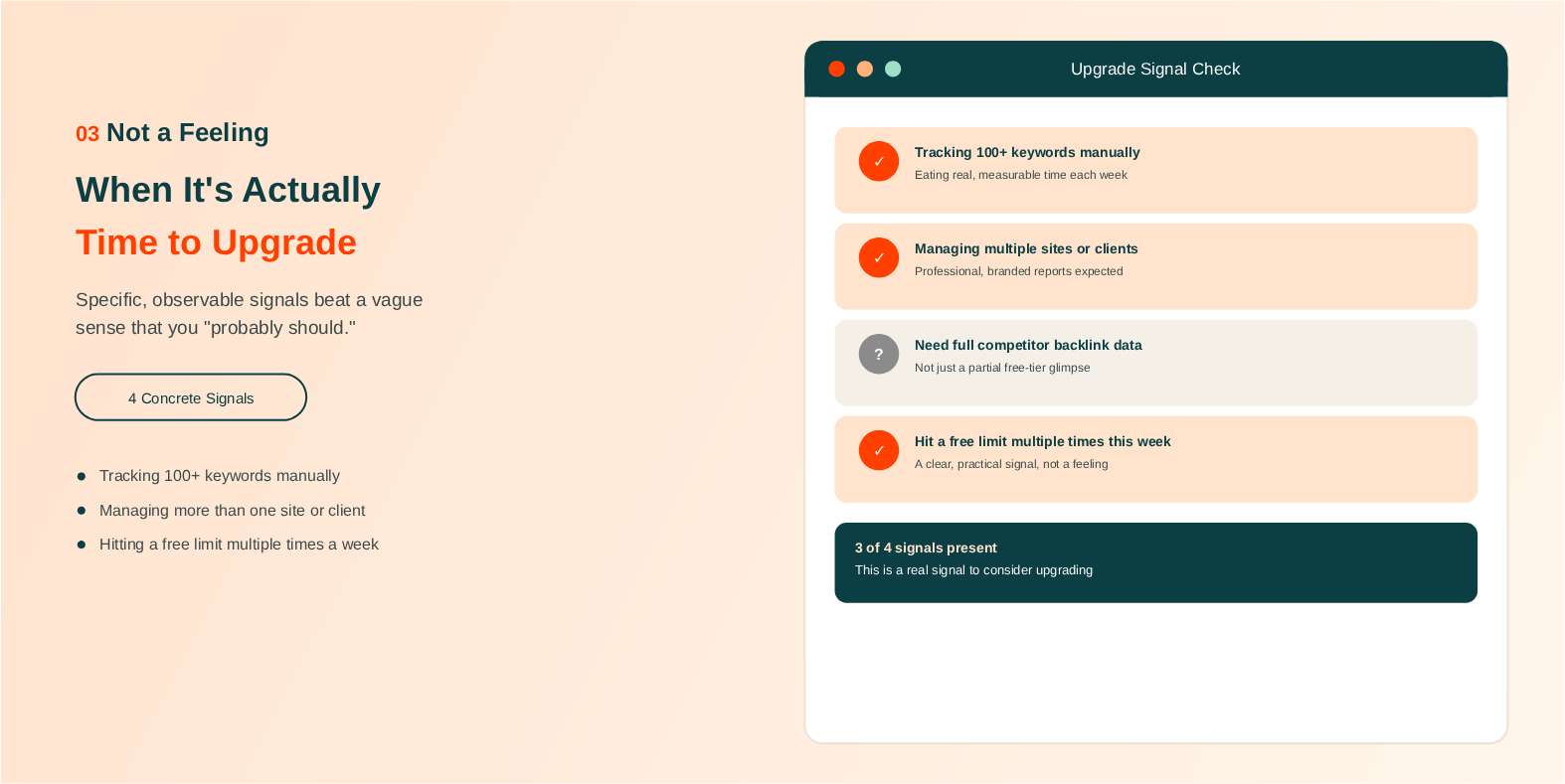
When It's Actually Time to Upgrade
A handful of specific, observable signals matter far more than a vague feeling that you "probably should" upgrade eventually.
You're tracking more than roughly 100 keywords and manually checking rankings is genuinely eating real time out of your week.
You're managing more than one site, or working with clients who expect professional, branded reports rather than a basic export.
You genuinely need to see a competitor's full keyword and backlink profile, not just the partial glimpse a free tier's limited view gives you.
You've hit a free tool's crawl or search limit multiple times in the same week. That's a clear, practical signal, not a vague sense that you should probably do something eventually.
Quick Reference: Free vs. Paid Capability Cheat Sheet
| Feature | What Free Gets You | What Paid Adds |
|---|---|---|
| Keyword research | Volume ranges, basic suggestions | Exact volume, difficulty scores, bulk data |
| Site audits | 100–500 URL cap, core issues | Tens of thousands of URLs, deep diagnostics |
| Backlink analysis | Partial, limited view | Comprehensive, continuously updated database |
| Rank tracking | Your own site's rankings | Competitor tracking, historical data, alerts |
| Reporting | Basic exports | Custom, white-labeled client reports |
| Domain diagnostics | Authority, WHOIS, DNS checks covered | Often bundled at extra cost elsewhere |
Final Thoughts
Free SEO tools genuinely cover a meaningful share of real, effective SEO work. The gap only really shows up at scale, once competitor intelligence matters, or once client reporting enters the picture.
For most people starting out, the right move is building the free stack first, and letting genuine, specific friction, not a vague feeling, tell you when it's actually time to pay for something. SEO Site Checker's free SEO tools are a solid starting point for the domain and technical side of that stack.
Frequently Asked Questions
Frequently Asked Questions (FAQs) is a list of common questions and answers provided to quickly address common concerns or inquiries.
Can I do SEO completely free?
Yes, for most of the fundamentals: keyword research, on-page optimization, and technical health checks are all genuinely achievable with free tools alone.
What's the biggest difference between free and paid SEO tools?
Scale and depth. Free tools cover the fundamentals well, while paid tools add larger crawl limits, deeper backlink data, and competitor intelligence.
Are free SEO tools accurate?
Tools pulling data directly from Google, like Search Console and Keyword Planner, are highly accurate. Third-party estimates are generally reliable but less precise than paid databases.
Is it worth paying for SEO tools as a small blog?
Usually not right away. Most small blogs can rely entirely on free tools until they hit a specific, observable limit like the ones described above.
What free SEO tool should I start with?
Google Search Console. It's the foundation almost everything else builds on, and no paid tool actually replicates its first-party data.
How much do paid SEO tools typically cost?
Entry-level paid SEO platforms generally start somewhere in the $50 to $130 per month range, with enterprise-tier plans running considerably higher.
Can free tools replace an all-in-one paid platform like Ahrefs or Semrush?
Partially. A well-assembled free stack covers a meaningful share of the same ground, but competitor gap analysis and large-scale crawls remain genuine gaps.
What's a good sign that I should upgrade to a paid tool?
Repeatedly hitting a free tool's search or crawl limit, managing multiple sites, or needing client-ready reports are all concrete, practical signals.