How to Convert Celsius to Fahrenheit: Free Converter
 Kendall Chris
Sep 02 /
1 month ago
Kendall Chris
Sep 02 /
1 month ago

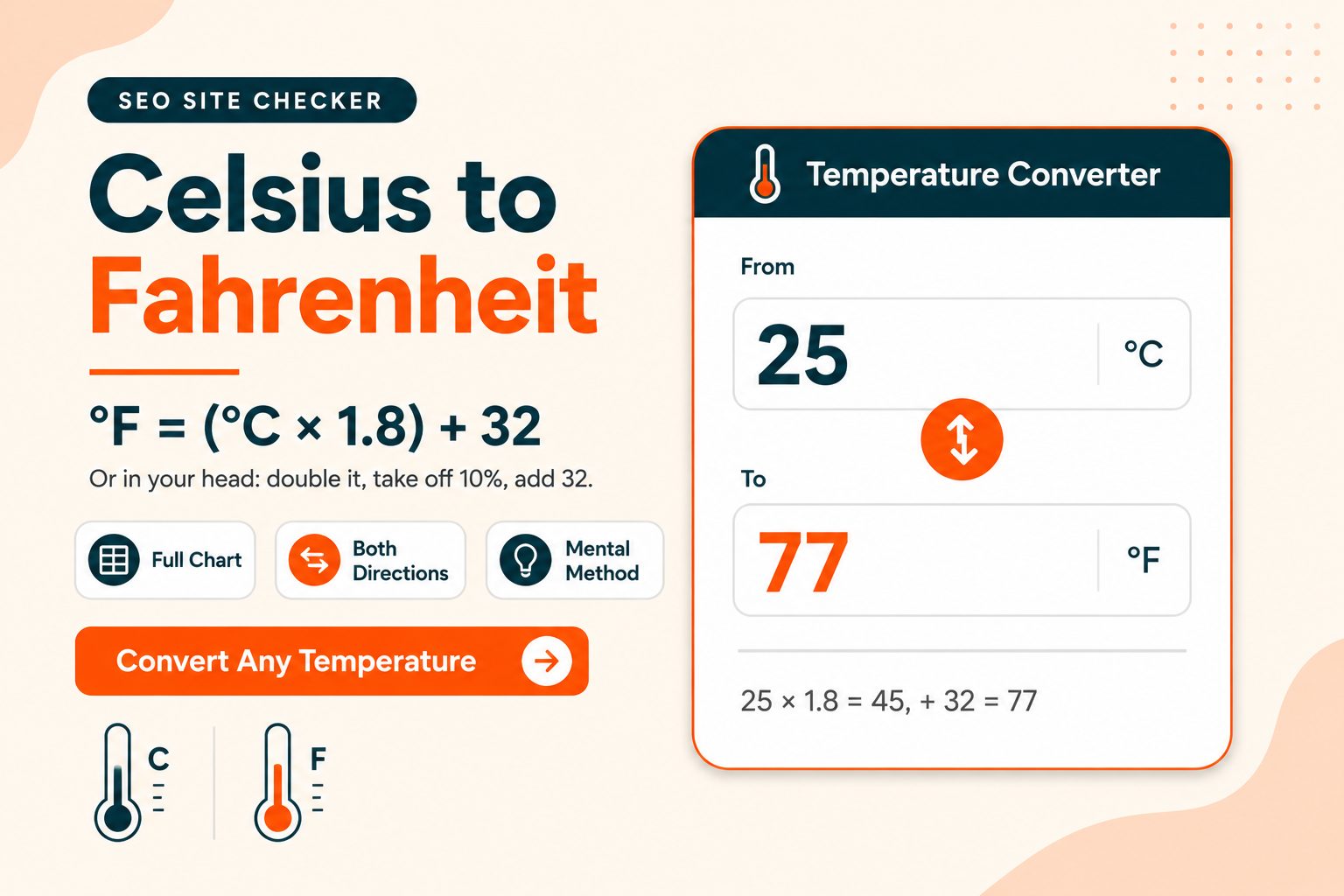
°F = (°C × 1.8) + 32
Multiply the Celsius value by 1.8, then add 32. For a rough estimate you can do in your head, double it and add 30.
Below: the full conversion chart, the reverse direction, an accurate mental method, and the temperatures worth memorising.
How to Convert Celsius to Fahrenheit: Free Converter
Three steps:
- Multiply the Celsius temperature by 1.8
- Add 32
- That is your Fahrenheit temperature
Example: 25°C × 1.8 = 45, then 45 + 32 = 77°F
The order matters. Multiply first, then add. Doing it the other way round gives you a number that is wrong by about 26 degrees, and it is the most common mistake people make with this conversion.
A converter is worth using when you are dealing with decimals, when the temperature is negative and the sign gets confusing, or when precision actually matters. Cooking and medical readings both fall into that last category, where being three degrees out is not acceptable.
The free Temperature Converter handles Celsius, Fahrenheit and Kelvin, with no signup and no usage limit.
The Celsius to Fahrenheit Formula
°F = (°C × 9/5) + 32
Since 9/5 equals 1.8, the same formula is more commonly written:
°F = (°C × 1.8) + 32
Both are identical. Use whichever you find easier to remember.
Here is why there are two operations rather than one, which is the thing that makes the formula stick rather than something you have to look up every time.
Two things differ between the scales.
The size of a degree. A Celsius degree is 1.8 times larger than a Fahrenheit degree. Water goes from freezing to boiling in 100 Celsius degrees but 180 Fahrenheit degrees, and 180 divided by 100 is 1.8. That is what the multiplication handles.
The starting point. Water freezes at 0°C but at 32°F. The scales do not begin in the same place. That is what the addition handles.
Compare this to converting kilograms to pounds, where you multiply by one number and stop. Weight conversions need one operation because only the unit size differs. Temperature needs two because the zero points differ as well.
Worked Examples
0°C = (0 × 1.8) + 32 = 32°F Freezing point of water.
20°C = (20 × 1.8) + 32 = 36 + 32 = 68°F Comfortable room temperature.
25°C = (25 × 1.8) + 32 = 45 + 32 = 77°F A warm day.
37°C = (37 × 1.8) + 32 = 66.6 + 32 = 98.6°F Normal body temperature.
100°C = (100 × 1.8) + 32 = 180 + 32 = 212°F Boiling point of water.
And one negative, since that is where people slip:
-10°C = (-10 × 1.8) + 32 = -18 + 32 = 14°F
Notice what happened there. The multiplication produced a negative number, and adding 32 pulled it back above zero. Keep the sign through the first step and the second step handles itself. 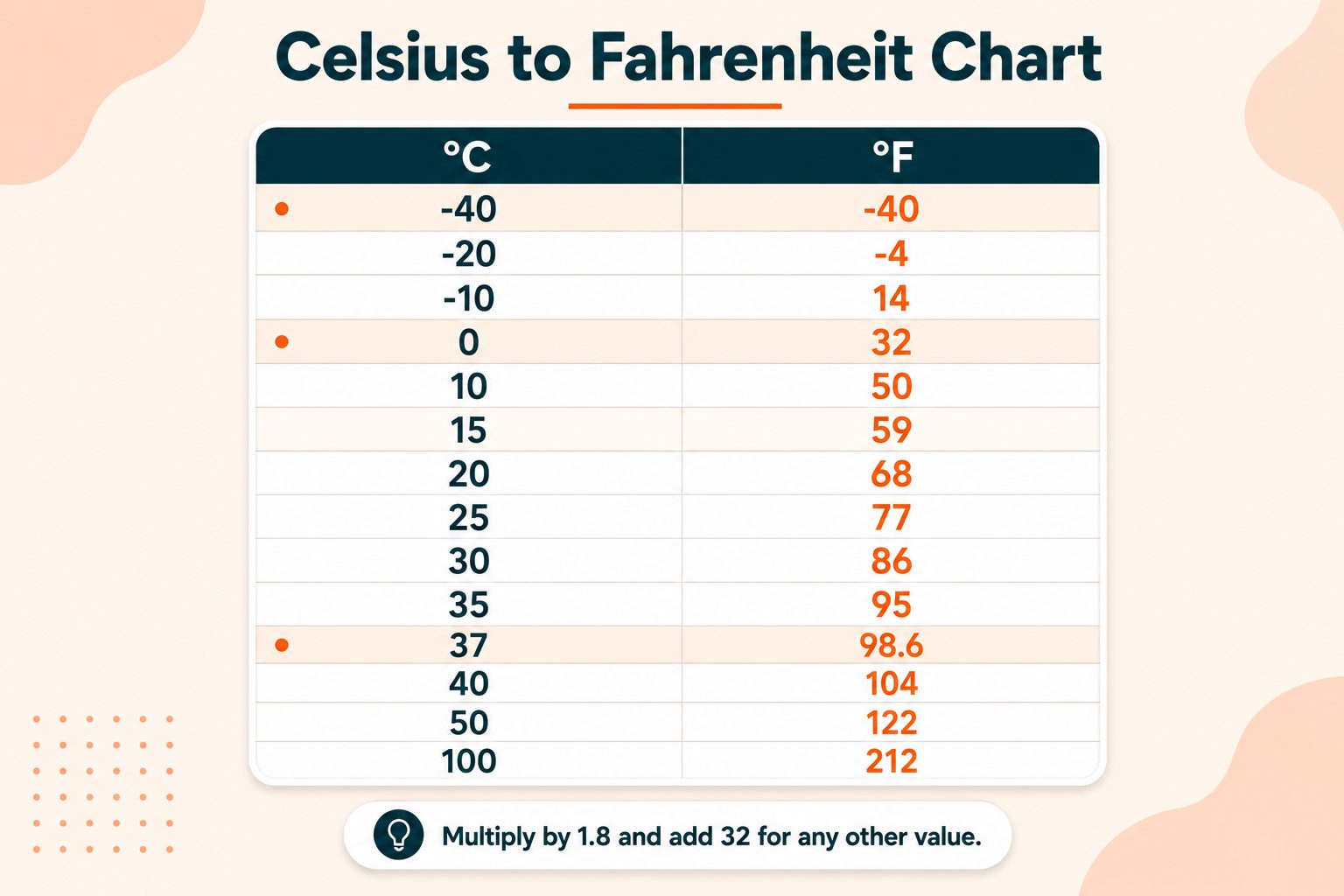
Celsius to Fahrenheit Conversion Chart
| °C | °F |
|---|---|
| -40 | -40 |
| -30 | -22 |
| -20 | -4 |
| -10 | 14 |
| 0 | 32 |
| 5 | 41 |
| 10 | 50 |
| 15 | 59 |
| 20 | 68 |
| 25 | 77 |
| 30 | 86 |
| 35 | 95 |
| 37 | 98.6 |
| 40 | 104 |
| 50 | 122 |
| 60 | 140 |
| 70 | 158 |
| 80 | 176 |
| 90 | 194 |
| 100 | 212 |
Converting Fahrenheit to Celsius
Going the other way reverses both operations, and reverses their order:
°C = (°F − 32) ÷ 1.8
Subtract 32 first, then divide. Dividing before subtracting is the equivalent mistake to adding before multiplying, and it produces an equally wrong answer.
70°F = (70 − 32) ÷ 1.8 = 38 ÷ 1.8 = 21.1°C 98.6°F = (98.6 − 32) ÷ 1.8 = 66.6 ÷ 1.8 = 37°C 32°F = (32 − 32) ÷ 1.8 = 0°C
| °F | °C |
|---|---|
| 0 | -17.8 |
| 32 | 0 |
| 50 | 10 |
| 68 | 20 |
| 77 | 25 |
| 86 | 30 |
| 98.6 | 37 |
| 100 | 37.8 |
| 212 | 100 |
| 350 | 176.7 |
How to Convert Celsius to Fahrenheit in Your Head
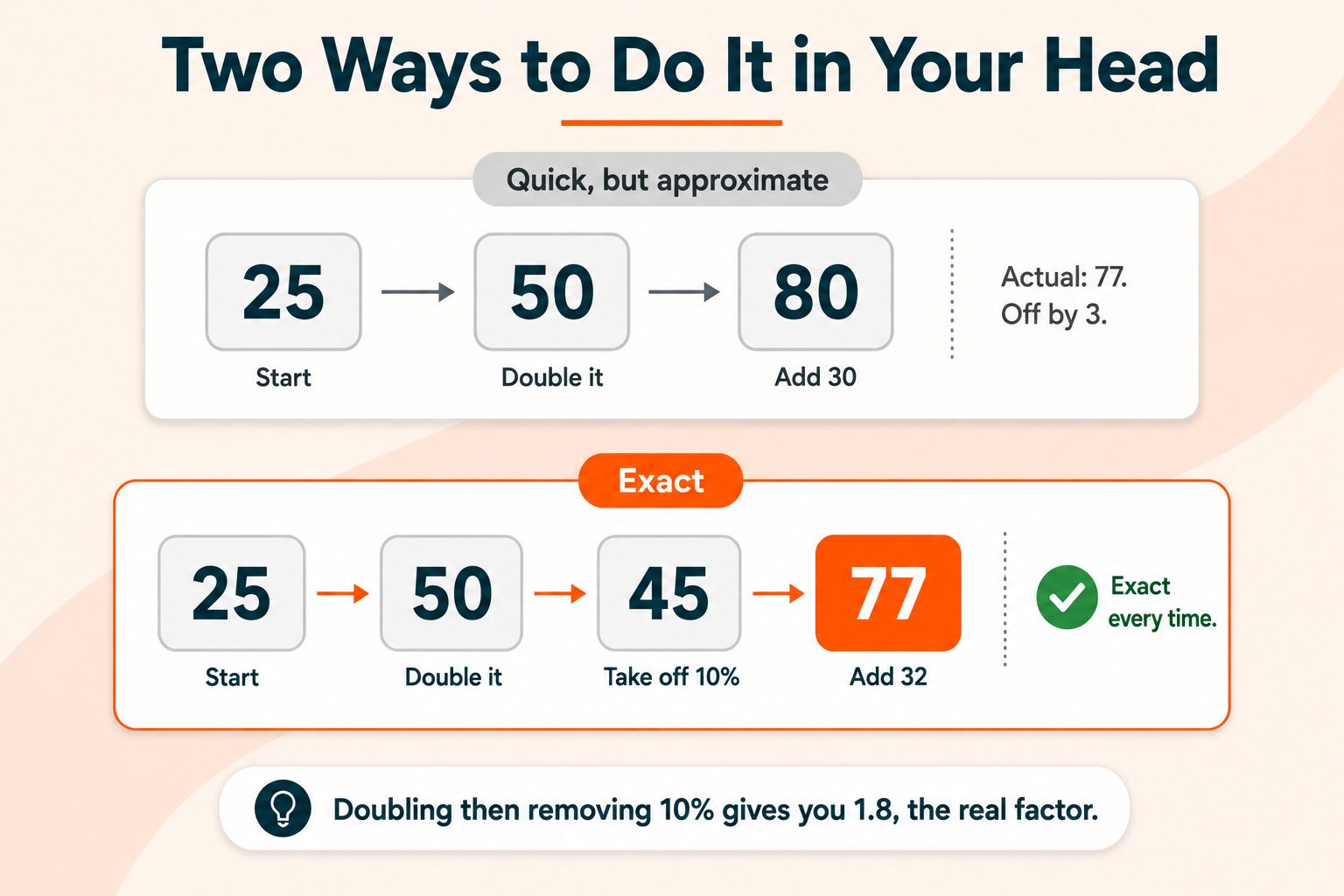
Two methods. One is fast and approximate. One is barely slower and exact.
The quick method: double it and add 30
25°C → double to 50 → add 30 → 80°F
The real answer is 77, so you are three degrees out. For deciding whether to take a jacket, that is fine.
Know where it breaks down, though. The shortcut uses 2 in place of 1.8, so the error grows with the temperature. Around room temperature you are within three degrees. At 100°C you are eighteen degrees out, which is no longer a rounding error.
Use it for weather. Do not use it for anything else.
The accurate method: double it, take off 10 percent, add 32
25°C → double to 50 → subtract 5 (10 percent of 50) → 45 → add 32 → 77°F
That is exact.
It works because doubling and then removing 10 percent gives you 1.8, which is the actual conversion factor. You are doing the real formula, just in steps your head can handle.
Try it on 30°C: double to 60, subtract 6, gives 54, add 32, gives 86°F. Correct.
The second method takes maybe two seconds longer than the first and it is right every time. Worth learning.
Temperatures Worth Memorising
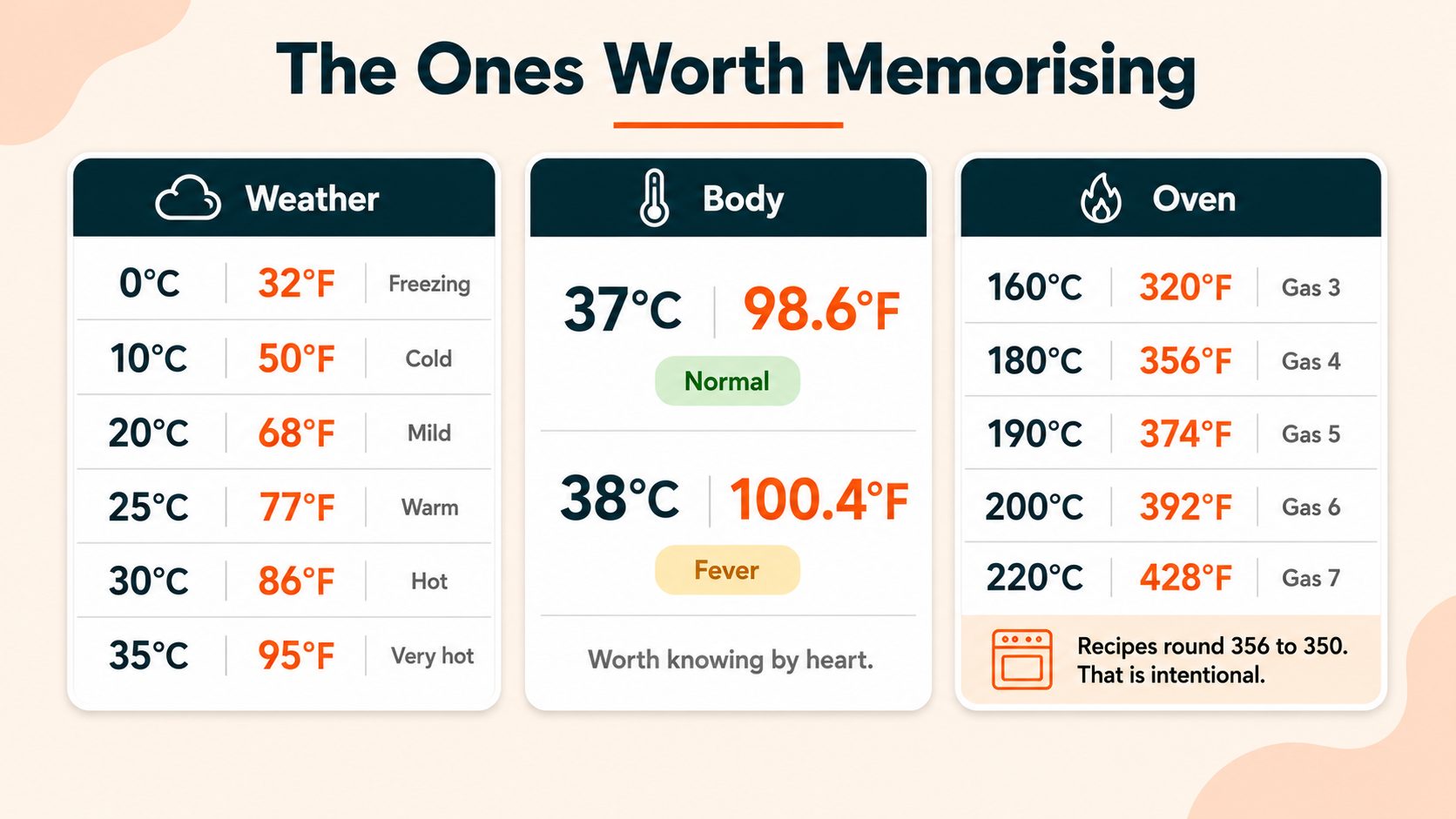
A handful of anchor points cover most everyday situations without any arithmetic.
Weather
| °C | °F | What it feels like |
|---|---|---|
| 0 | 32 | Freezing |
| 10 | 50 | Cold, coat weather |
| 20 | 68 | Mild |
| 25 | 77 | Warm |
| 30 | 86 | Hot |
| 35 | 95 | Very hot |
Body temperature
Normal is around 37°C, which is 98.6°F. A fever is generally considered to start at 38°C, or 100.4°F.
Those two numbers are worth knowing by heart if you travel between countries that use different scales, because it is exactly the moment you do not want to be doing arithmetic.
Oven temperatures
| °C | °F | Gas mark |
|---|---|---|
| 160 | 320 | 3 |
| 180 | 356 | 4 |
| 190 | 374 | 5 |
| 200 | 392 | 6 |
| 220 | 428 | 7 |
One practical note on cooking. Recipes round these. A UK recipe calling for 180°C will usually appear in a US version as 350°F rather than the exact 356°F. That is intentional rather than an error, because ovens are not precise enough for six degrees to matter and 350 is a standard dial marking. Follow the recipe's own convention rather than converting exactly.
The One Temperature Where Both Scales Agree
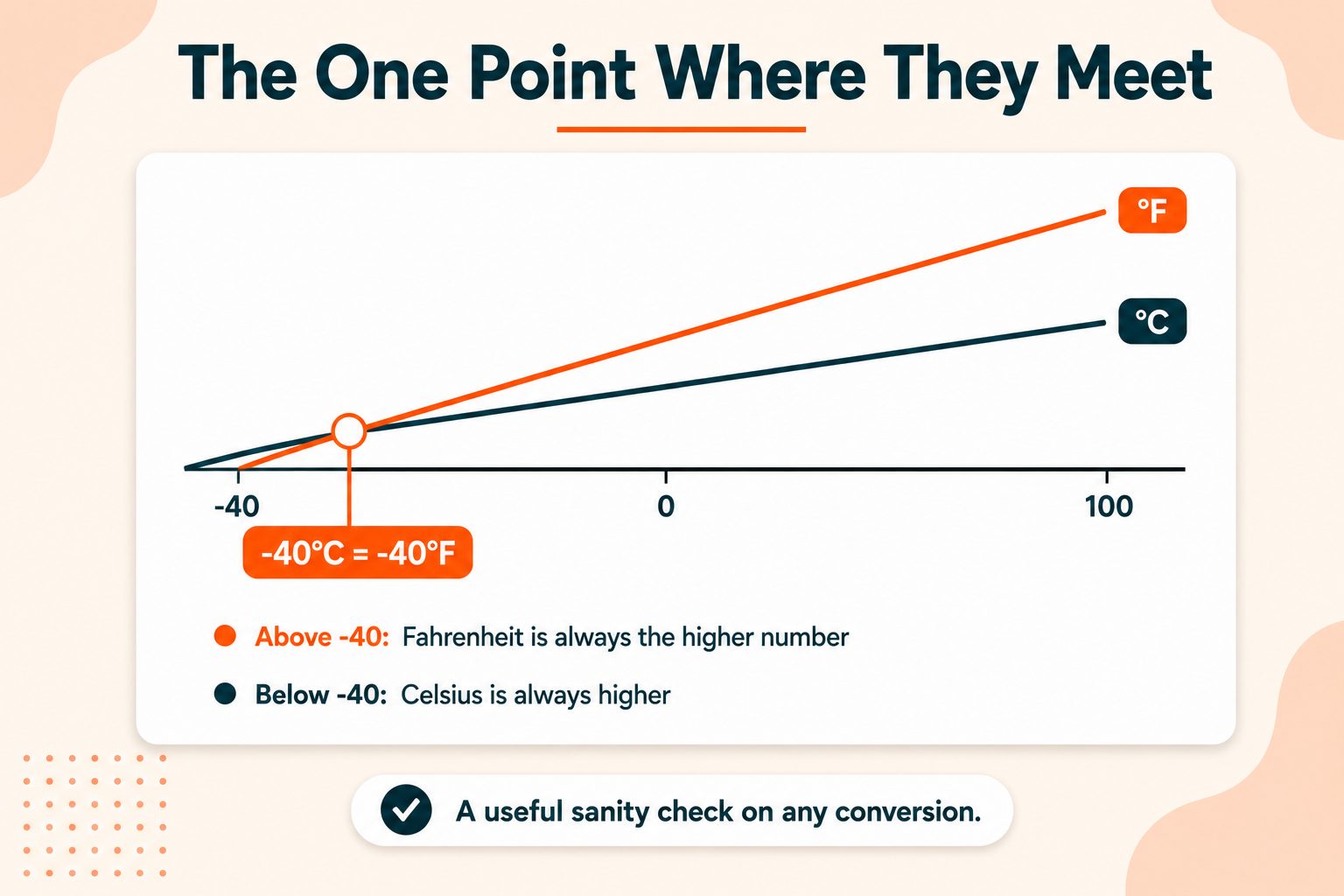
-40°C = -40°F. Exactly the same number.
It is the single point where the two scales cross, and it happens because one scale climbs faster than the other from a different starting point. Somewhere they have to meet, and that somewhere is -40.
You can prove it in one line. Set the two equal to each other:
°C = (°C × 1.8) + 32Solve for °C and you get -40.
Beyond being a good piece of trivia, this is a useful sanity check. Above -40, the Fahrenheit number is always the larger of the two. Below -40, the Celsius number is larger. If your conversion breaks that rule, you have made an arithmetic error somewhere.
What Are Celsius and Fahrenheit?
Celsius was devised in the 1740s, with 0 at the freezing point of water and 100 at its boiling point under standard pressure. It is used by nearly every country in the world and in science everywhere, including in the United States. In the SI system it is formally tied to the kelvin, which is the base unit of temperature. The BIPM's definition of the kelvin sets that out.
Fahrenheit came earlier, in the early 1700s. Water freezes at 32°F and boils at 212°F on this scale. It remains in everyday use in the United States and a small number of other places. Britannica on the Fahrenheit scale covers how the original reference points were chosen, which is a stranger story than you might expect.
One small notation point, since it comes up. In formal and technical writing, the correct form includes a space before the degree symbol: 25 °C rather than 25°C. NIST Special Publication 811 documents the convention. In everyday writing nobody minds, and this page uses the closed-up form throughout because that is what people read.
Common Conversion Mistakes
- Adding 32 before multiplying. Multiply first, then add. Reversing them is off by roughly 26 degrees.
- Dividing before subtracting on the reverse. Subtract 32 first, then divide by 1.8.
- Using 2 instead of 1.8 for anything precise. Fine for weather, wrong for cooking and medical readings.
- Losing the sign on negative temperatures. Carry the minus through the multiplication.
- Confusing Celsius with kelvin. Kelvin uses no degree symbol and starts at absolute zero, which is -273.15°C.
- Converting oven temperatures exactly. Recipes round. Follow the recipe's convention rather than your calculator.
Quick Reference
Celsius to Fahrenheit: multiply by 1.8, add 32 Fahrenheit to Celsius: subtract 32, divide by 1.8 In your head: double it, take off 10 percent, add 32 Sanity check: above -40, the Fahrenheit number is always larger
The chart above covers the temperatures people look up most often. If you also work between metric and imperial weights, the same principles apply to converting weight between kilograms and pounds, though that one only needs a single operation.
Frequently Asked Questions
Frequently Asked Questions (FAQs) is a list of common questions and answers provided to quickly address common concerns or inquiries.
How do you convert Celsius to Fahrenheit?
Multiply the Celsius value by 1.8, then add 32. For example, 25°C × 1.8 = 45, plus 32 gives 77°F.
What is the formula for Celsius to Fahrenheit?
°F = (°C × 9/5) + 32, which is the same as °F = (°C × 1.8) + 32. Multiply before adding.
What is 37 degrees Celsius in Fahrenheit?
37°C is 98.6°F, which is normal human body temperature.
What is 100 Celsius in Fahrenheit?
100°C is 212°F, the boiling point of water at standard pressure.
What is the easy way to convert Celsius to Fahrenheit?
Double the Celsius value and add 30 for a rough answer. For an exact one, double it, subtract 10 percent, then add 32.
At what temperature are Celsius and Fahrenheit the same?
At -40 degrees. -40°C equals -40°F exactly, and it is the only point where the two scales meet.
What is 180 Celsius in Fahrenheit?
180°C is 356°F. Most recipes round this to 350°F, since ovens are not precise enough for the difference to matter.
Is 20 degrees Celsius hot or cold?
20°C is 68°F, which is mild and comfortable. Most people find it pleasant indoors and slightly cool outdoors.
What is a fever in Celsius and Fahrenheit?
A fever is generally considered to start at 38°C, which is 100.4°F. Normal body temperature is around 37°C or 98.6°F.
Why does the United States still use Fahrenheit?
Largely historical inertia. The US adopted Fahrenheit before metrication spread and never fully switched, though it uses Celsius in science and medicine.