Compress PDF Free: Reduce File Size Without Losing Quality
 Kendall Chris
Sep 04 /
1 month ago
Kendall Chris
Sep 04 /
1 month ago

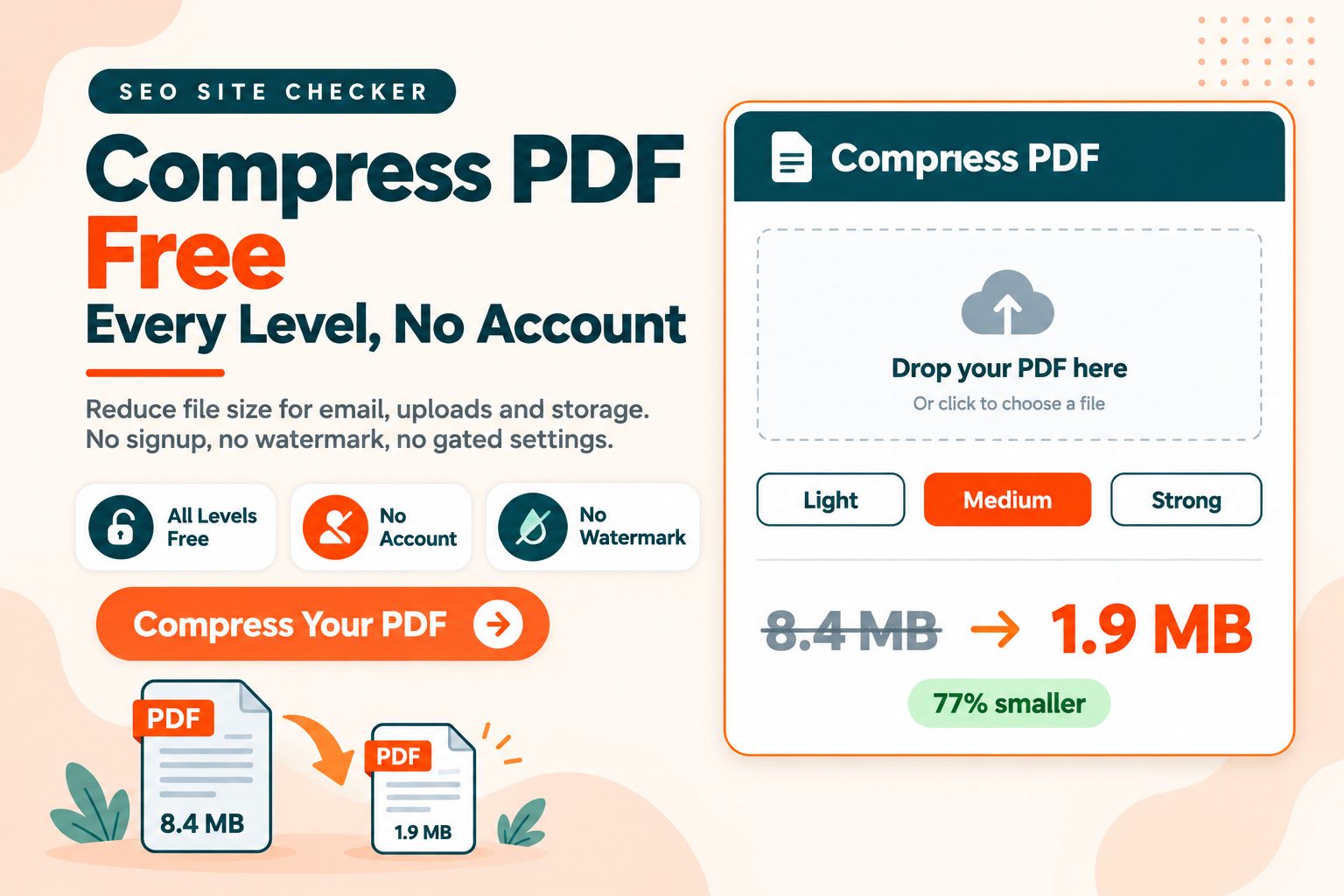
Your PDF is too big. The email bounced, or the upload form rejected it, and you need a smaller file in the next two minutes.
Below the tool you will find what actually makes a PDF large, what compression takes away, which level to pick for what you are doing, and what to try when compression alone is not enough.
How to Reduce PDF File Size for Free
Four steps:
- Upload your PDF
- Choose a compression level
- Compress
- Download the smaller file
That is the whole process, and it takes a few seconds. What matters more is which level you choose.
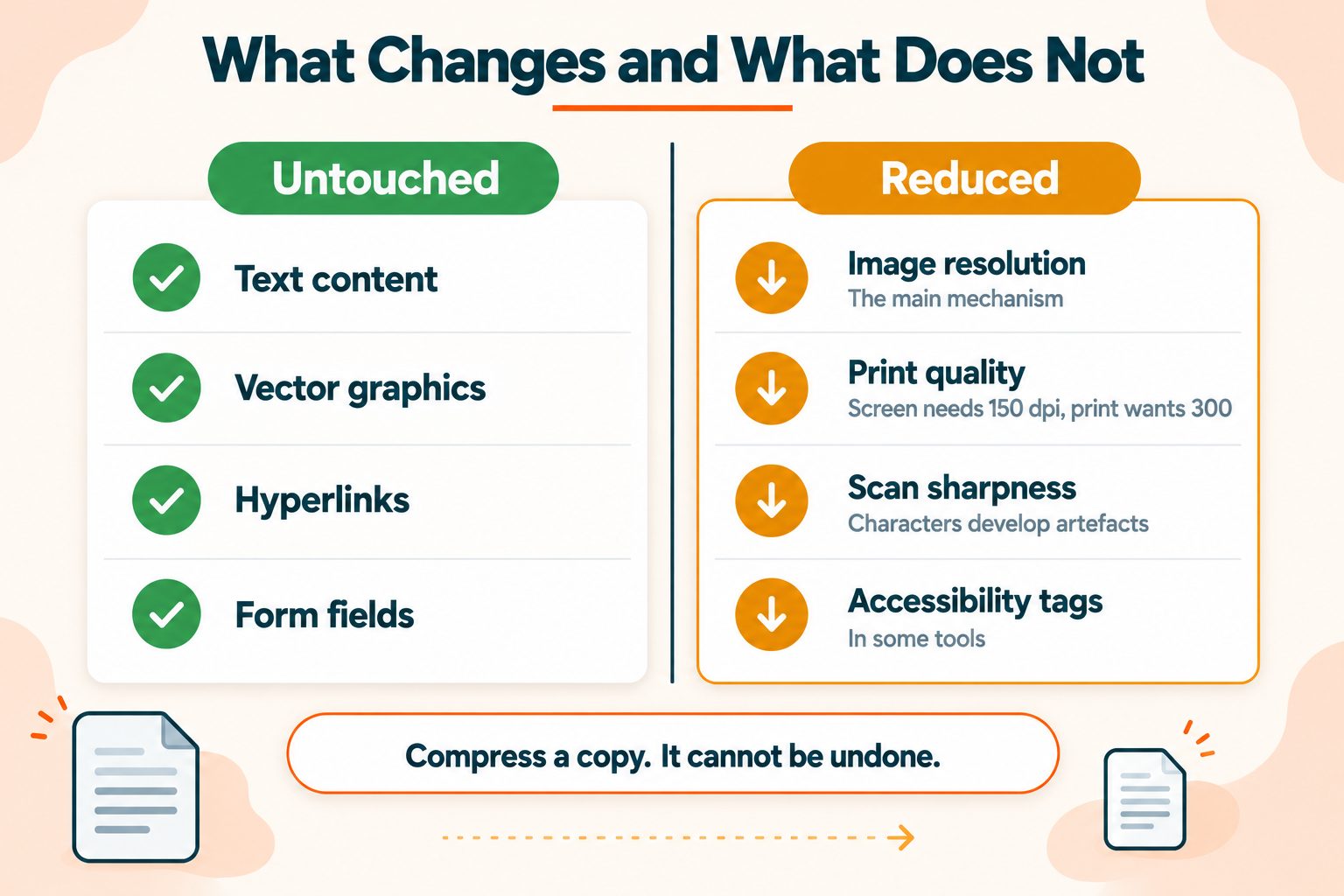
Compression levels trade file size against image quality. A lighter setting keeps more detail in your images and produces a larger file. A stronger setting reduces image resolution more aggressively and produces a smaller one. Text and vector graphics are usually untouched at any level.
Start with the middle setting and check the result. Most people go straight to maximum compression, end up with a document that is hard to read, and assume that is simply how compression works. It is not. Step up only if the middle setting has not got you small enough.
The tool is free with no signup and no usage limit.
[PLACEHOLDER: file size limit] Every competitor on this SERP states theirs. Confirm the number in your admin panel and add it here.
[PLACEHOLDER: compression level labels] The levels above are described generically. Send the tool screenshot and this section gets rewritten to match the actual labels and any additional options.
Why Your PDF Is Large in the First Place
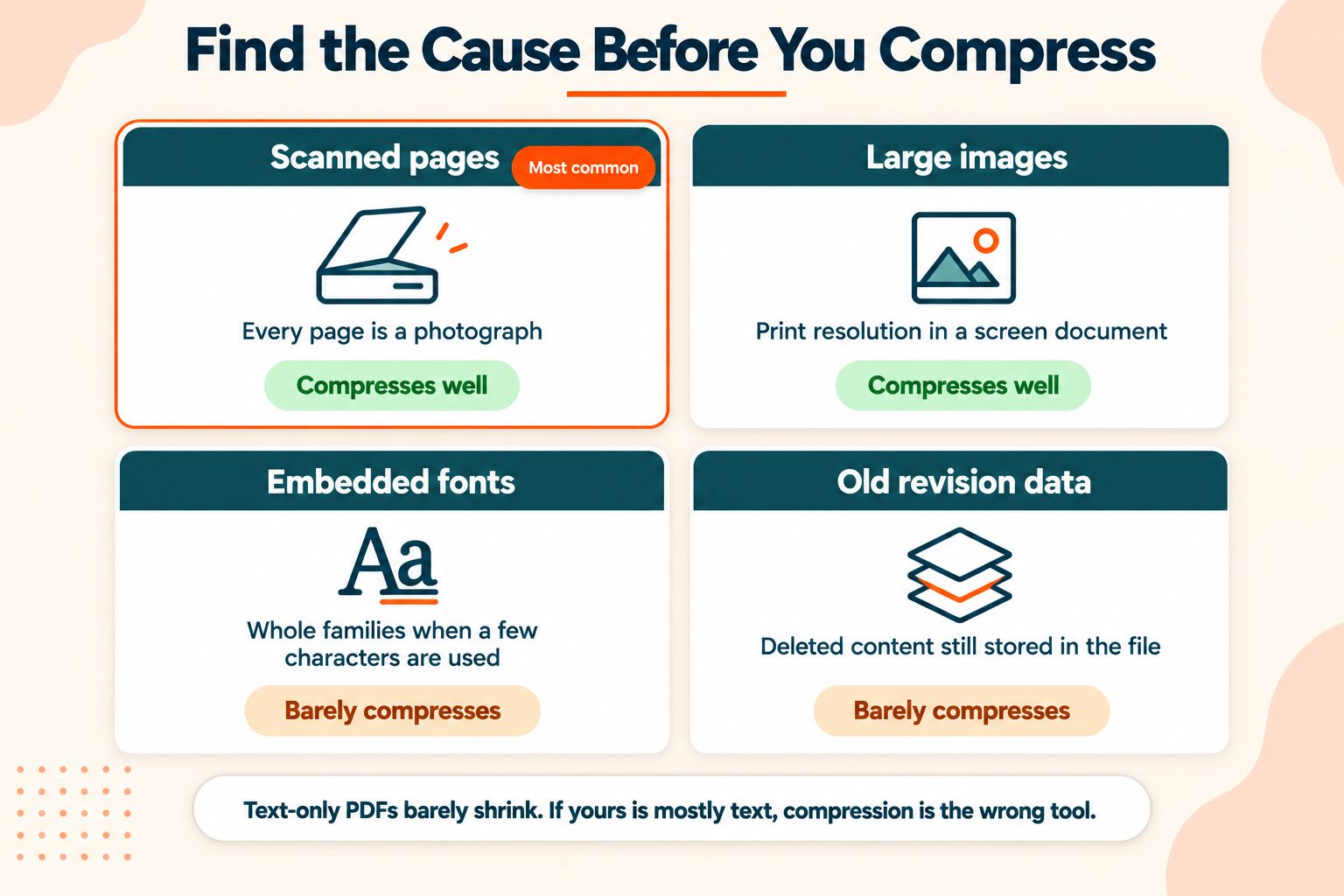
Most people compress without knowing what they are compressing. Knowing the cause tells you whether compression will help at all.
Scanned pages. This is the most common cause by a wide margin. A scanned document is not text, it is a stack of photographs. Twenty pages scanned at 600 dpi can easily exceed 40 MB before anything else is added. Scans compress very well, so if this is your situation you are in luck.
High-resolution images. Photographs placed at print resolution inside a document that will only ever be read on a screen. Also compresses well.
Embedded fonts. When a PDF embeds complete font families rather than just the characters actually used, it can add several megabytes. Compression barely touches this, because the weight is not in the images.
Accumulated metadata and revision history. Files that have been edited repeatedly can carry deleted content, old revisions, and leftover form data. None of it is visible and all of it is stored.
Here is the diagnostic that saves you a wasted attempt: a text-only PDF barely compresses. Text data is already compact. If your file is mostly text and it is still large, the weight is coming from fonts or accumulated data, and a compressor is the wrong tool. The section on other methods below covers what to do instead.
If you want to understand what a PDF actually contains, the PDF Association is the nonprofit body that governs the format, and ISO 32000, the PDF specification is the formal standard behind it.
What Compression Actually Does to Your File
Every tool on this subject tells you compression is lossless or that quality is preserved. That is not quite true, and knowing what you are trading matters.
Most PDF compression works by reducing the resolution of embedded images and re-encoding them more aggressively. Text and vector content are generally left as they are. So the question is never really "will my PDF lose quality," it is "how much do the images matter in this particular document."
What you can lose:
Print quality. Screen viewing needs 72 to 150 dpi. Printing wants 300. A file compressed for email will look noticeably poor on paper, and you cannot get that back.
Scanned text sharpness. Over-compress a scan and characters develop visible artefacts. If the document has an OCR text layer, the searchable text often survives while the visible image degrades, which produces the odd result of a document you can search but struggle to read.
Fine detail in diagrams. Thin lines, small labels, and chart axes suffer before photographs do.
Accessibility structure. Some optimisation processes strip the tags that screen readers rely on to navigate a document. If you have accessibility obligations, check the output rather than assuming. The W3C's accessibility guidelines set out what tagged documents need to preserve.
One rule covers most of this: compress a copy, never your original. Compression is not reversible. If you need the quality back, you need the source file, and if you overwrote it you no longer have one.
Choosing the Right Compression Level
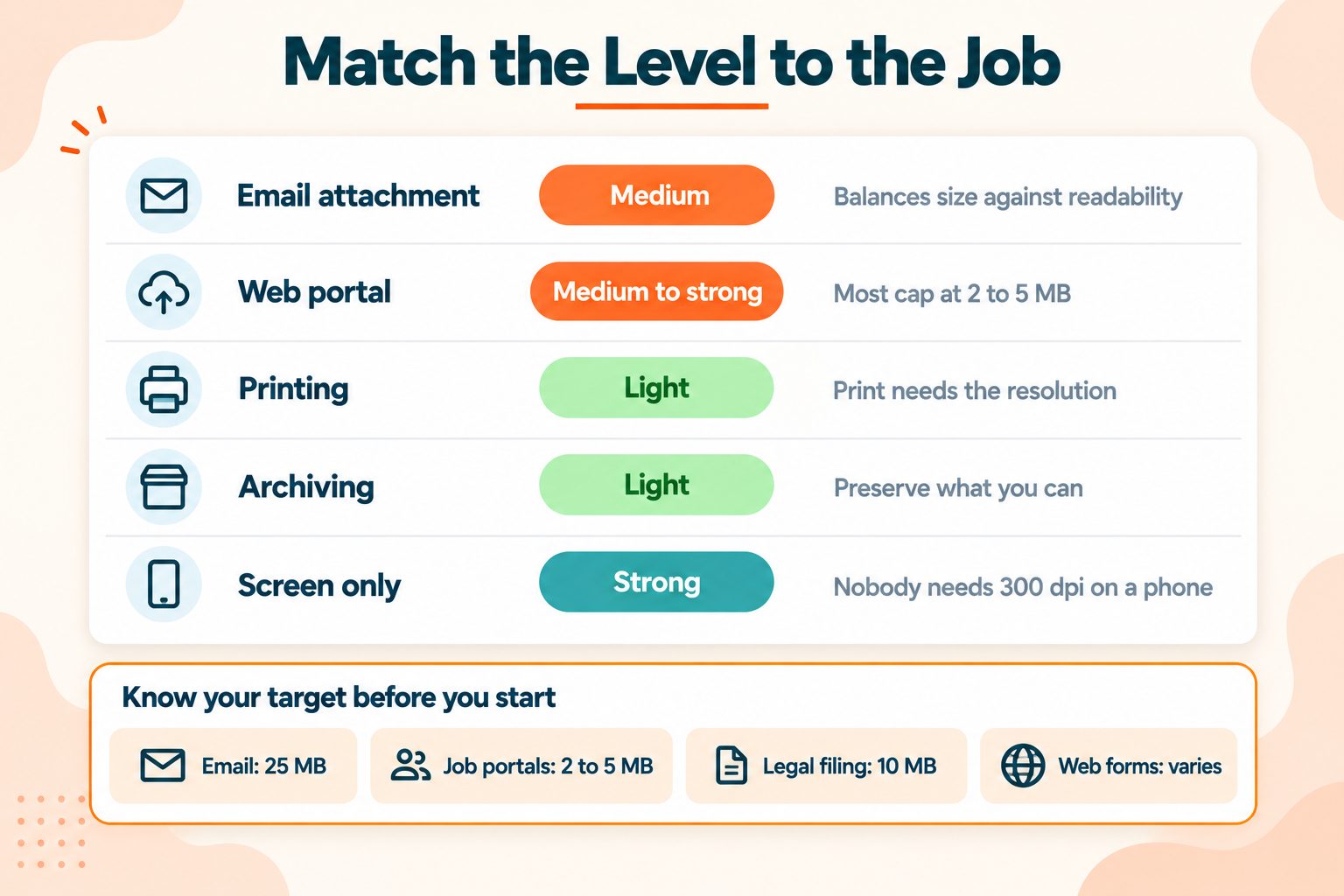
Match the level to what the file is for, rather than always reaching for maximum.
| What it is for | Level | Why |
|---|---|---|
| Email attachment | Medium | Balances size against readability |
| Web portal or upload form | Medium to strong | Most portals cap at 2 to 5 MB |
| Printing | Light, or none | Print needs the resolution |
| Long-term archiving | Light | Preserve what you can |
| Screen reading only | Strong | Nobody needs 300 dpi on a phone |
It also helps to know the number you are aiming at before you start:
- Email providers generally cap attachments around 25 MB
- Job application portals commonly cap at 2 to 5 MB
- Government and legal filing systems often cap at 10 MB
- Web upload forms vary enormously, so check the limit before compressing
Compressing toward a specific target is more efficient than compressing and hoping. If the portal says 5 MB and your file is 6 MB, light compression will do it and you keep the quality.
A Note on Privacy
Worth thinking about before you upload anything sensitive to any tool, including this one.
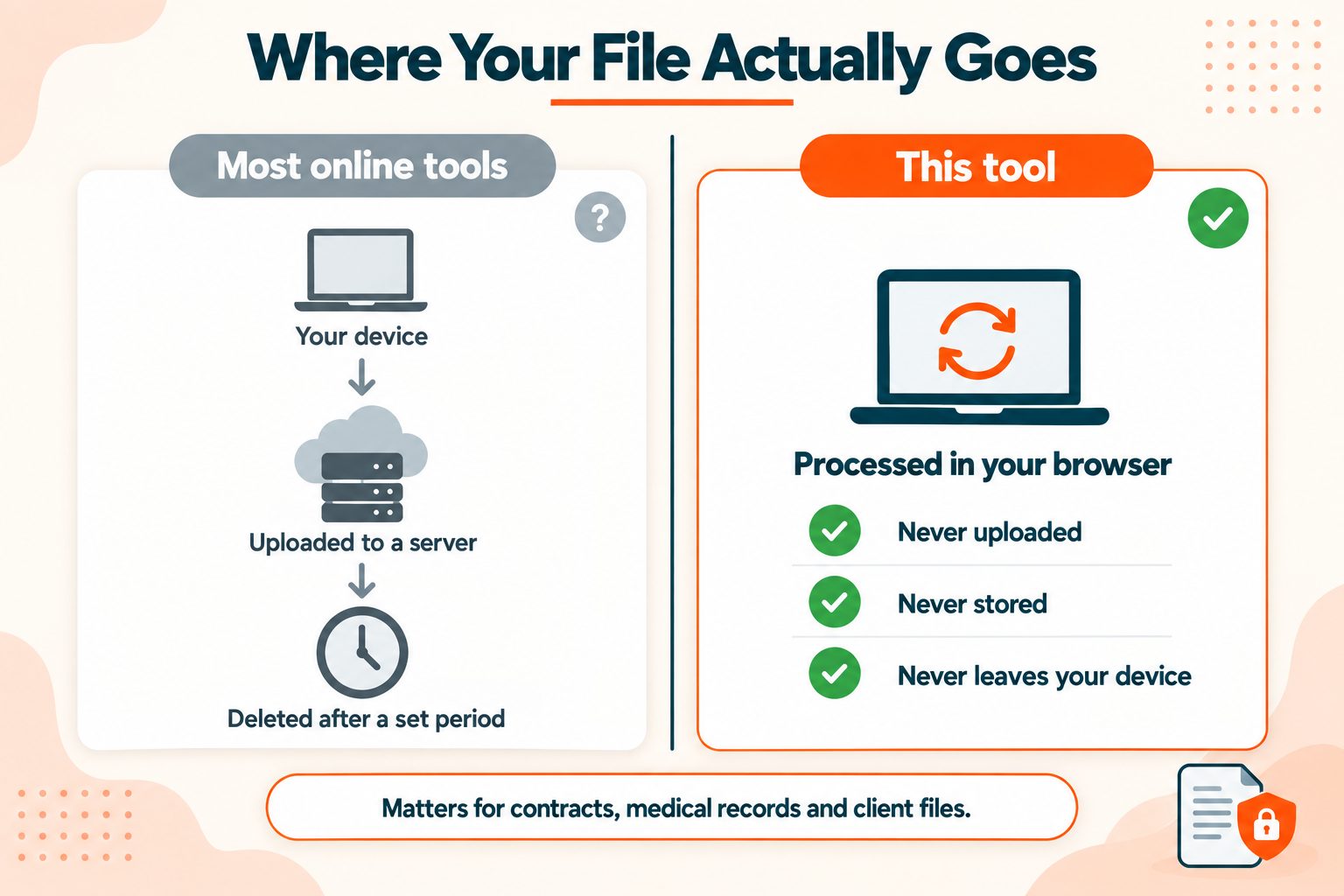
Most online PDF compressors upload your file to a server, process it there, and delete it after some period. That is simply how server-side processing works, and for a holiday itinerary or a public report it is fine.
It is a different question for a signed contract, a medical record, a tax return, or a document containing someone else's personal data.
Three things worth checking before you upload a sensitive document to any web tool:
- Whether the tool processes in your browser or on a server
- What the stated retention period is, which ranges from immediate deletion to several hours
- Whether your workplace has data handling rules that cover client documents
For genuinely confidential files, a desktop tool or your operating system's built-in print-to-PDF option keeps the document on your own machine.
[PLACEHOLDER: processing model] This section is written as general guidance and makes no claim about how this tool works, because I do not know yet. Confirm whether compression happens server-side or in the browser, and what the retention period is, and I will rewrite this section to state it directly. On a page about handling sensitive documents, getting this wrong would be worse than not raising it.
Other Free Ways to Reduce PDF Size
Compression is not always the right answer, and sometimes it is not the best one.
Print to PDF. On Windows and macOS you can print a PDF back out to PDF using the built-in printer. This often strips accumulated bloat from files that have been edited many times. Free, already installed, and surprisingly effective on exactly the files compression struggles with.
Export at a lower setting from the source. If you still have the original Word, Pages, or design file, exporting it at screen resolution produces a better result than compressing the finished PDF. You are choosing quality rather than removing it.
Compress the images first. For image-heavy documents where you have the original photos, compressing the images before you build the PDF gives a cleaner outcome than compressing the assembled file. You can also resize them to the dimensions they actually appear at, which is often the bigger saving.
Remove pages you do not need. Blank scanned pages, cover sheets, and duplicated appendices add weight for nothing.
Split the document. Sometimes the answer is not one smaller file but two files.
When Compression Is Not Enough
If the file is still too large after strong compression, the cause is usually one of three things: a very high-resolution scan, a document that is mostly full-page images, or simply a very long document.
Your options at that point:
- Rescan at a lower dpi if you still have the physical document. 200 to 300 dpi is plenty for most purposes and produces a fraction of the file size
- Split it and send the parts separately
- Share a cloud storage link instead of attaching the file
- Ask whether PDF is required. If the recipient just needs to read it, other formats may be much smaller
And a reality check worth stating: a 300-page scanned document has a floor. Below a certain size it stops being legible, and no tool changes the physics of that. If you are fighting a limit that a legible file cannot meet, the answer is splitting or a different delivery method rather than more compression.
Wrapping Up
Two rules cover most of it.
Compress a copy, not your original. Compression cannot be undone, and if you need the quality back you will need the source file.
Match the level to the purpose. Maximum compression is the right choice for a document nobody will print and the wrong choice for almost everything else.
Frequently Asked Questions
Frequently Asked Questions (FAQs) is a list of common questions and answers provided to quickly address common concerns or inquiries.
How do I reduce the size of a PDF for free?
Upload it to a free compressor, pick a compression level, and download the result. Start with a middle setting and increase only if needed.
How can I compress a PDF without losing quality?
Use the lightest setting that gets you under your target size. Text and vector content are unaffected; only images lose detail as compression increases.
Why is my PDF file so large?
Usually scanned pages or high-resolution images. Embedded fonts and accumulated revision data are common causes too, and neither compresses well.
How do I make a PDF small enough to email?
Most email providers cap attachments around 25 MB. Medium compression handles most files. For larger documents, split them or share a cloud link.
Is it safe to compress a PDF online?
For ordinary documents, yes. For contracts, medical records or client files, check whether the tool uploads to a server and what its retention period is.
Does compressing a PDF reduce quality?
Image quality, yes. Text and vector graphics are normally untouched. How noticeable it is depends on how image-heavy the document is.
How small can a PDF be compressed?
Image-heavy files often drop by 50 to 80 percent. Text-only files barely shrink, since text data is already compact.
Can I compress a PDF on my phone?
Yes. Browser-based compressors work on mobile without installing anything, though very large files may be slow on a mobile connection.
How do I compress a PDF without Adobe?
Any free online compressor works, as does printing to PDF using your operating system's built-in printer, which needs no software at all.
Will compression affect a scanned document's text?
If the scan has an OCR text layer, the searchable text usually survives. The visible image can degrade, so check readability after compressing.