
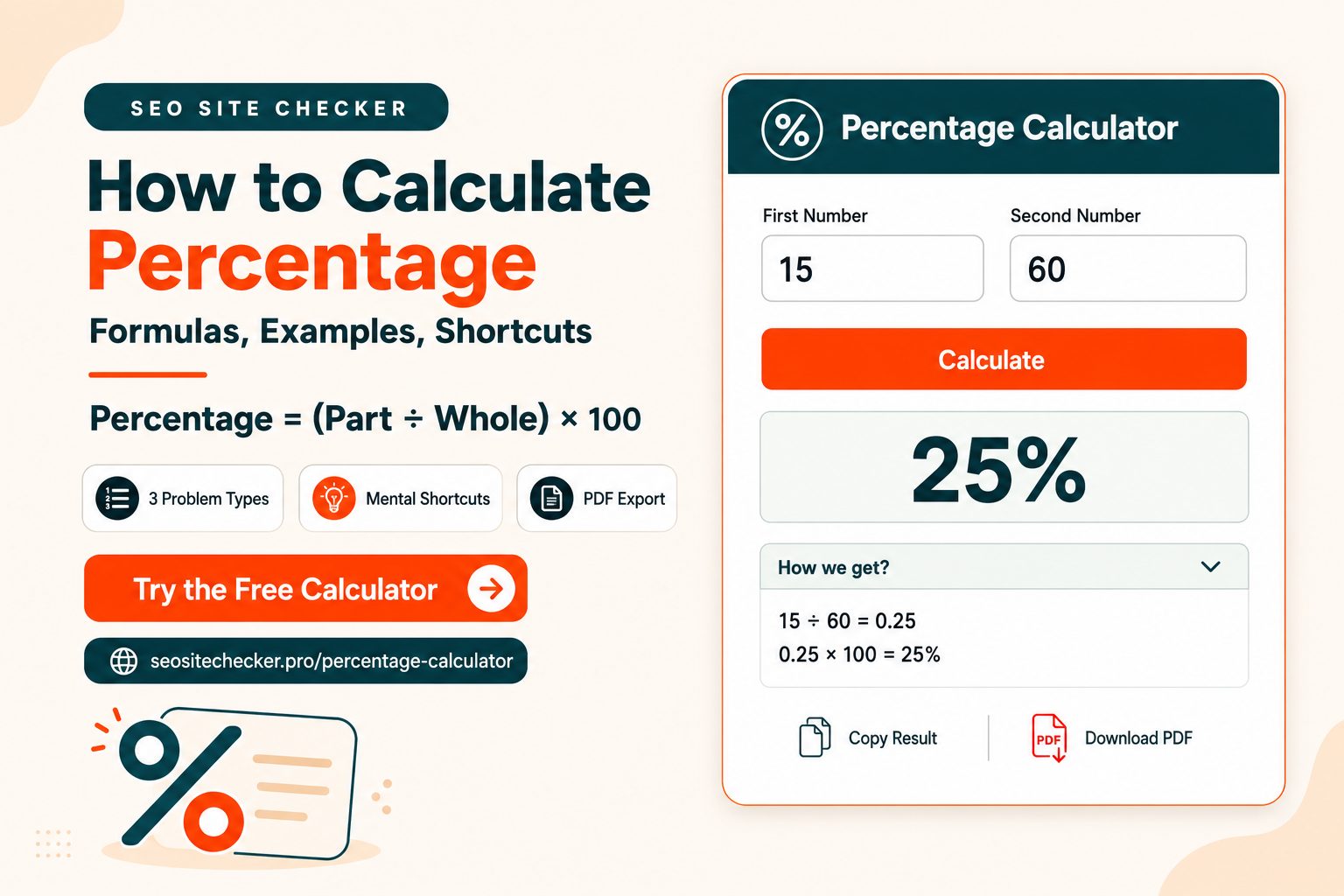
Here is the formula, since that is probably why you are here:
Percentage = (Part ÷ Whole) × 100
That one line handles most percentage questions you will ever face. The rest of this guide covers the three shapes every percentage problem takes, how to work out increases and discounts correctly, the mental shortcuts that let you skip the calculator entirely, and the mistakes that quietly produce wrong answers.
The Percentage Formula
Percentage = (Part ÷ Whole) × 100
Say 15 students out of 60 wear glasses. What percentage is that?
- Part = 15
- Whole = 60
- 15 ÷ 60 = 0.25
- 0.25 × 100 = 25%
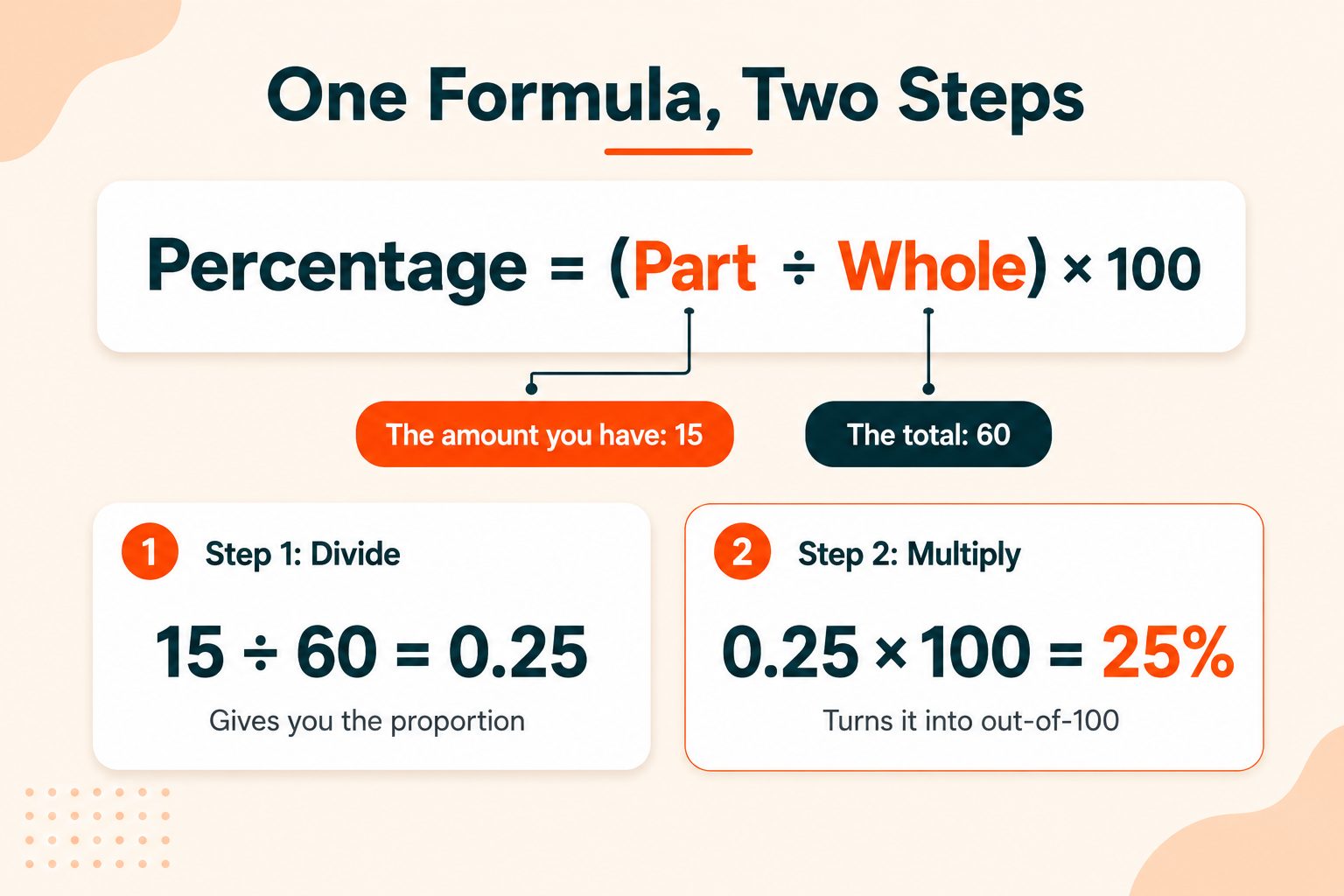
Two steps, and each one does a specific job. Dividing gives you the proportion as a decimal. Multiplying by 100 turns that decimal into a number "out of 100."
That second step is worth understanding rather than just doing, because it explains what a percentage actually is. The word comes from the Latin per centum, meaning "per hundred." When you say 25%, you are saying 25 out of every 100. The origin of the word percent is not just trivia here. It is the whole concept.
This is also why percentages are useful. "15 out of 60" and "22 out of 88" are hard to compare at a glance. Convert both to percentages and they are both 25%, and the comparison becomes obvious.
How to Calculate Percentage: Free Online Calculator
If you want the answer without the arithmetic, the free Percentage Calculator handles every problem type covered in this guide, including "What is P% of X?" and "Y is what percent of X?"
One thing sets it apart from most calculators, and it matters if you are checking homework or want to understand rather than just get a number. It shows the working. Alongside the result, a "How we get?" breakdown walks through each step, so you can see exactly how the answer was reached rather than trusting a box.
The results panel displays your first number, your second number, and the final result, so you can confirm you entered the values in the right order. That sounds minor until you have reversed part and whole and got 500% instead of 20%.
You can also copy the result or download it as a PDF, which is useful for coursework, invoices, or anything you need a record of. It works on mobile, it is free with no signup, and there is no usage limit.
The sensible way to use it: work the problem out yourself using the formulas below, then check your answer against the calculator. You keep the understanding and you catch your arithmetic slips.
The Three Types of Percentage Problem
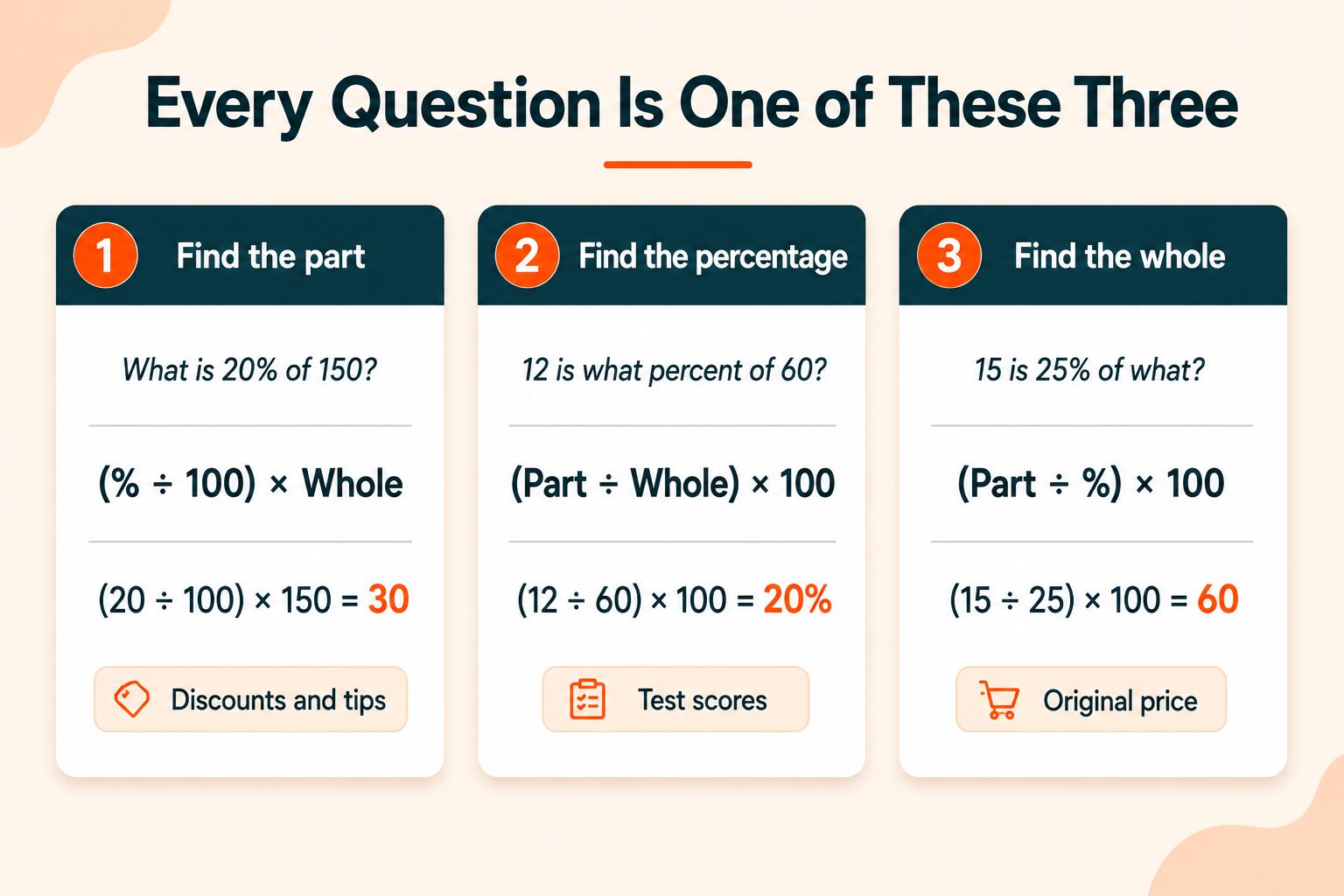
Every percentage question is one of three shapes. Once you can spot which one you have, the formula follows automatically. This is the part that turns percentages from a set of rules into something that makes sense.
In all three cases you have two of these three values, and you are looking for the third: the part, the whole, and the percentage.
Type 1: Finding the part
"What is 20% of 150?"
Formula: (Percentage ÷ 100) × Whole
(20 ÷ 100) × 150 = 0.20 × 150 = 30
You use this constantly: working out a discount amount, a tip, a commission, or how much tax is on a price.
Type 2: Finding the percentage
"12 is what percent of 60?"
Formula: (Part ÷ Whole) × 100
(12 ÷ 60) × 100 = 0.20 × 100 = 20%
This is the one for test scores, completion rates, survey results, and any time you want to express one number as a share of another.
Type 3: Finding the whole
"15 is 25% of what number?"
Formula: (Part ÷ Percentage) × 100
(15 ÷ 25) × 100 = 0.60 × 100 = 60
Less common but genuinely useful. You need it when working backwards from a discounted price to the original, or from a partial figure to a total.
Recognising which one you have
The difficulty is almost never the arithmetic. It is working out which question you are being asked. The phrasing gives it away:
| The question sounds like | It is | You need |
|---|---|---|
| "What is X% of Y?" | Type 1 | The part |
| "X is what percent of Y?" | Type 2 | The percentage |
| "X is Y% of what number?" | Type 3 | The whole |
Percentage Increase and Decrease
This is the second thing most people need, and it is where a specific trap lives.
Percentage increase = ((New − Original) ÷ Original) × 100
A price rises from $40 to $50. (50 − 40) ÷ 40 × 100 = 10 ÷ 40 × 100 = 25% increase
Percentage decrease = ((Original − New) ÷ Original) × 100
A price falls from $50 to $40. (50 − 40) ÷ 50 × 100 = 10 ÷ 50 × 100 = 20% decrease
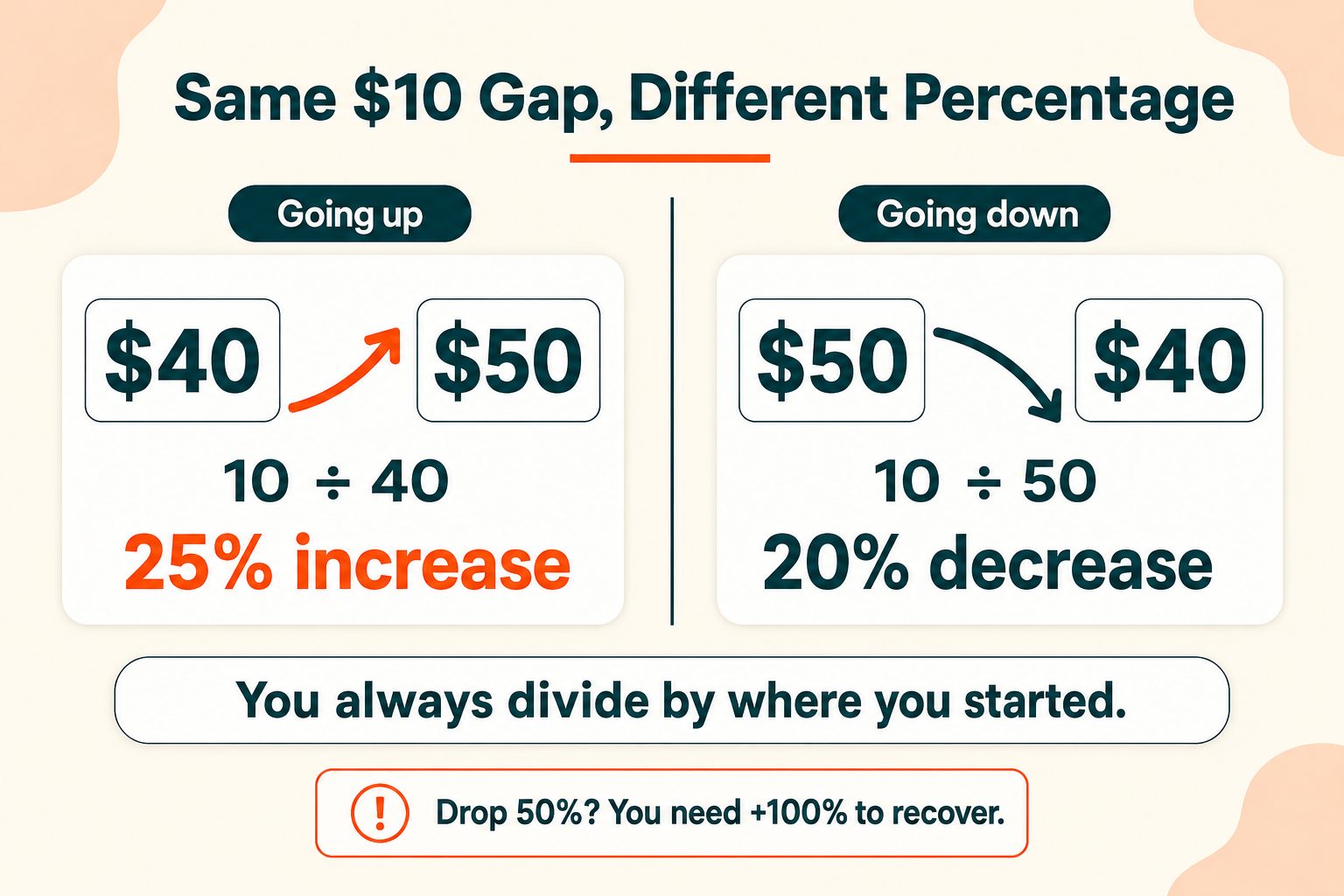
Look at those two together. Same two numbers. Same $10 gap. Different percentages.
| Change | Calculation | Result |
|---|---|---|
| $40 up to $50 | 10 ÷ 40 | 25% increase |
| $50 down to $40 | 10 ÷ 50 | 20% decrease |
The reason is that you always divide by the starting value, and the starting value is different in each direction. Forgetting this is the most common percentage error people make, and it produces answers that are confidently wrong.
The practical version of this catches out a lot of people looking at investments. A value that drops 50% needs to gain 100% just to get back to where it started. Drop $100 by half and you have $50. To get from $50 back to $100 you need to double it, and doubling is a 100% gain. The percentages do not cancel out, because each one is measured against a different base.
Percentage Points vs Percent
These two get mixed up constantly in news reports and business updates, and knowing the difference protects you from being misled.
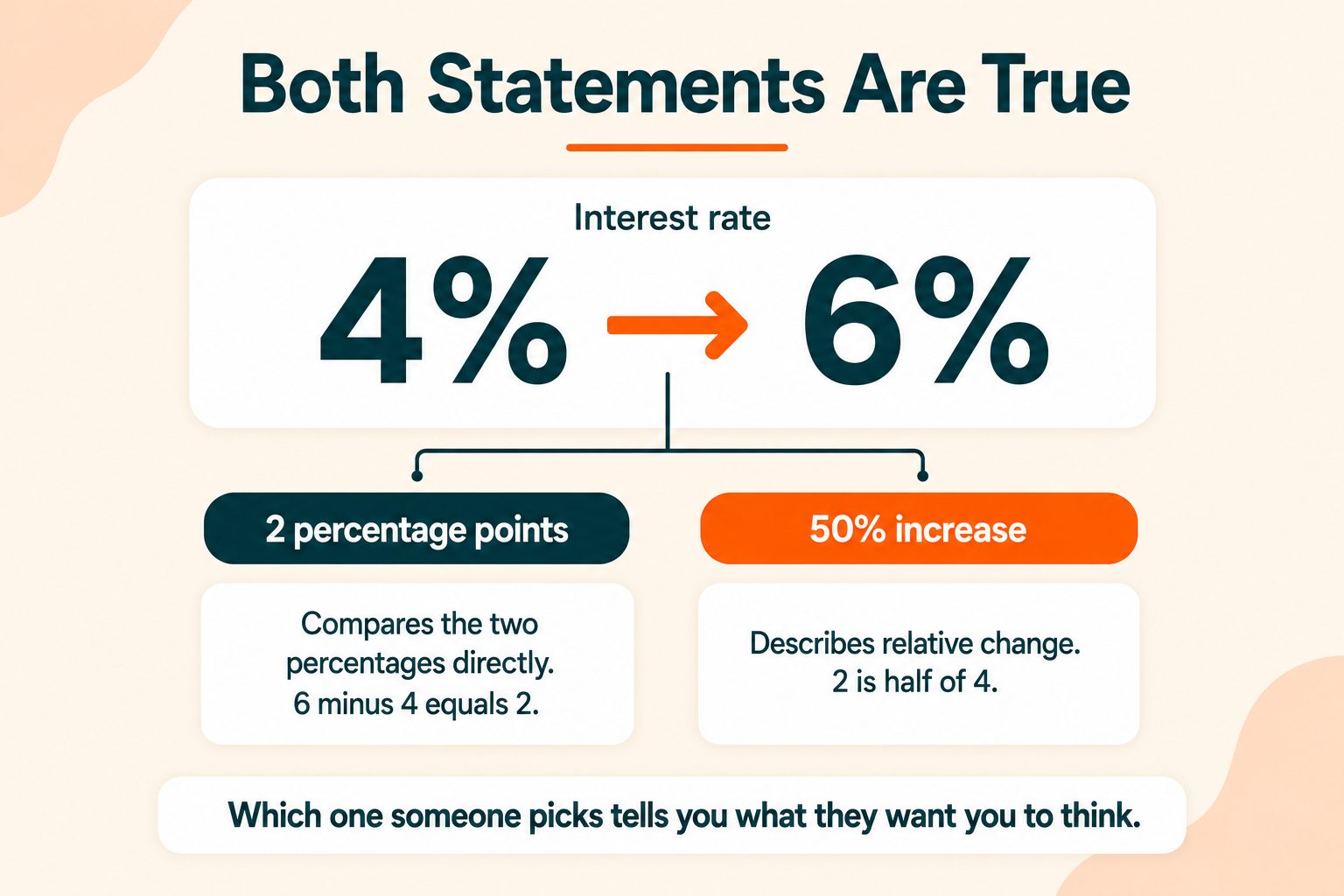
Say an interest rate moves from 4% to 6%. Two statements are both correct:
- It rose by 2 percentage points
- It rose by 50%
The first compares the two percentages directly. The second describes the relative change, because 2 is half of 4.
The rule: use percentage points when comparing two percentages to each other. Use percent when describing how much something changed relative to where it was.
This matters more than it sounds. A conversion rate improving from 2% to 3% is one percentage point, which sounds tiny. It is also a 50% improvement, which sounds substantial. Both are true, and whichever framing someone picks tells you something about what they want you to think. NIST's guidance on using the percent symbol covers the formal conventions if you need to be precise in professional writing.
Everyday Percentage Examples
Working out a discount
A jacket costs $80 and is 25% off.
80 × 0.25 = $20 off, so you pay $60.
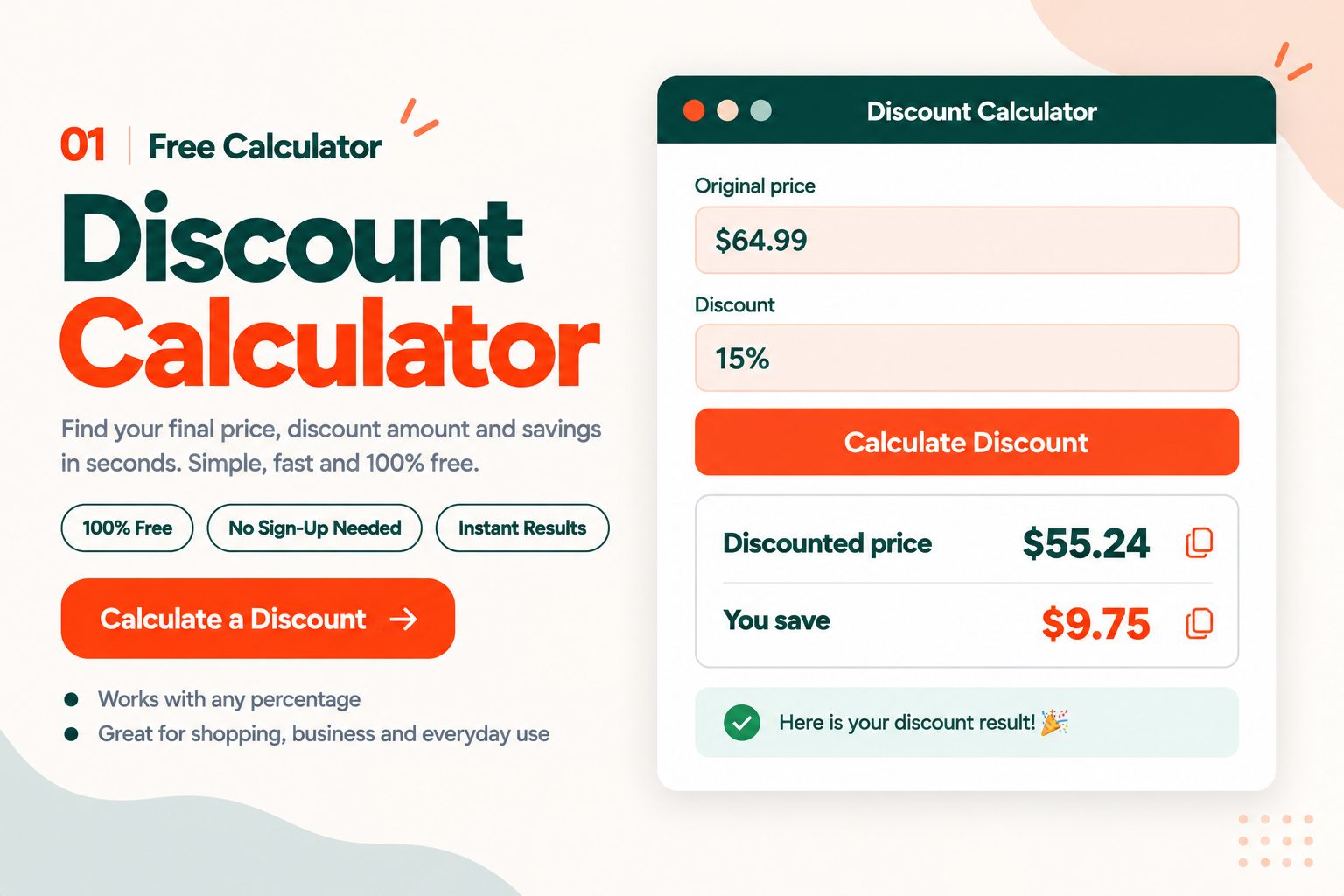
Faster method: instead of finding the discount and subtracting it, multiply by what you will actually pay. 25% off means you pay 75%, so 80 × 0.75 = $60 in one step. The Discount Calculator does this instantly if you are comparing several items.
Calculating a tip
A restaurant bill is $45 and you want to leave 18%.
45 × 0.18 = $8.10
In your head: 10% of $45 is $4.50. Half of that is $2.25, which is 5%. Add them for 15%, giving $6.75. Round up to $8 and nobody is counting.
Adding sales tax
An item costs $120 and tax is 7%.
120 × 1.07 = $128.40
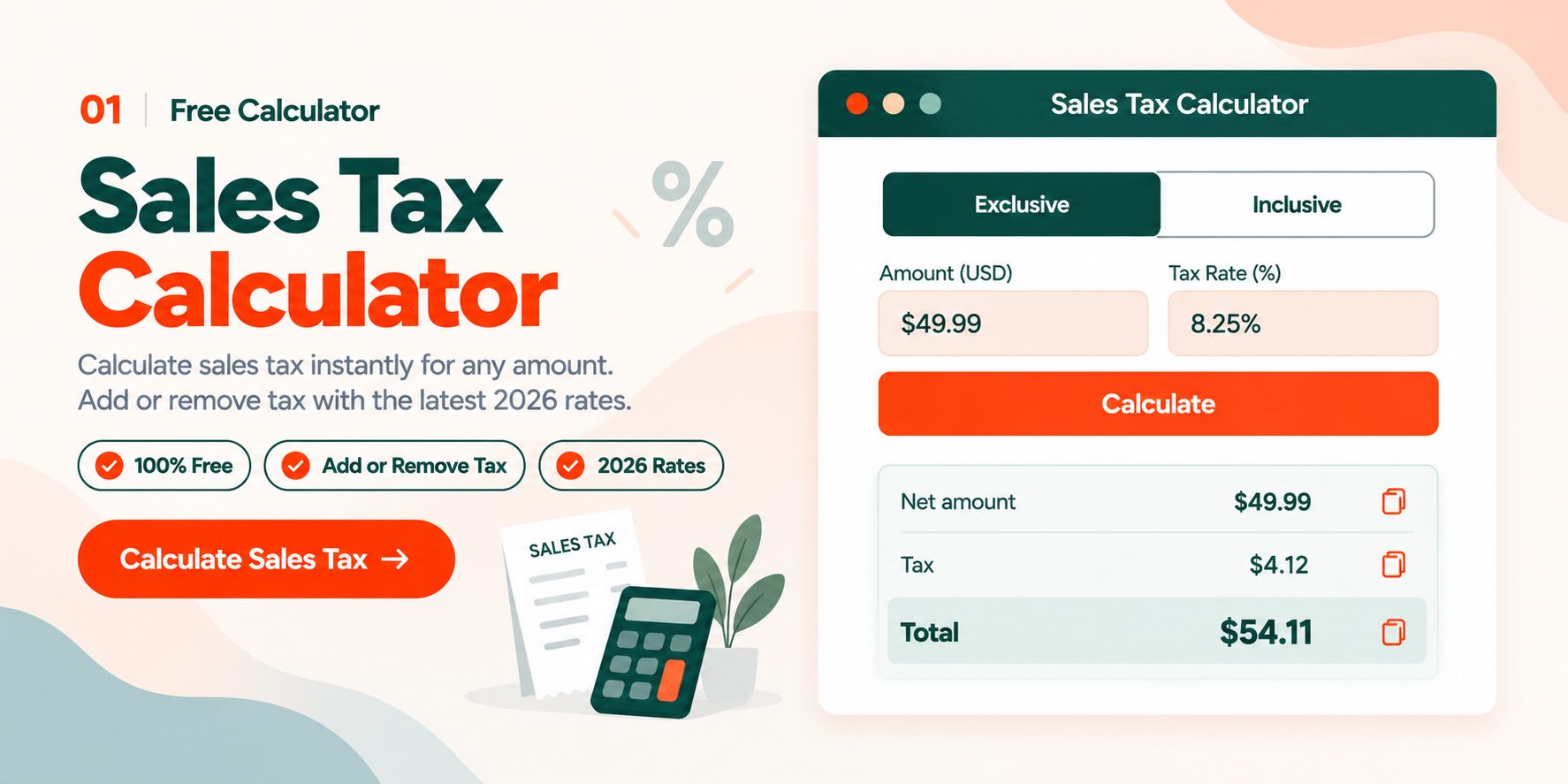
The 1.07 does both steps at once: the 1 keeps the original price, the 0.07 adds the tax. Use the Sales Tax Calculator when the rate is awkward or varies by location.
Converting a test score
You got 38 questions right out of 45.
(38 ÷ 45) × 100 = 84.4%
Stacked discounts, and why they trip people up
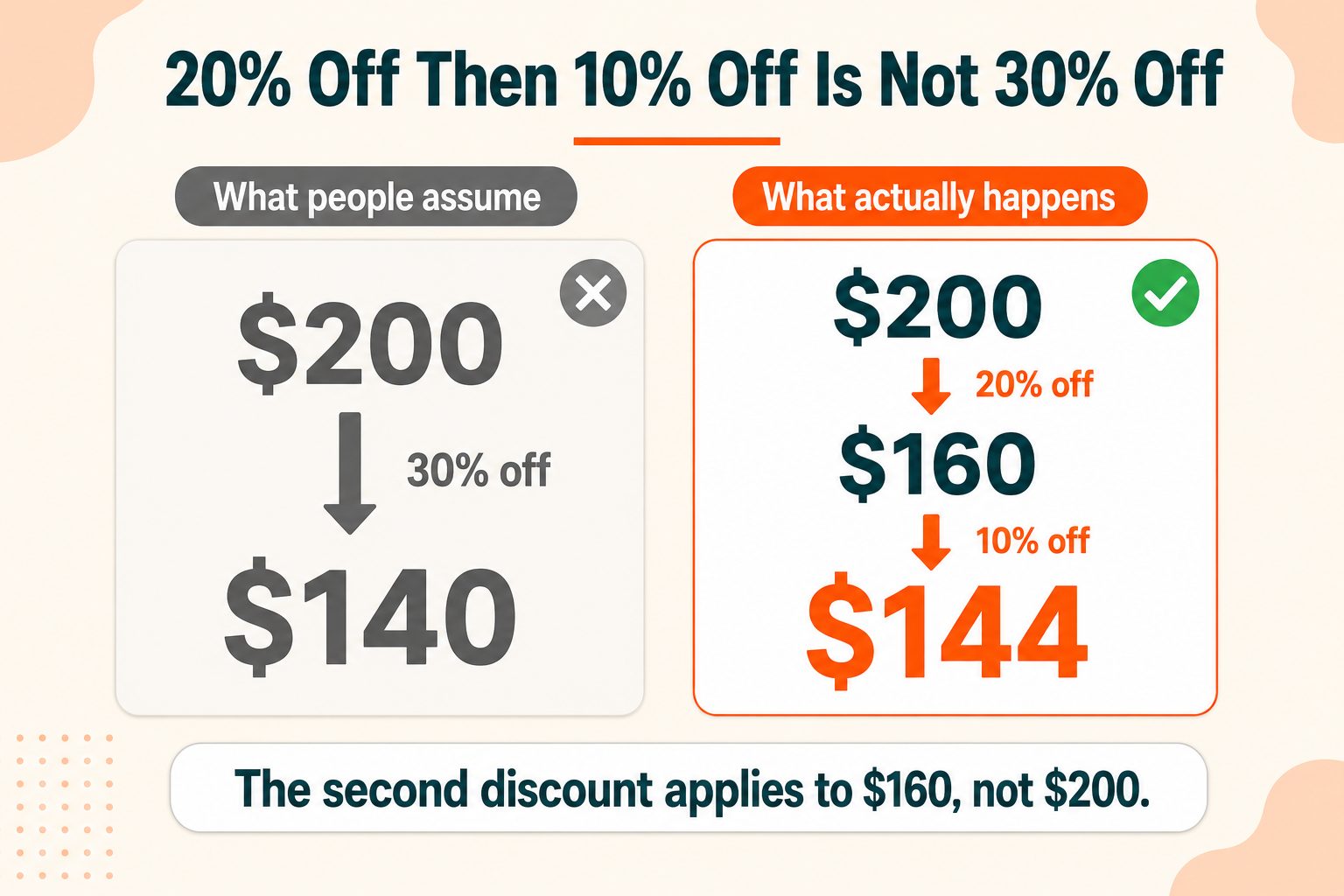
An item costs $200. It is 20% off, and there is a further 10% off at checkout.
Most people assume that is 30% off, giving $140. It is not.
- 200 × 0.80 = $160 after the first discount
- 160 × 0.90 = $144 after the second
The difference is $4. It exists because the second discount applies to the already-reduced price of $160, not to the original $200. Ten percent of $160 is $16, not $20.
Stacked percentages never simply add. This works in your favour with compound interest and against you with stacked discounts, and it is worth knowing which situation you are in.
How to Calculate Percentages in Your Head
You can do most everyday percentages without a calculator once you know a few tricks.
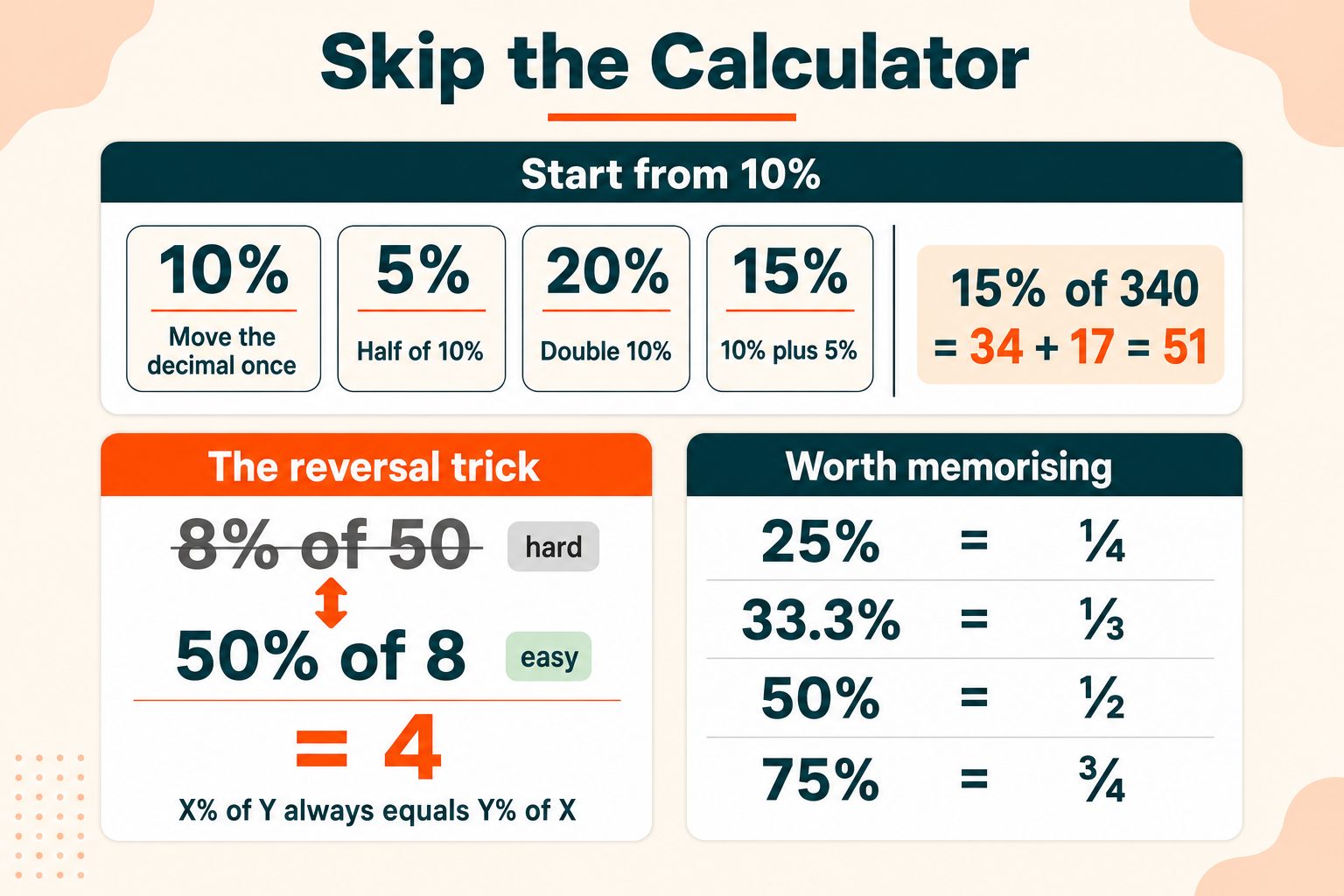
Start from 10%. Move the decimal one place to the left. 10% of 340 is 34. Everything else builds from there:
- 5% is half of 10%
- 20% is double 10%
- 15% is 10% plus 5%
- 1% is moving the decimal two places instead of one
So 15% of 340: 10% is 34, 5% is 17, total is 51.
The reversal trick. X% of Y always equals Y% of X. This surprises almost everyone and it is genuinely useful.
8% of 50 is awkward. But 50% of 8 is just half of 8, which is 4. Same answer, no effort.
Another: 16% of 25 looks hard. 25% of 16 is a quarter of 16, which is 4. Done.
Memorise the common fractions.
| Percentage | Fraction |
|---|---|
| 25% | One quarter |
| 33.3% | One third |
| 50% | Half |
| 75% | Three quarters |
Always sense check. Before you trust an answer, ask whether it should be bigger or smaller than what you started with. 20% of something is roughly a fifth. If your answer is not roughly a fifth of the original, something went wrong.
If you want structured practice rather than tricks, Khan Academy's percentage lessons are free and go deeper than any single article can.
Common Percentage Mistakes
- Forgetting to multiply by 100. You have the decimal, not the percentage. 0.25 is not 25.
- Dividing by the wrong number for increases and decreases. Always divide by the original value, never the new one.
- Adding stacked percentages. 20% off then 10% off is not 30% off.
- Confusing percentage points with percent. Two percentage points and 50% can describe the same change.
- Reversing part and whole. 12 out of 60 is 20%, not 500%. A quick sense check catches this every time.
- Assuming an increase and decrease cancel out. Up 50% then down 50% leaves you below where you started.
- Rounding too early. Round at the end, not in the middle, or small errors compound.
- Applying a discount to the wrong price. Some shops discount before tax, others after, and the final figure differs.
Wrapping Up
One idea covers almost everything here.
Every percentage problem involves three values: the part, the whole, and the percentage. You always have two of them, and you are solving for the third. Work out which one is missing and the formula follows without any memorising.
For the rest, three things are worth keeping in mind. Always divide by the original value when calculating change. Never add stacked percentages. And sense check your answer before you trust it, because a wrong percentage usually looks obviously wrong once you ask whether it should be bigger or smaller than what you started with.
Frequently Asked Questions
Frequently Asked Questions (FAQs) is a list of common questions and answers provided to quickly address common concerns or inquiries.
What is the formula for percentage?
Percentage = (Part ÷ Whole) × 100. Divide the part by the whole to get a decimal, then multiply by 100 to express it out of a hundred.
How do you calculate a percentage of a number?
Divide the percentage by 100, then multiply by the number. For 20% of 150: 20 ÷ 100 = 0.20, then 0.20 × 150 = 30.
How do you find what percentage one number is of another?
Divide the first number by the second, then multiply by 100. For 12 out of 60: 12 ÷ 60 = 0.20, then × 100 = 20%.
How do you calculate percentage increase?
Subtract the original from the new value, divide by the original, then multiply by 100. From 40 to 50: (50 − 40) ÷ 40 × 100 = 25%.
What is 20% of 100?
Since a percentage is a share out of 100, any percentage of 100 is simply the percentage itself.
How do you work out percentages without a calculator?
Find 10% by moving the decimal one place left, then build from there. 5% is half of 10%, 20% is double, and 15% is 10% plus 5%.
How do you convert a fraction to a percentage?
Divide the top number by the bottom number, then multiply by 100. For 3/20: 3 ÷ 20 = 0.15, then × 100 = 15%.
How do you calculate percentage of marks?
Divide marks obtained by total marks, then multiply by 100. Scoring 38 out of 45 gives (38 ÷ 45) × 100 = 84.4%.
What is the difference between percentage and percentage points?
Percentage points compare two percentages directly. Percent describes relative change. A rate going from 4% to 6% rose two percentage points, or 50%.
Why do I multiply by 100 when calculating a percentage?
Because a percentage means "out of 100." Dividing gives you a decimal proportion, and multiplying by 100 converts that proportion into the out-of-a-hundred format.