
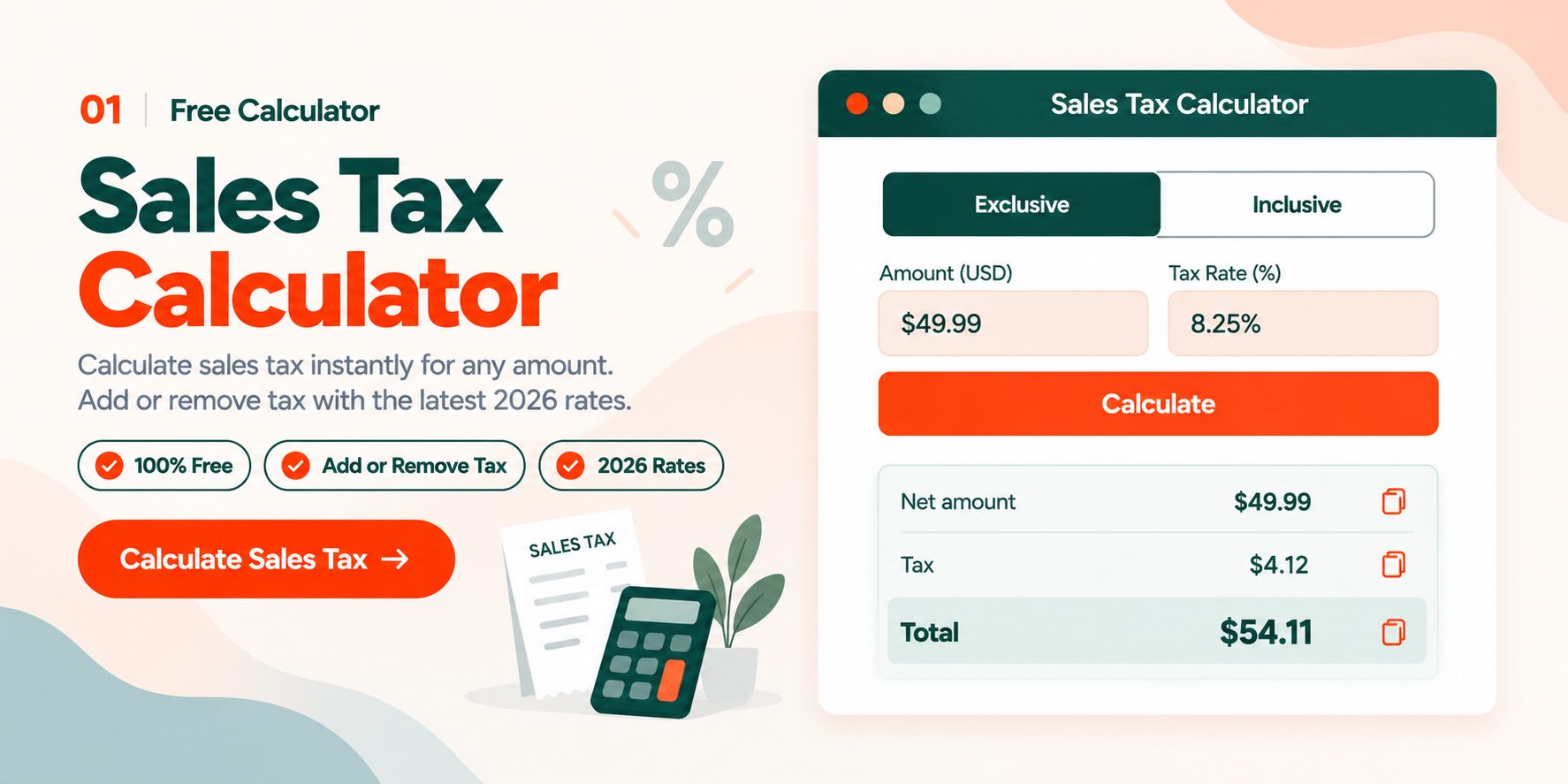
Use this free sales tax calculator to add tax to a price, or to pull the tax back out of a total you already paid. It has two modes, one for each job, and it gives you the net amount, the tax and the gross total in one click, with no sign-up and no limits.
One thing decides whether your answer is right: the rate you enter. Most people type their state's rate, and that is almost never the rate they actually pay. The section on finding your real rate takes two minutes and will save you from undercharging or underclaiming.
How to Calculate Sales Tax: Free Calculator
The calculator works in two directions. Pick the mode that matches the number you already have.
Adding tax to a price (Exclusive mode)
Use this when you know the price before tax and need the total.
- Choose Exclusive. This tells the calculator your amount does not include tax yet.
- Enter the pre-tax price. For example,
49.99. - Enter your combined tax rate as a percentage. For example,
8.25. If you are not sure what your rate is, check the rate section below before you go further. - Read your results. You get the net amount, the tax amount and the gross total, and each one has a copy button so you can paste it straight into an invoice or spreadsheet.
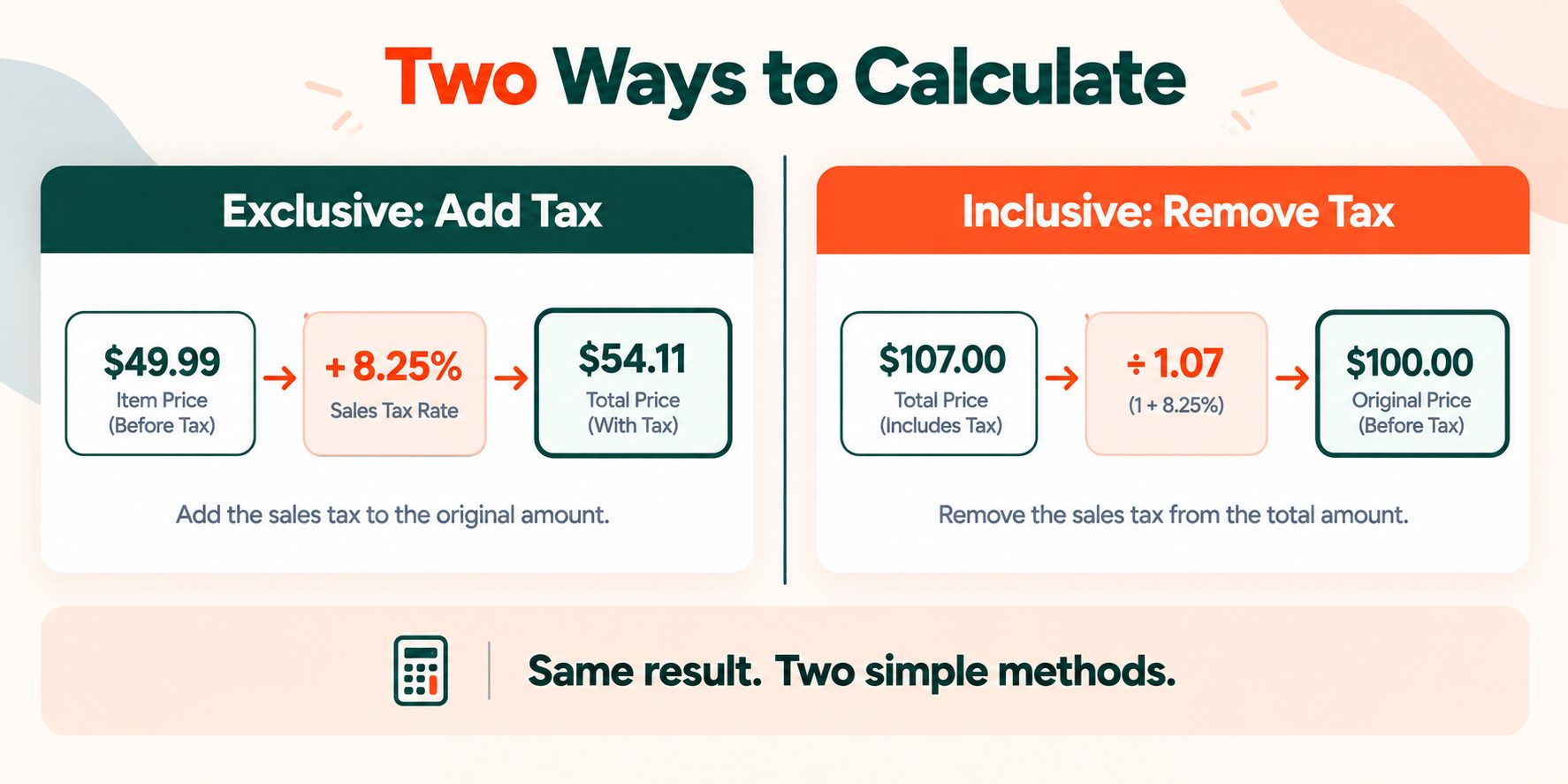
Example: a $49.99 item at 8.25% carries $4.12 in tax, for a total of $54.11.
Removing tax from a total (Inclusive mode)
Use this when you have a receipt total and need to know how much of it was tax.
- Choose Inclusive. This tells the calculator the tax is already inside your amount.
- Enter the total from the receipt. For example,
107.00. - Enter the rate that was charged. For example,
7. - Read your results. The calculator separates the pre-tax price from the tax portion.
Example: a $107.00 receipt at 7% breaks down into a $100.00 pre-tax price and $7.00 of tax.
Both modes run instantly in your browser, with nothing to install and nothing stored. Open the Sales Tax Calculator at the top of the page whenever you need it.
The Sales Tax Formula, With Worked Examples
If you want to check the math, or build it into your own spreadsheet, three formulas cover everything:
Sales tax  = price × (rate ÷ 100)
Total      = price × (1 + rate ÷ 100)
Rate (%)   = (tax ÷ price) × 100
Here is how they play out:
- $100 at 7%. Tax is $100 × 0.07 = $7.00, and the total is $107.00.
- $1,000 at 7.53%, which is the current national average. Tax is $75.30, and the total is $1,075.30.
- $3.00 of tax on a $40 item. The rate is $3 ÷ $40 × 100 = 7.5%.
Spreadsheet tip. If cell A2 holds the price and B2 holds the rate formatted as a percentage, =A2*B2 gives you the tax and =A2*(1+B2) gives you the total. Drag the formula down a column and a whole list of prices is done at once.
If the percentage side of this feels rusty, the Percentage Calculator handles any percent-of question, and our guide on how to calculate percentage walks through the basics step by step.
How to Remove Sales Tax From a Total
This is where most manual calculations go wrong, and the mistake feels completely reasonable while you are making it.
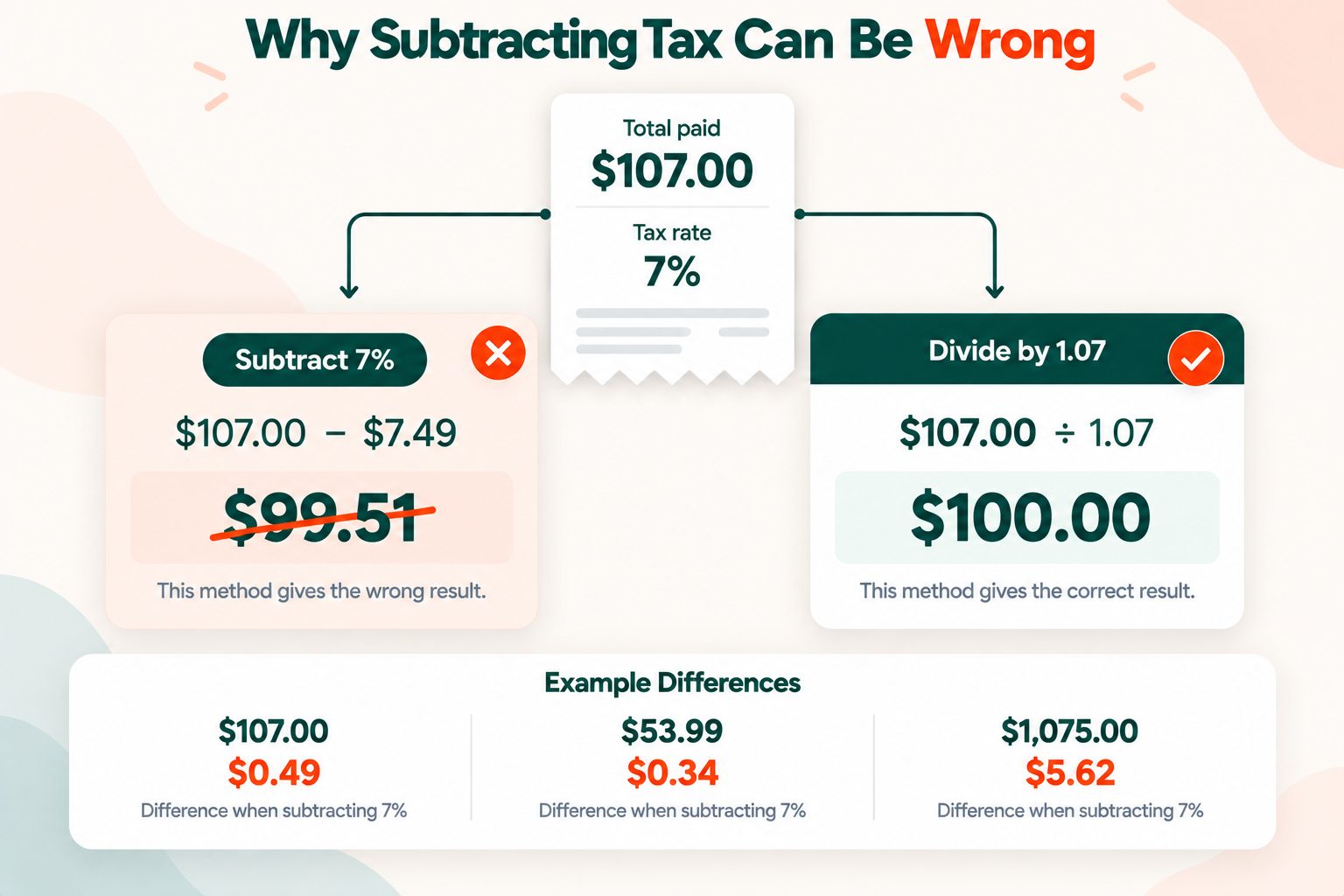
You have a receipt for $107.00, and you know the tax rate was 7%. The obvious move is to take 7% off the total. That gives you $107.00 minus $7.49, which is $99.51. It looks right, but the real pre-tax price was $100.00.
The problem is that the 7% was calculated on the price before tax, not on the total. When you take 7% of the total, you are taking 7% of a bigger number, so you remove too much. The gap is small on one receipt, and it grows with every dollar:
| Total paid | Rate | Subtracting the rate (wrong) | Dividing by 1 + rate (right) | Error |
|---|---|---|---|---|
| $107.00 | 7% | $99.51 | $100.00 | $0.49 |
| $53.99 | 8.25% | $49.54 | $49.88 | $0.34 |
| $1,075.00 | 7.5% | $994.38 | $1,000.00 | $5.62 |
The right method is to divide the total by one plus the rate. At 7%, that means dividing by 1.07, so $107.00 ÷ 1.07 = $100.00. At 8.25%, you divide by 1.0825.
This matters most to three groups of people. Anyone claiming expenses needs the net figure to match what their employer or client expects. Bookkeepers splitting receipts into net and tax need the two parts to add back up to the total exactly. And anyone checking a quote needs to know whether a price they were given already included tax.
Inclusive mode does the division for you, so you never have to remember which way round it goes. The same method also works for VAT-inclusive prices on receipts from the UK, the EU or Australia. Only the rate changes.
The State Rate Is Not Your Rate
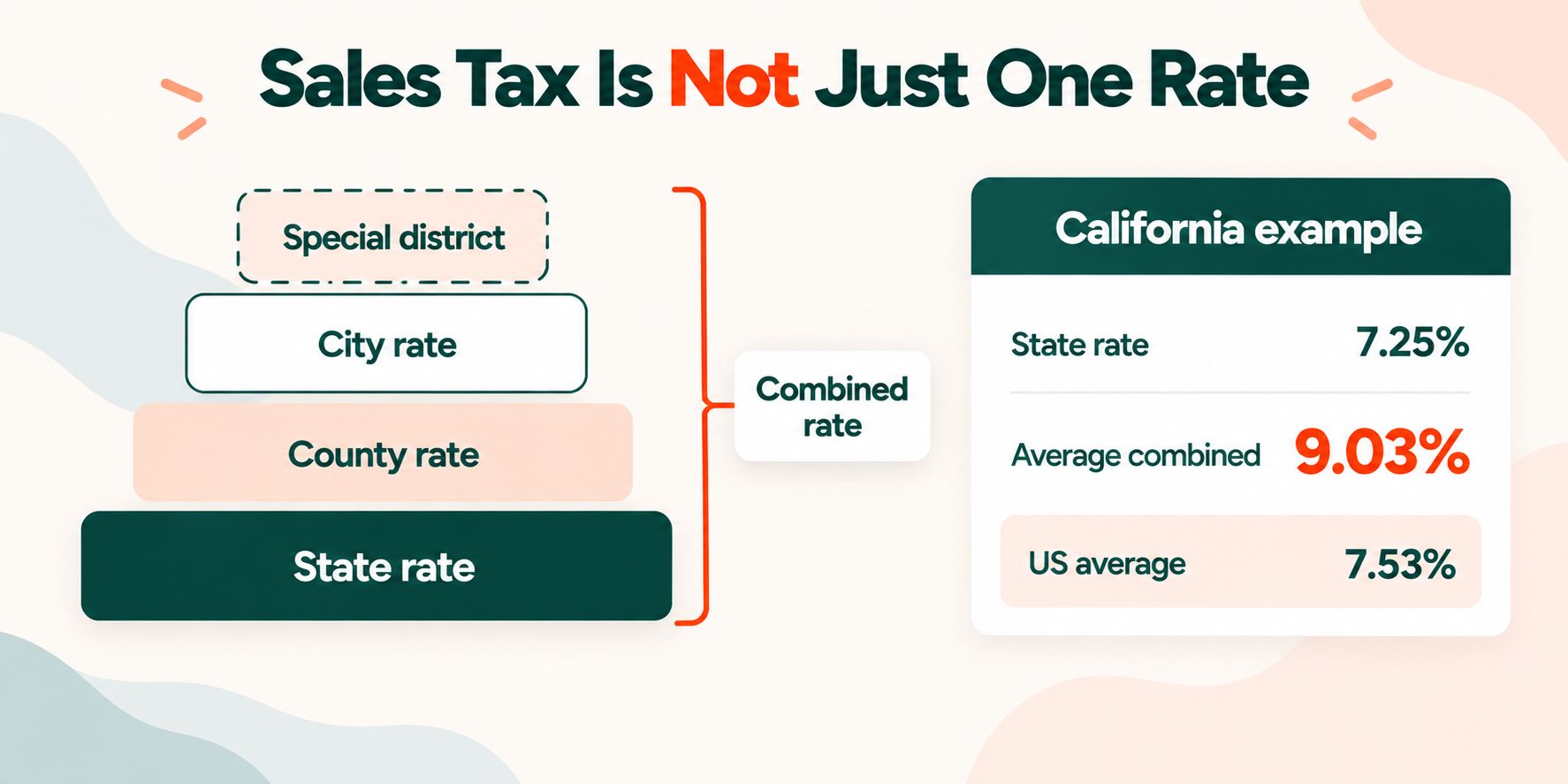
Here is the part most calculators skip. The sales tax you pay is rarely just the state rate. It is a combined rate, built from up to four layers:
- the state rate
- a county rate
- a city rate
- one or more special district rates, often for transit or stadiums
Because those layers overlap in different ways, two addresses in the same ZIP code can pay different rates.
California shows this clearly. It has the highest state-level rate in the country at 7.25%, yet nobody in California pays only 7.25%, because local taxes are added on top everywhere. The state's average combined rate is 9.03%. Across the whole country, the population-weighted average combined rate is 7.53%, according to Tax Foundation's 2026 state and local sales tax rates.
The difference is real money. On a $1,000 purchase, the California state rate alone gives you $72.50 of tax. Louisiana's average combined rate of 10.13% gives you $101.30. Enter the wrong layer and your answer is off by the difference.
How to find your real rate:
- Check a recent receipt from a shop near you. The rate is usually printed next to the tax line.
- Use your state revenue department's address lookup. Most states run a free one that returns the exact combined rate for a street address.
- If you are a seller, use the rate for your buyer's delivery address, not your own, in most cases. Many states tax based on where the goods end up.
Once you have the combined rate, enter that into the calculator and the answer will match the receipt.
2026 Sales Tax Rates by State
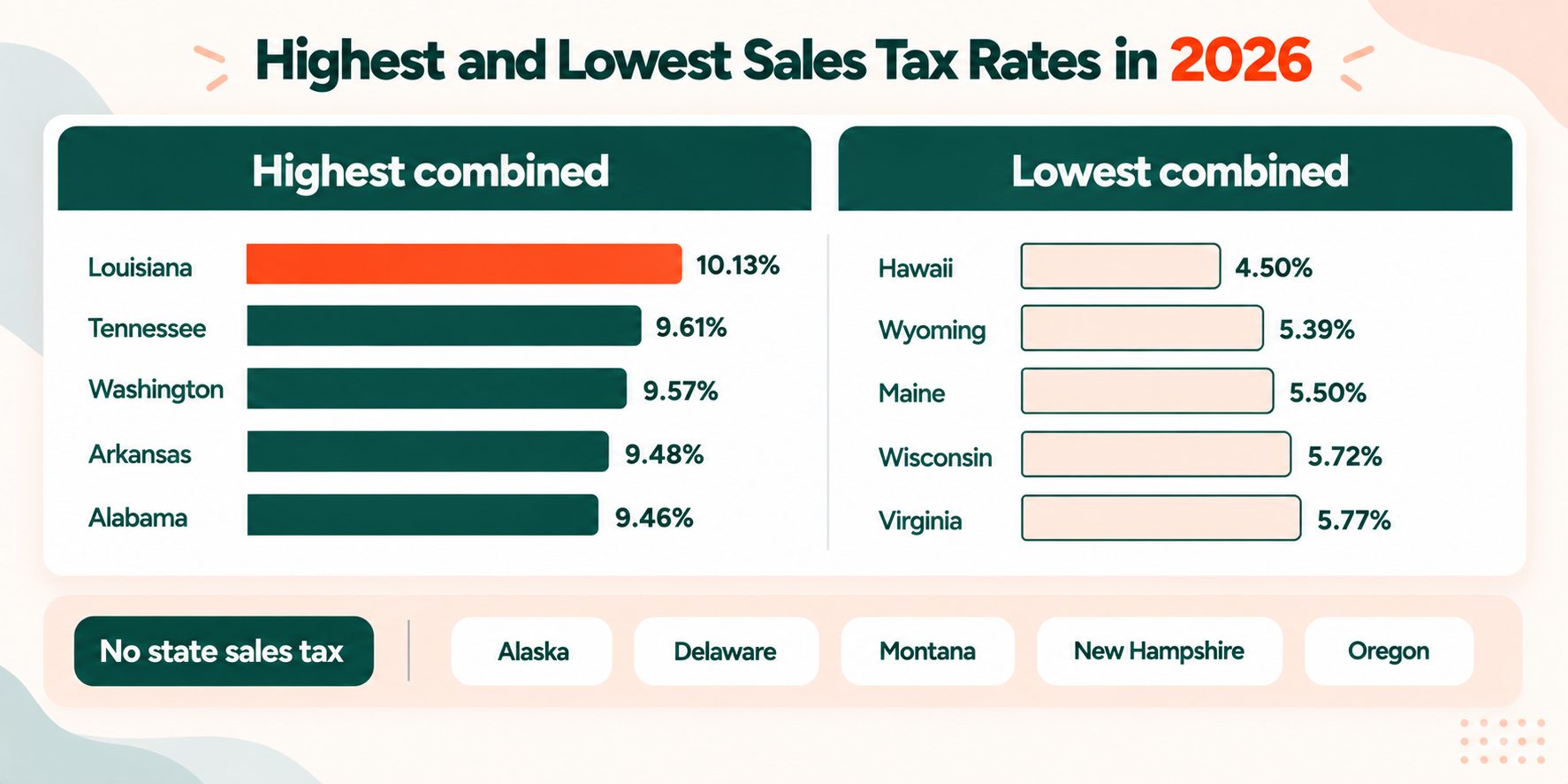
The table below shows each state's rate, the average local rate added on top of it, and the average combined rate, ranked from highest to lowest. These are averages, so your exact local rate may be a little higher or lower depending on your address. Five states have no statewide sales tax: Alaska, Delaware, Montana, New Hampshire and Oregon. Alaska is the exception among them, because it allows local governments to charge sales tax, so parts of Alaska are not tax-free at all.
| Rank | State | State rate | Avg. local rate | Combined rate |
|---|---|---|---|---|
| 1 | Louisiana | 5.00% | 5.13% | 10.13% |
| 2 | Tennessee | 7.00% | 2.61% | 9.61% |
| 3 | Washington | 6.50% | 3.07% | 9.57% |
| 4 | Arkansas | 6.50% | 2.98% | 9.48% |
| 5 | Alabama | 4.00% | 5.46% | 9.46% |
| 6 | Oklahoma | 4.50% | 4.56% | 9.06% |
| 7 | California | 7.25% | 1.78% | 9.03% |
| 8 | Illinois | 6.25% | 2.73% | 8.98% |
| 9 | Kansas | 6.50% | 2.21% | 8.71% |
| 10 | New York | 4.00% | 4.54% | 8.54% |
| 11 | Arizona | 5.60% | 2.94% | 8.54% |
| 12 | Missouri | 4.23% | 4.22% | 8.44% |
| 13 | Nevada | 6.85% | 1.39% | 8.24% |
| 14 | Texas | 6.25% | 1.95% | 8.20% |
| 15 | Minnesota | 6.88% | 1.26% | 8.14% |
| 16 | Colorado | 2.90% | 4.99% | 7.89% |
| 17 | New Mexico | 4.88% | 2.80% | 7.68% |
| 18 | Georgia | 4.00% | 3.56% | 7.56% |
| 19 | South Carolina | 6.00% | 1.49% | 7.49% |
| 20 | Utah | 6.10% | 1.32% | 7.42% |
| 21 | Ohio | 5.75% | 1.54% | 7.29% |
| 22 | North Carolina | 4.75% | 2.35% | 7.10% |
| 23 | North Dakota | 5.00% | 2.09% | 7.09% |
| 24 | Mississippi | 7.00% | 0.06% | 7.06% |
| 25 | Indiana | 7.00% | 0.00% | 7.00% |
| 25 | Rhode Island | 7.00% | 0.00% | 7.00% |
| 27 | Nebraska | 5.50% | 1.48% | 6.98% |
| 28 | Florida | 6.00% | 0.98% | 6.98% |
| 29 | Iowa | 6.00% | 0.94% | 6.94% |
| 30 | New Jersey | 6.63% | -0.02% | 6.60% |
| 31 | West Virginia | 6.00% | 0.60% | 6.60% |
| 32 | Vermont | 6.00% | 0.43% | 6.43% |
| 33 | Connecticut | 6.35% | 0.00% | 6.35% |
| 34 | Pennsylvania | 6.00% | 0.34% | 6.34% |
| 35 | Massachusetts | 6.25% | 0.00% | 6.25% |
| 36 | South Dakota | 4.20% | 1.91% | 6.11% |
| 37 | Idaho | 6.00% | 0.03% | 6.03% |
| 38 | Kentucky | 6.00% | 0.00% | 6.00% |
| 38 | Maryland | 6.00% | 0.00% | 6.00% |
| 38 | Michigan | 6.00% | 0.00% | 6.00% |
| (38) | District of Columbia | 6.00% | 0.00% | 6.00% |
| 41 | Virginia | 5.30% | 0.47% | 5.77% |
| 42 | Wisconsin | 5.00% | 0.72% | 5.72% |
| 43 | Maine | 5.50% | 0.00% | 5.50% |
| 44 | Wyoming | 4.00% | 1.39% | 5.39% |
| 45 | Hawaii | 4.00% | 0.50% | 4.50% |
| 46 | Alaska | 0.00% | 1.82% | 1.82% |
| 47 | Delaware | 0.00% | 0.00% | 0.00% |
| 47 | Montana | 0.00% | 0.00% | 0.00% |
| 47 | New Hampshire | 0.00% | 0.00% | 0.00% |
| 47 | Oregon | 0.00% | 0.00% | 0.00% |
Rates as of July 1, 2026. Source: Tax Foundation. The District of Columbia is shown for reference and its rank is given in brackets. New Jersey's average local rate is slightly negative because some areas charge a reduced rate below the state level.
Discounts, Coupons and Shipping
Three everyday situations change the amount that gets taxed, and people regularly worry about the wrong one.
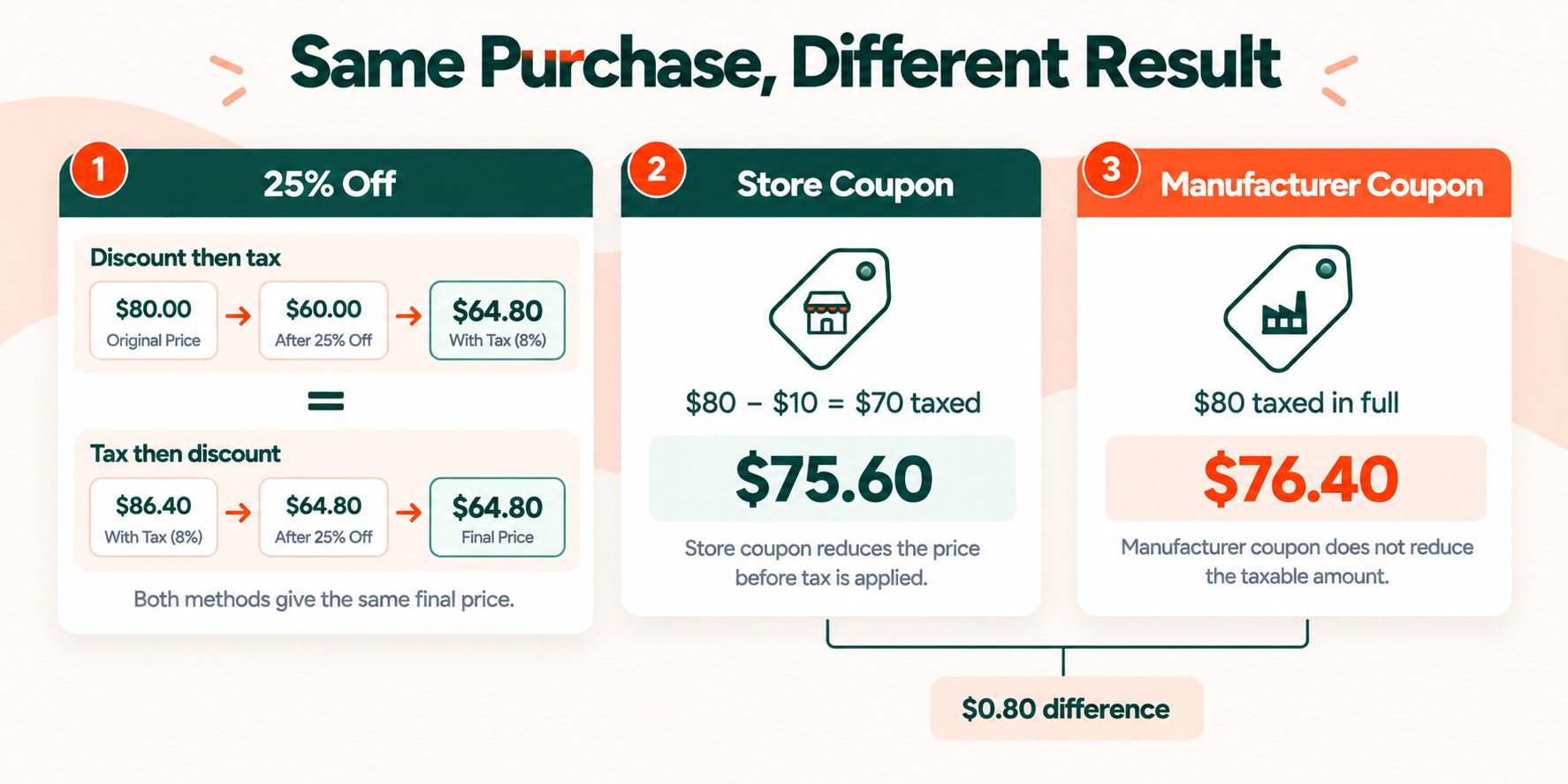
Percentage discounts: the order makes no difference. Take an $80 item with 25% off and 8% sales tax. Apply the discount first and then the tax, and you pay $64.80. Apply the tax first and then the discount, and you still pay $64.80. Multiplication works the same in either order, so this one is not worth a second thought. The Discount Calculator will handle the discount side if you want to check it.
Fixed-amount coupons: it depends on who issued the coupon. Take the same $80 item with a $10 coupon at 8%.
- A store coupon usually reduces the price that gets taxed, so you pay tax on $70 and the total is $75.60.
- A manufacturer coupon is taxed on the full $80 in many states, because the store is reimbursed for it. The total becomes $76.40.
That is an $0.80 difference on a single item. How coupons are treated varies from state to state, so if the difference matters, your state revenue department's website will have the rule.
Shipping. Some states tax delivery charges and others do not, and in several states the answer changes depending on whether shipping is listed separately on the invoice. The rules shift often enough that a fixed list would go out of date quickly, so check your state's guidance when shipping makes up a meaningful part of an order.
Sales Tax on Online Purchases
For years, online sellers generally only had to collect sales tax in states where they had a physical presence, such as a store, an office or a warehouse. That changed with South Dakota v. Wayfair, decided by the Supreme Court on June 21, 2018. The ruling allowed states to require remote sellers to collect sales tax based on their economic activity in the state, even without any physical presence there.
For a shopper, the practical result is simple. Most online purchases are now taxed at the rate for your delivery address, which is why the tax on the same product can change when you ship it somewhere else.
For a small seller, each state sets its own economic nexus threshold, which is the level of sales that triggers a duty to collect. Those thresholds differ and change over time, so check the rules for each state you sell into. If you sell through a large marketplace, the platform usually collects and remits the tax for you.
Sales Tax vs VAT vs GST
All three are consumption taxes, but they are collected differently.
- Sales tax is charged once, at the final sale to the consumer. This is the US system, and prices on the shelf usually do not include it.
- VAT (value added tax) is charged at every stage of production and sale, and businesses reclaim what they paid along the way. It is normally already included in the price you see.
- GST (goods and services tax) works on the same principle as VAT under a different name, and is used in countries such as Canada, Australia and India.
This calculator works for all three. Enter the rate, and use Inclusive mode for VAT or GST prices, since that is how most of those countries display them.
Can You Deduct Sales Tax?
You can, but only if you itemize deductions on your federal return. You then choose between deducting your state and local income tax or your state and local sales tax. You cannot deduct both. Sales tax is often the better choice for people living in states with no income tax, or for anyone who made a large purchase such as a car during the year.
The deduction counts toward the state and local tax (SALT) cap, and that limit has changed in recent years, so check the current figure before you plan around it. The IRS Sales Tax Deduction Calculator estimates the amount you can claim based on your income, location and household size.
Quick Reference
| I want to | Do this |
|---|---|
| Add tax to a price | Price × (1 + rate) |
| Find the tax amount | Price × rate |
| Remove tax from a total | Total ÷ (1 + rate) |
| Find the rate from a receipt | Tax ÷ price × 100 |
| Apply a discount first | Discount Calculator |
Frequently Asked Questions
Frequently Asked Questions (FAQs) is a list of common questions and answers provided to quickly address common concerns or inquiries.
How do you calculate sales tax?
Multiply the price by the tax rate written as a decimal. At 7%, a $100 item has $7 of sales tax, so the total comes to $107.
How much is 7% sales tax on $100?
$7.00, which brings the total to $107.00. Multiply $100 by 0.07 to get the tax, then add it to the original price.
How do I calculate sales tax backwards from a total?
Divide the total by one plus the rate. At 7%, $107 ÷ 1.07 = $100 before tax. Do not subtract 7% of the total, because that gives $99.51.
What is the average sales tax rate in the US?
The population-weighted average combined state and local sales tax rate is 7.53% as of July 2026, according to the Tax Foundation.
Which states have no sales tax?
Alaska, Delaware, Montana, New Hampshire and Oregon have no statewide sales tax. Alaska still lets local governments charge sales tax in some areas.
Which state has the highest sales tax?
Louisiana has the highest average combined rate at 10.13%. California has the highest state-level rate at 7.25%, before any local taxes are added.
Is sales tax calculated before or after a discount?
For a percentage discount, the total is identical either way. Store coupons usually reduce the taxable price, while manufacturer coupons are often taxed on the full price.
Do I pay sales tax on online purchases?
Usually, yes. Since the 2018 Wayfair ruling, most online purchases are taxed at the rate that applies to your delivery address.
Is shipping subject to sales tax?
It depends on the state. Some states tax delivery charges and others do not, and the answer can change if shipping is listed separately on the invoice.
Can I deduct sales tax on my federal return?
Yes, if you itemize. You choose either state income tax or sales tax to deduct, and the deduction counts toward the SALT cap.