
You used a model to draft something. It is coherent, it is grammatical, and it reads like nobody wrote it.
That feeling is real and it has specific causes. AI prose has a handful of recognisable habits, and once you can name them you can fix them in about ten minutes with no tool at all.
This covers what those habits actually are, how to fix each one by hand, and why a rewriting tool is a poor substitute for knowing them.
How to Humanize AI Text for Free
The short version, before the detail.
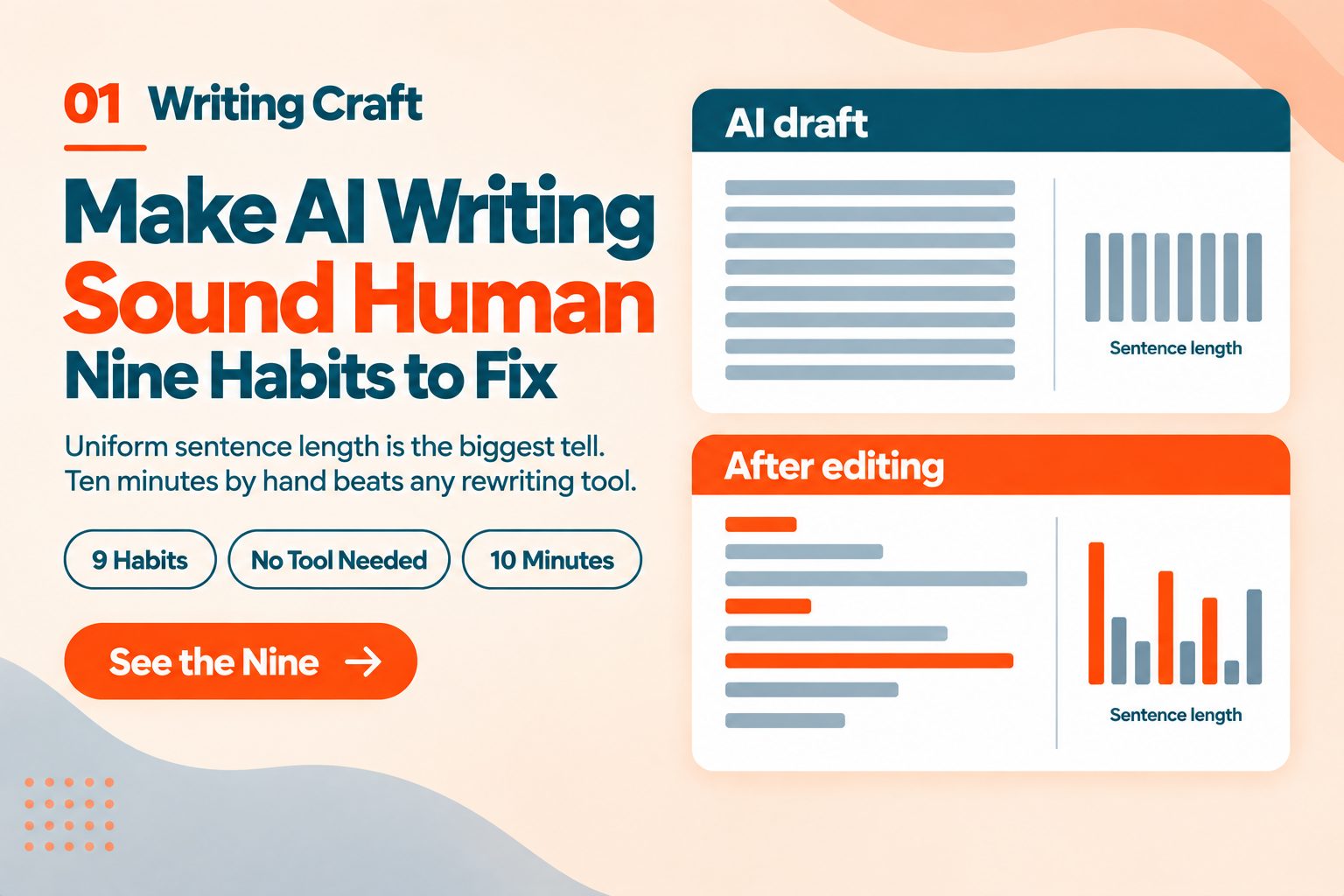
Vary your sentence lengths. This is the single biggest change and it fixes more than everything else combined.
Cut the hedging. Models qualify almost every claim. Pick a position.
Replace signposting transitions. "Moreover" and "Furthermore" announce structure instead of carrying an argument.
Add something only you would know. A number, an example, a thing that happened. Models produce the average of what has been written; specifics are what they cannot invent.
Cut the closing summary. AI drafts nearly always end by restating what they just said.
Those five passes take ten minutes on a 1,000-word draft and do more than any rewriting tool. The rest of this explains why each one works.
Why AI Prose Reads the Way It Does
Worth understanding, because the fix follows from the cause.
A language model generates text by repeatedly choosing a likely next word. Not the most likely every time, but from a distribution weighted toward the probable. Do that thousands of times and you get prose that is fluent, coherent, and statistically average in every dimension at once.
Average sentence length. Average vocabulary. Average structure. Average level of commitment to any claim.
Human writing is not average. A person writing well produces a short sentence after three long ones because the rhythm needed breaking. They commit to a claim because they believe it. They reach for an odd word because it was the right word. None of that is the most probable choice, which is precisely why it reads as human.
So "sounding human" is not a style you apply at the end. It is the accumulated effect of a few hundred small decisions that were not the safest available option.
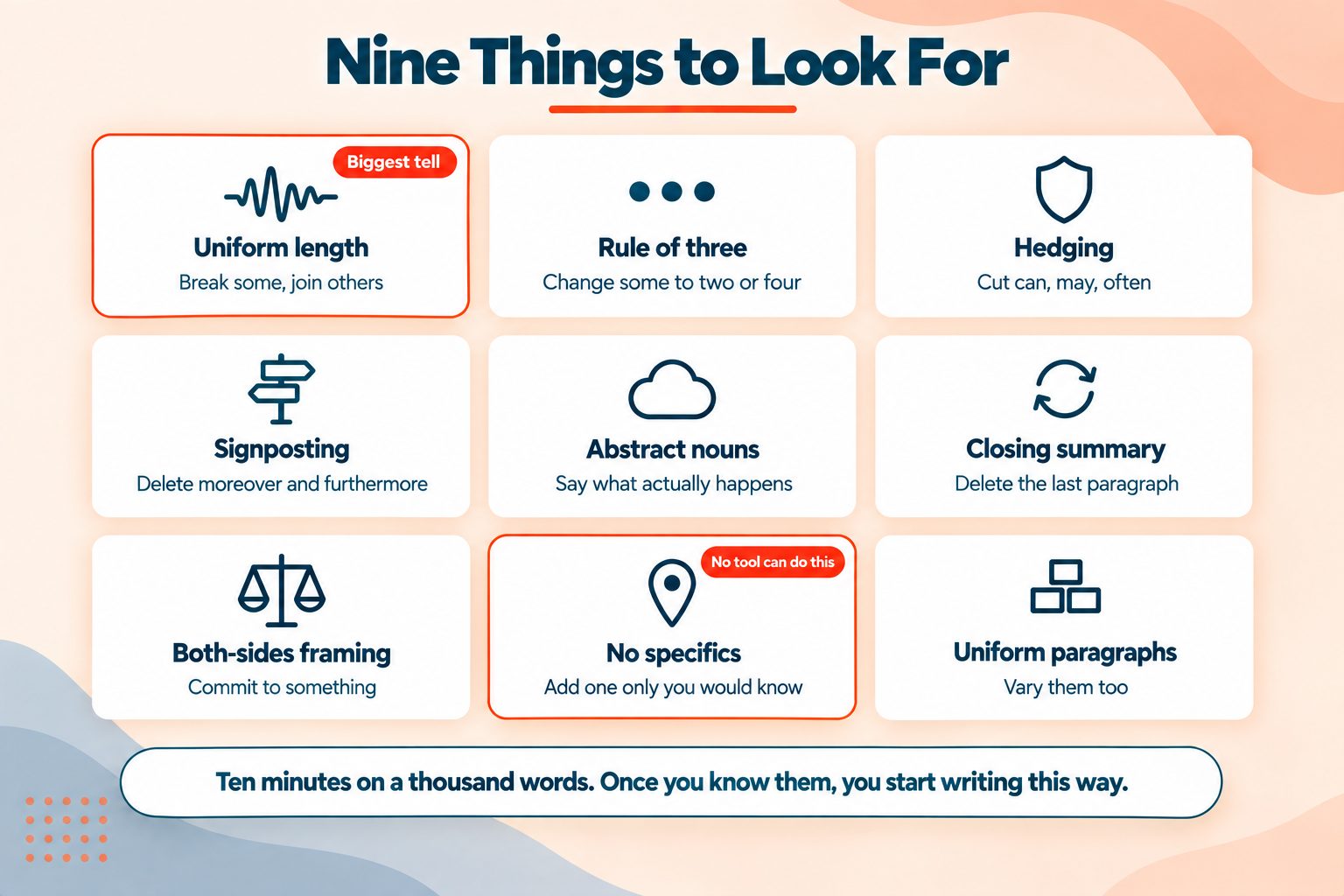
The Nine Habits
Each of these is diagnosable in a specific draft, which is what makes them fixable.
1. Uniform sentence length
The clearest tell, and the one that produces the flat feeling people describe without being able to name it.
Model output tends to cluster tightly around 15 to 20 words per sentence. Human writing varies far more, swinging between three words and forty depending on what the sentence is doing.
The fix: read your draft and mark every sentence length. If they are all similar, break some in half and join others. A three-word sentence after two long ones creates emphasis that no amount of word choice will.
Like that.
2. The rule of three, everywhere
Models produce three-item lists relentlessly. Three adjectives, three examples, three benefits. It is a genuinely effective rhetorical pattern, which is exactly why it appears so often in the training data.
The fix: count your three-item lists. Change some to two, some to four, and cut some to one well-chosen example. Two items reads as considered. Four reads as thorough. Three, over and over, reads as a template.
3. Hedging every claim
"This can often be useful." "Results may vary depending on context." "It is generally considered good practice."
Models hedge because hedging is the safest continuation. A confident claim risks being wrong; a qualified one rarely is.
The fix: find every instance of can, may, often, generally, typically, tends to, and potentially. Delete the ones that are not doing real work. "This is useful" is a stronger sentence than "this can often be useful," and if it happens to be an overstatement you will notice immediately, which is the point.
Keep the hedges where the uncertainty is real. Cut the ones protecting you from a commitment you should be making.
4. Signposting transitions
"Moreover." "Furthermore." "In addition." "It is important to note that."
These announce that a structure exists rather than carrying an argument forward. Human writers use them occasionally. Models use them as connective tissue between every paragraph.
The fix: delete them and read the result. Most paragraphs flow perfectly well without any transition word, because the logical relationship is already clear from the content. Where a connection genuinely needs signalling, a short sentence does it better than an adverb.
5. Abstract nouns where concrete ones belong
"Leverage solutions to optimise outcomes." "Utilise resources to enhance capabilities."
Abstraction is safe. It is also unmemorable, and it is what makes AI business writing read like every other piece of AI business writing.
The fix: find nouns ending in -tion, -ment, -ance and -ity. Ask what actually happens in each case. "Implementation of the solution" is "we built it." The US government's plain language guidelines are the best free resource on this, and they are written by people who had to make regulations readable.
6. The summary that restates
AI drafts end by explaining what they just explained. "In conclusion, we have explored the various ways in which..."
The fix: delete your final paragraph and read the piece again. It usually ends better one paragraph earlier. If a close is genuinely needed, it should add something rather than recap: an implication, a next step, a reframe.
7. Balanced both-sides constructions
"While X offers advantages, it is important to consider Y." Every claim immediately counterweighted.
Balance is a virtue in analysis and a habit in AI prose. The model balances because it has no stake, and text with no stake reads as text nobody meant.
The fix: on at least some points, say the thing without the counterweight. If you genuinely think one approach is better, write that. A reader can handle an opinion.
8. No specifics
This is the deepest one and the hardest to fix with a tool.
Models produce the aggregate of what has been written about a topic. They cannot tell you the number you measured, the thing a client said on a call, the mistake you made in 2023 and what it cost.
The fix: add at least one specific per section that only you could have written. A real figure. A named example. Something that happened. This does more for how a piece reads than every other item on this list, and no rewriting tool can do it for you, because the tool does not know anything about you.
9. Uniform paragraph length
The same problem as sentence length, one level up. Model output tends toward paragraphs of similar size, usually three to four sentences.
The fix: vary them. A one-sentence paragraph after a long one lands hard.
It also gives the reader somewhere to breathe.
Two Things Worth Keeping
Not everything models do is a flaw, and over-correcting produces its own problem.
Clarity. Model prose is usually clear, well-ordered and easy to follow. Do not sacrifice that reaching for personality. Writing that is hard to follow is worse than writing that is plain, and the Plain English Campaign has spent decades making that case.
Structure. The logical ordering in a good AI draft is often sound. You are changing texture rather than rebuilding the argument.
The goal is prose that reads as though a person wrote it carefully. Not prose that reads as though someone was trying to sound casual.
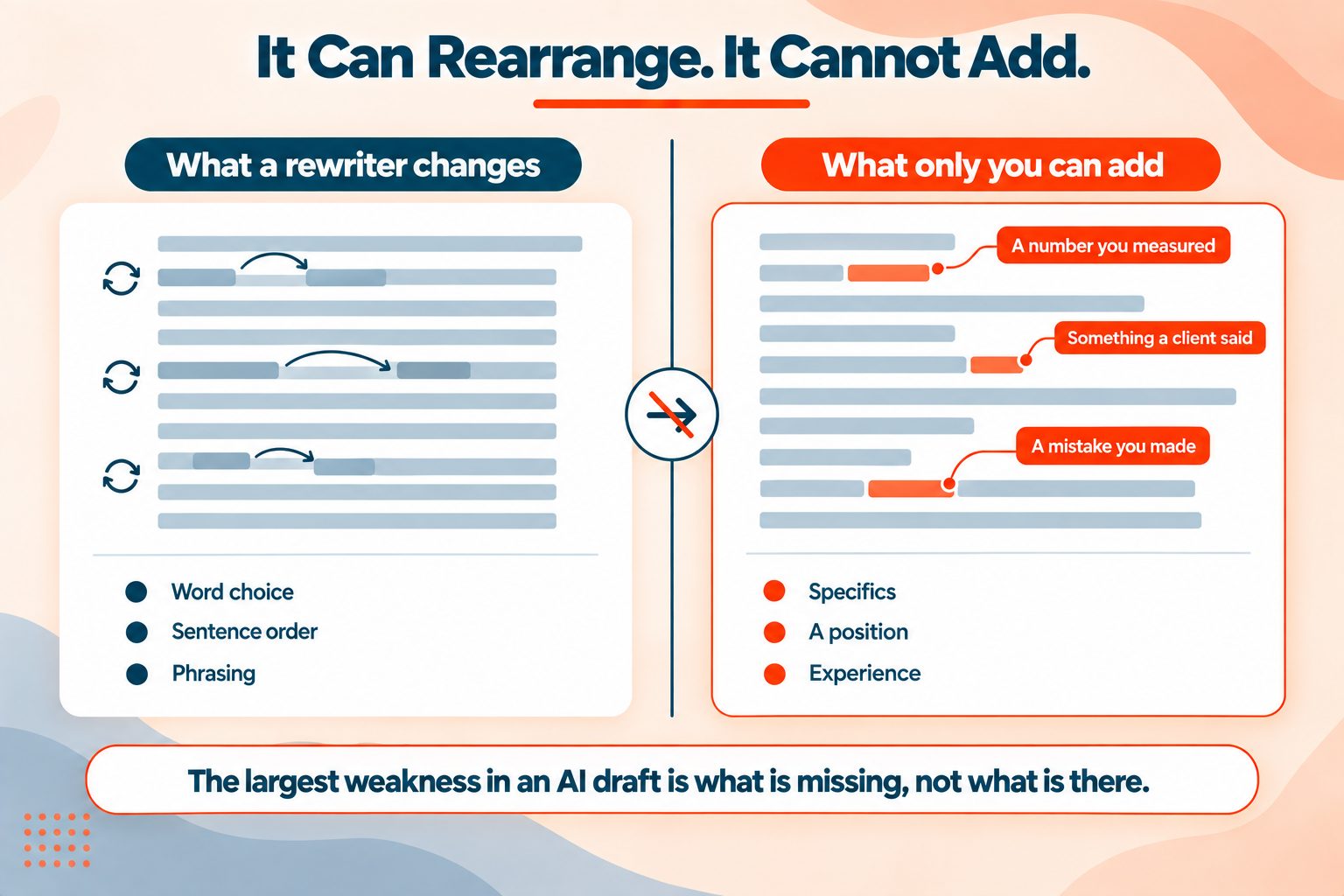
Why a Humanizer Tool Is a Poor Substitute
Most tools on this subject rewrite your text for you. There are three problems with that.
Synonym swapping produces odd prose, not natural prose. Replacing "important" with "pivotal" and "use" with "utilise" makes text stranger rather than more human. Anyone who has read the output of an aggressive paraphraser recognises the effect immediately.
A rewrite cannot add what is missing. The largest weakness in most AI drafts is the absence of specifics, and no tool can supply the number you measured or the thing your client said. It can only rearrange what is already there.
You learn nothing. Do the nine passes by hand three or four times and you start writing that way in the first place, including when you draft without a model. That compounds. Running text through a tool does not.
There is a legitimate use for these tools: a fluency pass on text in a language you do not write natively, or a quick tidy on something low-stakes. For anything you will put your name to, the manual version produces better writing and makes you better at writing.
If you want a reference on prose craft rather than a rewriting tool, Strunk's Elements of Style is free, public domain, and about a hundred pages. Most of the nine habits above are covered in it, which tells you they are not new problems.
A Note on Disclosure
Separate from whether the writing is good.
If you are working under rules about AI use, follow them. An institution with a disclosure policy, a client whose contract specifies original authorship, a publication with editorial standards. Editing a draft well does not change what you agreed to.
The two questions are genuinely independent. Is this good writing and am I allowed to use it this way have different answers and different stakes, and getting the first one right does not settle the second.
On the related question of detection, AI content detectors are considerably less reliable than their marketing suggests, and they produce false positives disproportionately against non-native English writers. Which is a reason to be careful about how detection scores get used, not a reason to treat evasion as a goal.
Wrapping Up
Three things carry most of the weight.
Vary your sentence lengths. It fixes the flat feeling more than any other single change, and it takes five minutes.
Add one specific per section that only you could have written. A number, an example, something that happened. This is the one a tool cannot do for you.
Cut the hedging and the closing summary. Both are safety behaviours, and safety is what makes prose forgettable.
Do those three on your next draft and the difference will be obvious to you before it is obvious to anyone else. Which is roughly how learning to write works.
Frequently Asked Questions
Frequently Asked Questions (FAQs) is a list of common questions and answers provided to quickly address common concerns or inquiries.
How do I make AI writing sound more human?
Vary sentence length, cut hedging words, remove signposting transitions, add specifics only you would know, and delete the closing summary.
Why does AI writing sound robotic?
Models choose statistically likely words, which produces prose that is average in every dimension at once. Human writing varies because people make unlikely choices.
What is the biggest giveaway of AI text?
Uniform sentence length. Model output clusters tightly around 15 to 20 words per sentence where human writing swings much more widely.
Do AI humanizer tools work?
They change the words. They cannot add the specifics that are missing, and synonym swapping often produces odd prose rather than natural prose.
How long does it take to edit an AI draft properly?
About ten minutes for 1,000 words once you know what to look for. The passes get faster with practice.
Should I disclose that I used AI?
Follow whatever rules you are working under. Many institutions and clients have policies, and editing a draft well does not change what you agreed to.
Can I just use a thesaurus to change the wording?
That makes text stranger, not more human. The problems are structural, meaning rhythm, commitment and specificity, rather than vocabulary.
Does editing AI text make it original?
Editing improves the writing. Whether the result counts as your original work depends on the rules you are working under, not on how much you changed.
What words should I avoid?
Moreover, furthermore, delve, leverage, robust, landscape, realm, and any hedge not doing real work. The patterns matter more than individual words.
Will this help my content rank?
Google judges content quality rather than how it was produced. Better writing helps because it is better, not because it disguises anything.