

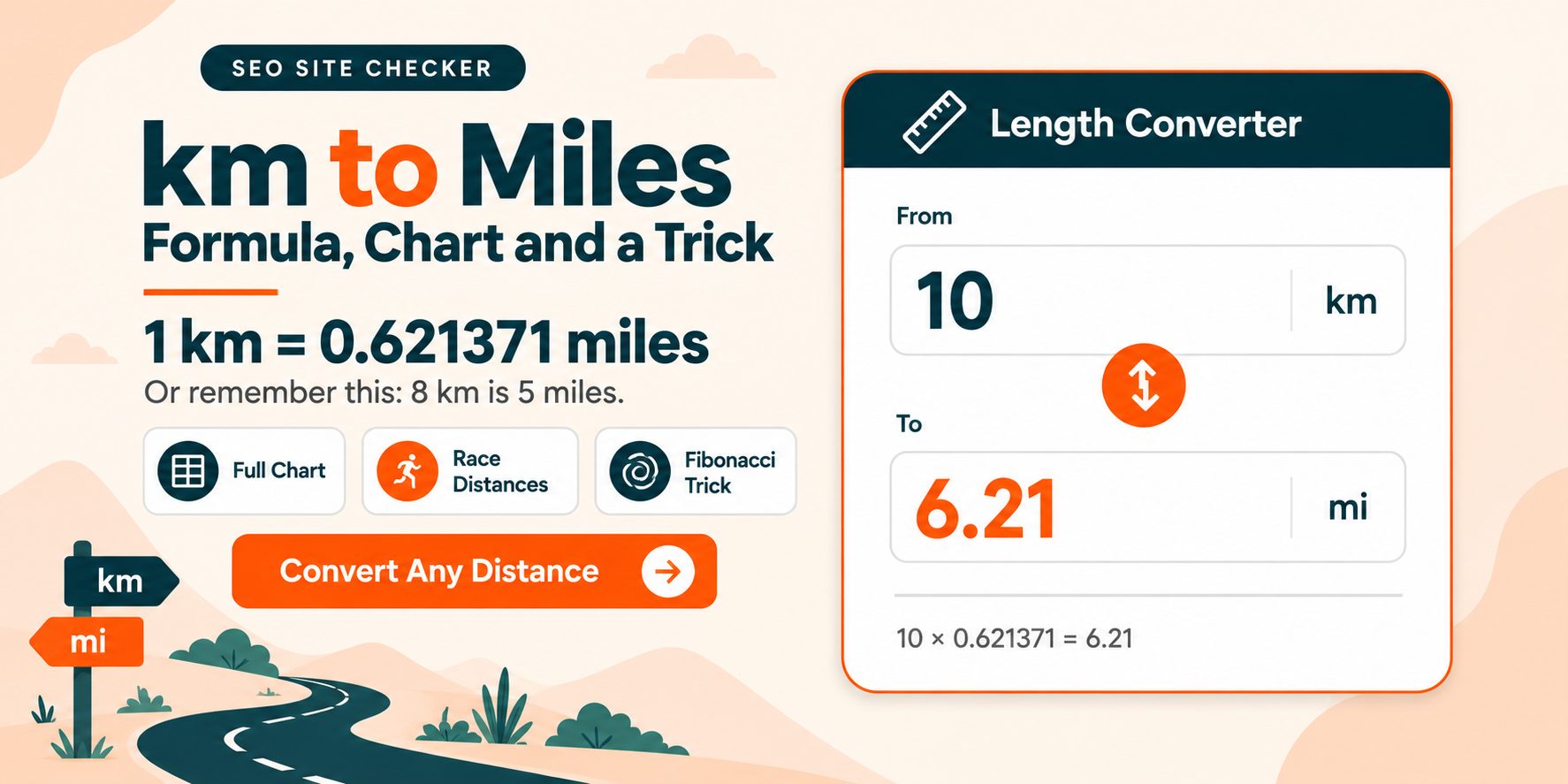
1 km = 0.621371 miles
Multiply kilometres by 0.621371, or divide by 1.609344. Both give the same answer.
Below: the full conversion chart, the reverse direction, every common race distance, and a mental shortcut based on the Fibonacci sequence that works far better than it should.
How to Convert km to Miles: Free Length Converter
There are two ways to do the same thing, and they give identical results:
Multiply by 0.621371, or divide by 1.609344.
Those two numbers are reciprocals of each other, so use whichever you find easier to remember. Most people find multiplying simpler.
Example: 10 km × 0.621371 = 6.21 miles
A converter is worth reaching for when you are dealing with decimals, when the distance is large enough that a rough estimate would be several miles out, or when you are recording the number rather than just getting a sense of it.
The free Length Converter handles kilometres, miles and the other common length units, with no signup and no usage limit.
The km to Miles Formula
Miles = Kilometres × 0.621371
Or, identically:
Miles = Kilometres ÷ 1.609344
Here is where that number comes from, which most conversion pages leave out.
One mile is defined as exactly 1.609344 kilometres. That is a legal definition, agreed internationally in 1959, and it is exact rather than rounded. Divide 1 by 1.609344 and you get 0.6213711922. The conversion factor is simply the reciprocal of that definition, which is why it runs to so many decimal places.
How many of them you need depends on the job:
| Factor | Use it for |
|---|---|
| 0.6 | Rough mental estimates only |
| 0.62 | Travel, driving, everyday distances |
| 0.621371 | Race distances, records, anything documented |
The gap between 0.6 and 0.62 sounds trivial and is not. On a 100 km drive it is a two-mile difference. On a marathon it changes the number a runner would put on a t-shirt.
NIST Special Publication 811 documents the exact definition and the correct notation conventions.
Worked Examples
5 km × 0.621371 = 3.11 miles
10 km × 0.621371 = 6.21 miles
42 km × 0.621371 = 26.10 miles
100 km × 0.621371 = 62.14 miles
And a longer one, where rounding starts to matter:
650 km × 0.621371 = 403.89 miles
On decimal places: for travel and general use, one or two is plenty. For race distances keep more, because the difference between 26.1 and 26.2 miles is a real distance to anyone who has run it.
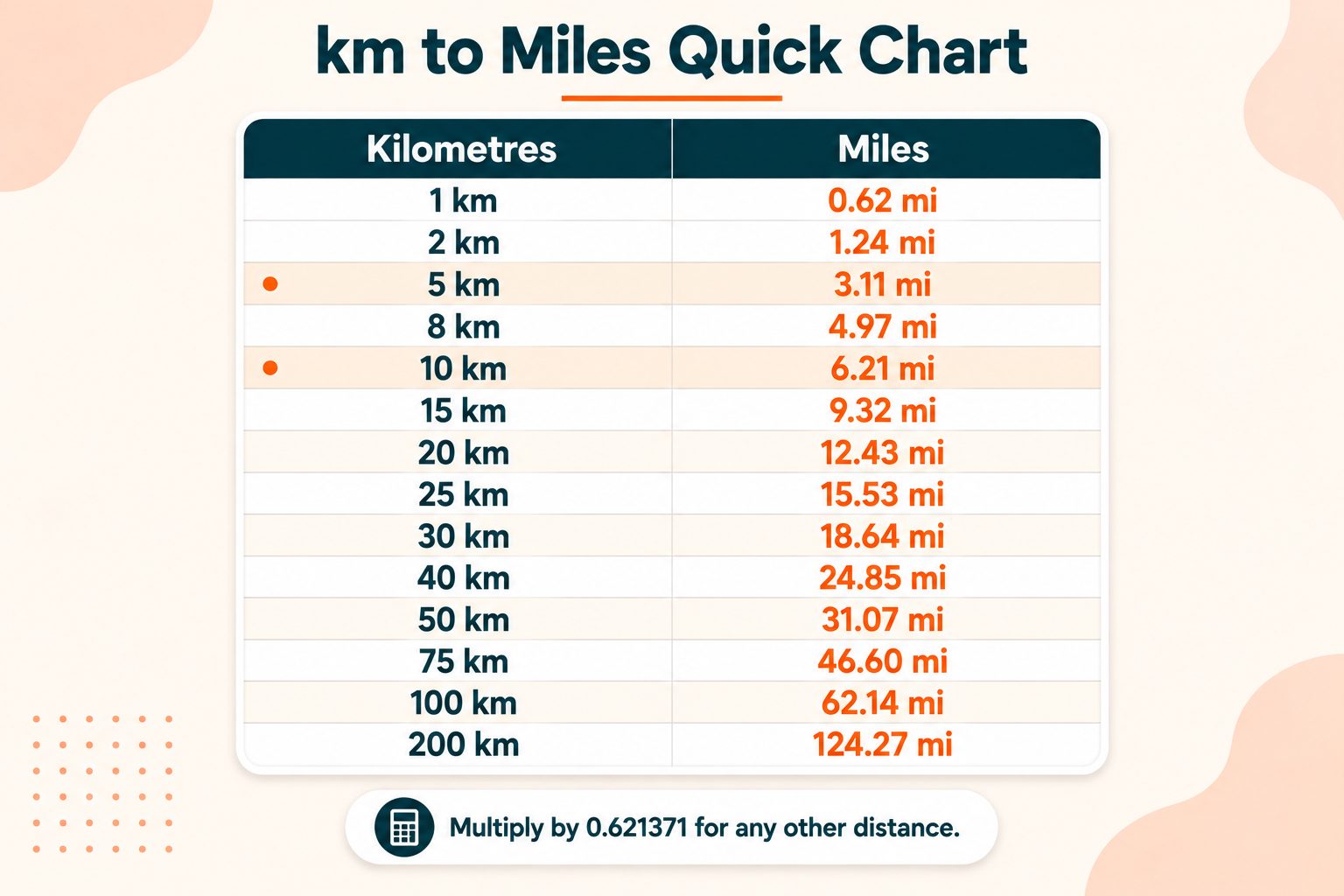
km to Miles Conversion Chart
| Kilometres | Miles |
|---|---|
| 1 km | 0.62 mi |
| 2 km | 1.24 mi |
| 3 km | 1.86 mi |
| 4 km | 2.49 mi |
| 5 km | 3.11 mi |
| 6 km | 3.73 mi |
| 7 km | 4.35 mi |
| 8 km | 4.97 mi |
| 9 km | 5.59 mi |
| 10 km | 6.21 mi |
| 15 km | 9.32 mi |
| 20 km | 12.43 mi |
| 25 km | 15.53 mi |
| 30 km | 18.64 mi |
| 40 km | 24.85 mi |
| 50 km | 31.07 mi |
| 60 km | 37.28 mi |
| 70 km | 43.50 mi |
| 80 km | 49.71 mi |
| 90 km | 55.92 mi |
| 100 km | 62.14 mi |
| 150 km | 93.21 mi |
| 200 km | 124.27 mi |
| 500 km | 310.69 mi |
| 1000 km | 621.37 mi |
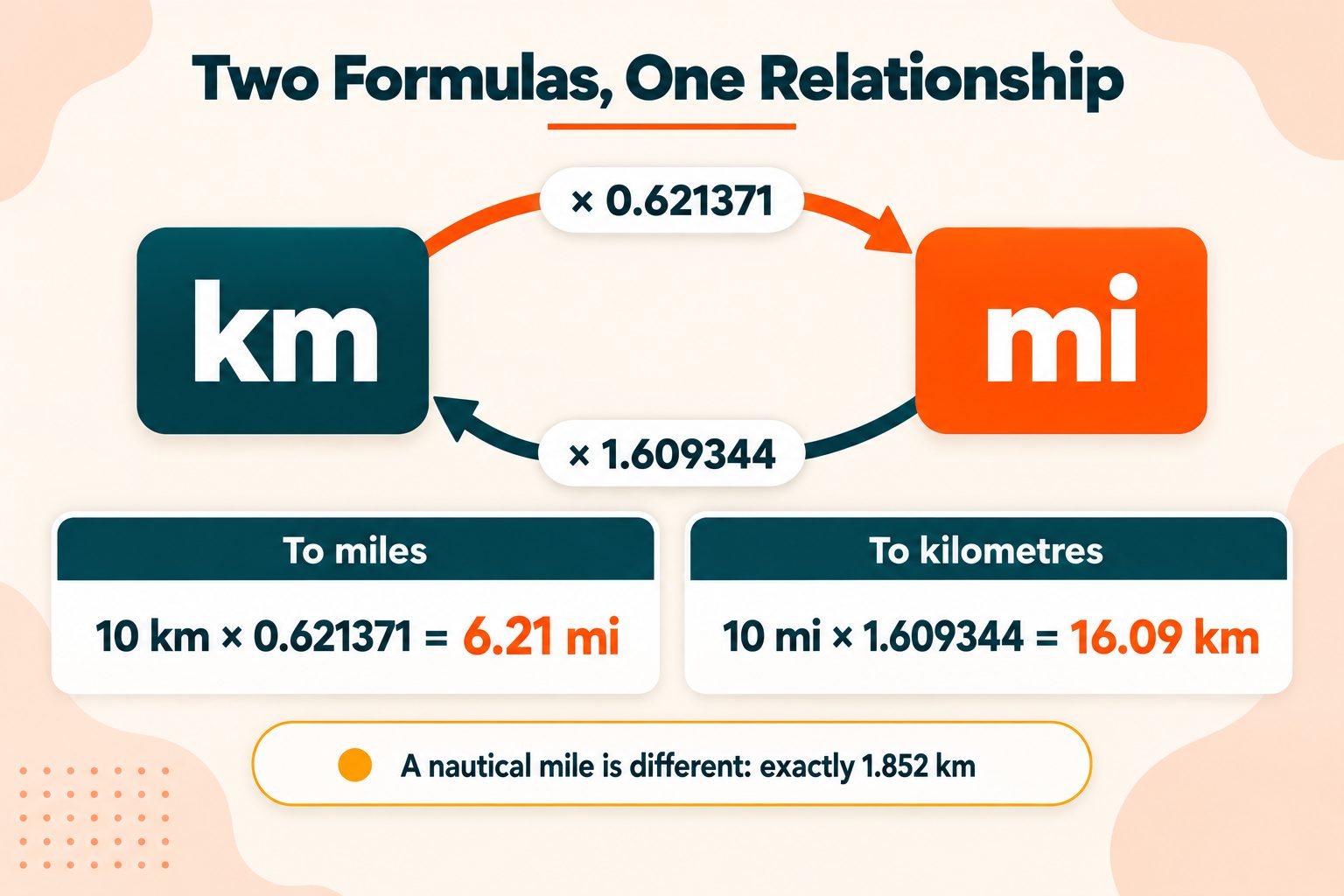
Converting Miles to km
Going the other way:
Kilometres = Miles × 1.609344
| Miles | Kilometres |
|---|---|
| 1 mi | 1.61 km |
| 2 mi | 3.22 km |
| 3 mi | 4.83 km |
| 5 mi | 8.05 km |
| 10 mi | 16.09 km |
| 20 mi | 32.19 km |
| 26.2 mi | 42.16 km |
| 30 mi | 48.28 km |
| 50 mi | 80.47 km |
| 60 mi | 96.56 km |
| 100 mi | 160.93 km |
One thing worth flagging here, because it catches people out and no competing page mentions it in this context. A nautical mile is not the same as a mile. A nautical mile is exactly 1.852 km, used in aviation and shipping. If you are converting a distance from a flight tracker or a marine chart, check which mile you are dealing with before you multiply.
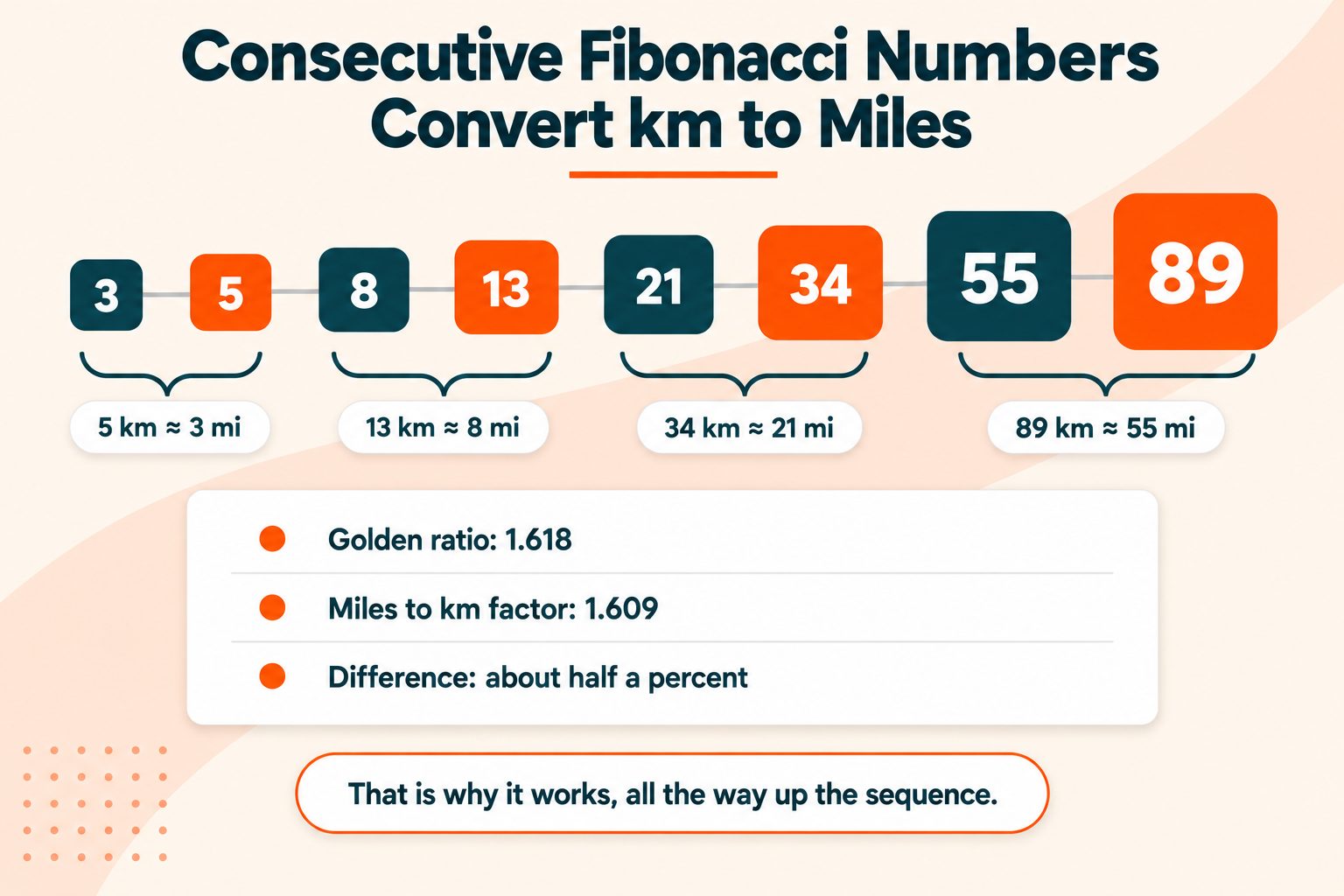
The Fibonacci Trick
This is the best mental conversion method for any pair of units, and almost nobody knows it.
Take the Fibonacci sequence: 1, 1, 2, 3, 5, 8, 13, 21, 34, 55, 89.
Any number in the sequence, read as kilometres, converts to roughly the number before it in miles.
| Fibonacci pair | Read as | Actual |
|---|---|---|
| 5 and 3 | 5 km ≈ 3 miles | 3.11 |
| 8 and 5 | 8 km ≈ 5 miles | 4.97 |
| 13 and 8 | 13 km ≈ 8 miles | 8.08 |
| 21 and 13 | 21 km ≈ 13 miles | 13.05 |
| 34 and 21 | 34 km ≈ 21 miles | 21.13 |
| 55 and 34 | 55 km ≈ 34 miles | 34.18 |
| 89 and 55 | 89 km ≈ 55 miles | 55.30 |
Every one of those is within a third of a mile.
Why it works
This is not a coincidence, which is what makes it worth remembering rather than just a party trick.
Consecutive Fibonacci numbers converge on the golden ratio, approximately 1.618. The actual conversion factor from miles to kilometres is 1.609344. Those two numbers differ by about half a percent, which is close enough that the approximation holds all the way up the sequence.
It also gets proportionally more accurate as the numbers grow. At 5 km the estimate is about 3.5 percent out. At 89 km it is about 0.5 percent out.
Combining pairs
You are not limited to sequence numbers. Break a distance into Fibonacci components and convert each piece.
100 km = 89 + 8 + 3 Which converts to 55 + 5 + 2 = 62 miles
The actual answer is 62.14. You did that in your head with no calculator and landed within a seventh of a mile.
Other Mental Methods
For distances that do not break neatly into Fibonacci numbers.
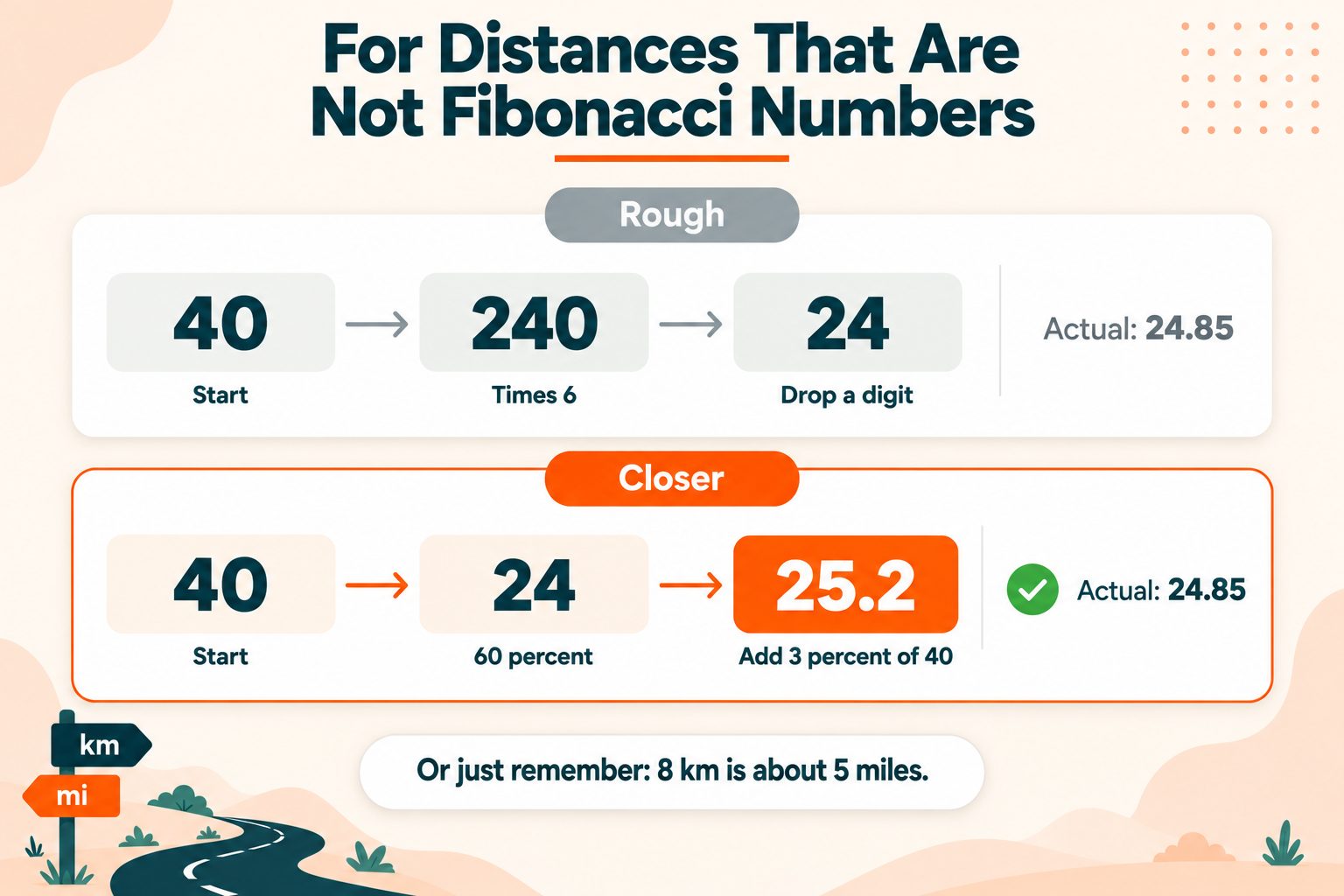
The rough method: multiply by 6, drop a digit. 40 km → 240 → 24 miles. The actual answer is 24.85, so this undershoots slightly but gets you close.
The better method: take 60 percent, then add 3 percent of the original. 40 km → 24 → plus 1.2 → 25.2 miles. Actual is 24.85. Marginally over, but tighter than the first.
The simplest anchor: 8 km is about 5 miles. Scale from there. 80 km is about 50 miles, 16 km is about 10.
Sense check: the miles figure is always smaller than the kilometres figure, and always more than half of it. If your answer falls outside that range, you have gone the wrong way.
Race Distances in km and Miles
A large share of the people converting kilometres to miles are runners, and the distances they care about are not round numbers.
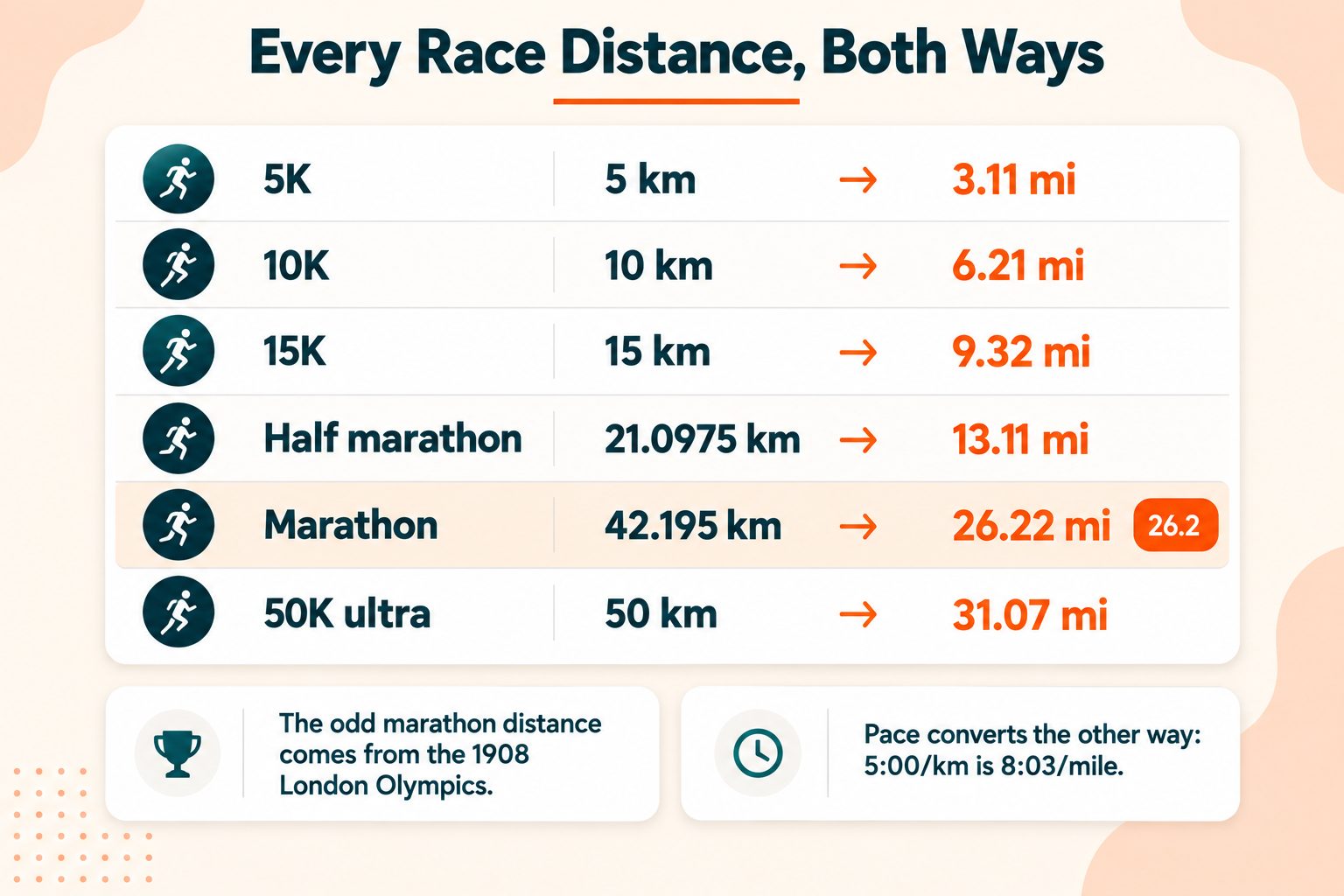
| Race | Kilometres | Miles |
|---|---|---|
| 5K | 5 | 3.11 |
| 10K | 10 | 6.21 |
| 15K | 15 | 9.32 |
| Half marathon | 21.0975 | 13.11 |
| Marathon | 42.195 | 26.22 |
| 50K ultra | 50 | 31.07 |
Two things runners tend to want explained.
A marathon is 26.2 miles, and the odd distance is historical rather than mathematical. It comes from the 1908 London Olympics, where the course was set from Windsor Castle to the royal box at the stadium. That distance was formalised in 1921 and has stayed ever since.
A half marathon is 13.1 miles, which is where the "13.1" bumper stickers come from, exactly as "26.2" comes from the full distance.
Converting pace works differently from converting distance. To turn a per-kilometre pace into a per-mile pace, multiply by 1.609344, because you are covering more ground per unit. A 5:00 per km pace is roughly 8:03 per mile. Runners who convert their pace the same way they convert distance end up with a number that is badly wrong.
What Are Kilometres and Miles?
The kilometre is one thousand metres. The metre is an SI base unit, defined by the distance light travels in a specific fraction of a second, which makes it one of the most precisely defined quantities in existence. The BIPM's definition of the metre has the formal wording. Kilometres are used for road and geographic distances in nearly every country.
The mile is 5,280 feet, or 1,760 yards. Since 1959 it has been defined as exactly 1.609344 km. It remains standard for road distances in the United States and the United Kingdom.
The 5,280 figure looks arbitrary because it is. The Roman mile was 5,000 feet, and the English mile was adjusted in 1593 to fit a whole number of furlongs, which mattered for measuring farmland. Britannica on the mile covers how a unit ended up with such an awkward number in it.
On spelling: kilometre is British, kilometer is American. Same unit, same abbreviation, no difference whatsoever. Neither is more correct than the other.
Common Conversion Mistakes
- Multiplying by 1.609 instead of dividing. That converts miles to kilometres, which is the opposite of what you wanted.
- Using 0.6 when precision matters. Two miles out on a 100 km distance.
- Confusing statute miles with nautical miles. A nautical mile is 1.852 km, not 1.609.
- Assuming a marathon is 42 km. It is 42.195, and the difference is a fifth of a mile.
- Converting pace the same way you convert distance. Pace goes the other direction. Multiply by 1.609344, do not divide.
- Rounding at every leg of a multi-stage journey. Round once, at the end.
Quick Reference
km to miles: multiply by 0.621371 Miles to km: multiply by 1.609344 In your head: 8 km is about 5 miles, or use consecutive Fibonacci numbers Sense check: the miles number is always smaller, but always more than half
If you also work between metric and imperial in other units, the same principles apply to converting weight between kilograms and pounds and to converting temperature between Celsius and Fahrenheit, though temperature needs two operations rather than one.
Frequently Asked Questions
Frequently Asked Questions (FAQs) is a list of common questions and answers provided to quickly address common concerns or inquiries.
How many miles is 1 km?
One kilometre equals 0.621371 miles. For rough estimates, 0.62 is close enough.
How do you convert km to miles?
Multiply the kilometres by 0.621371, or divide by 1.609344. Both produce the same result.
Is 5 km 3 miles?
Almost. 5 km is 3.11 miles. It is one of the Fibonacci pairs, which is why the approximation is so close.
What is 10 km in miles?
10 km is 6.21 miles. This is the standard 10K race distance.
How many km is a mile?
One mile is exactly 1.609344 kilometres, a definition agreed internationally in 1959.
Why is a mile 1.6 km?
Because a mile is 5,280 feet and a foot is 0.3048 metres. Multiply those and you get 1,609.344 metres.
How far is a 5K in miles?
A 5K is 3.11 miles. A 10K is 6.21 miles, and a half marathon is 13.11 miles.
Is a marathon 26 miles or 42 km?
Both. A marathon is 42.195 km, which is 26.22 miles, usually written as 26.2.
What is the easy way to convert km to miles?
Use consecutive Fibonacci numbers: 8 km is about 5 miles, 13 km is about 8, 21 km is about 13.
What is the difference between a mile and a nautical mile?
A statute mile is 1.609344 km. A nautical mile is exactly 1.852 km and is used in aviation and shipping.